













Blog

  • productivity stack AI: 10 Powerful AI Productivity Apps That Replace 5+ Tools and Save 10+ Hours Weekly (Amazing Ultimate 2026 Guide)

    productivity stack AI: 10 Powerful AI Productivity Apps That Replace 5+ Tools and Save 10+ Hours Weekly (Amazing Ultimate 2026 Guide)


    In 2026, productivity is no longer about working harder—it is about working smarter with systems. The rise of productivity stack AI has completely changed how professionals, freelancers, and businesses manage their daily tasks.

    Instead of switching between 10–15 different apps for writing, scheduling, project management, and communication, AI now brings everything into a unified ecosystem. This shift is why AI productivity apps are becoming essential tools for modern digital work.

    A well-built productivity stack AI system can:

    • Replace 5+ traditional work tools
    • Automate repetitive workflows
    • Reduce decision fatigue
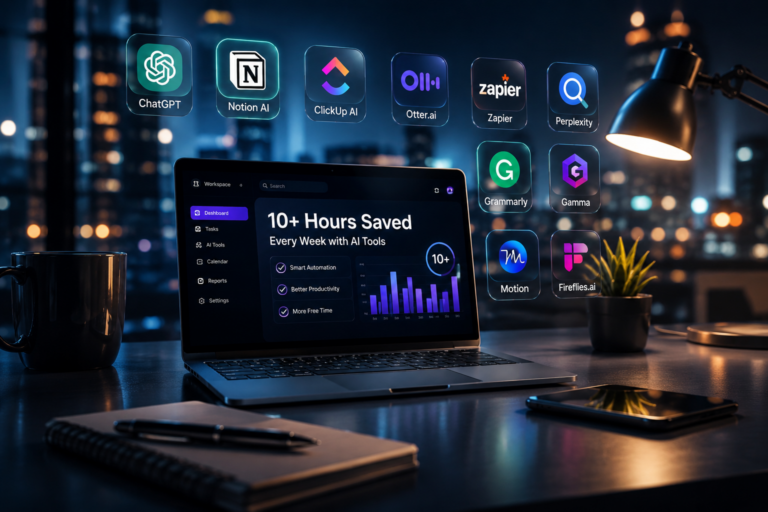
    • Save 10+ hours weekly
    • Increase focus and deep work time

    This guide breaks down everything you need to know about building the perfect AI-powered productivity system in 2026

    WHAT IS PRODUCTIVITY STACK AI AND WHY IT MATTERS IN 2026

    The term productivity stack AI refers to a combination of AI-powered tools that work together to automate, organize, and optimize your entire workflow.

    Instead of using separate apps for:

    • Notes
    • Tasks
    • Emails
    • Scheduling
    • Content creation

    You now use integrated AI automation tools that handle all of these tasks intelligently.

    Why it matters now more than ever:

    • Remote work has increased globally
    • Digital overload is at an all-time high
    • AI tools have become highly advanced and affordable
    • Businesses are prioritizing efficiency over manpower

    According to modern workflow studies and productivity research (see insights from Zapier), automation is now a core driver of workplace efficiency.

    Official resource: https://zapier.com/blog/ai-automation-workflows/

    HOW TO BUILD A PRODUCTIVITY STACK AI THAT REPLACES 5+ WORK TOOLS

    Building a powerful productivity stack AI system requires structure, not randomness. You cannot just download apps—you must build a workflow ecosystem.

    Step 1: Identify your workflow gaps

    Ask yourself:

    • Where do I waste the most time?
    • Which tasks repeat daily?
    • What apps do I constantly switch between?

    Step 2: Replace categories, not apps

    Instead of replacing one tool, replace entire functions:

    • Writing → AI writing assistant
    • Scheduling → AI calendar automation
    • Task management → AI project planner
    • Communication → AI email assistant

    Step 3: Build a minimal stack

    Your ideal AI stack should include:

    • 1 AI writing tool
    • 1 AI task manager
    • 1 AI automation hub
    • 1 AI note-taking system
    • 1 AI scheduling assistant

    Step 4: Integrate everything

    Use automation platforms like Zapier to connect apps together.

    TOP AI PRODUCTIVITY APPS IN PRODUCTIVITY STACK AI (2026)

    Here are the most powerful AI productivity apps dominating 2026 workflows:

    1.  NOTION AI (ALL-IN-ONE WORKSPACE)

    Notion AI has evolved into a complete productivity hub.

    Key features:

    • AI writing assistance
    • Database automation
    • Task generation
    • Meeting summaries

    Why it stands out:

    • Replaces notes + docs + project tools
    • Centralizes workflow

    2.  MOTION (AI SCHEDULING ENGINE)

    Motion uses AI to automatically plan your day.

    Features:

    • Smart calendar optimization
    • Automatic task prioritization
    • Deadline-based scheduling

    It is one of the strongest AI apps that save 10 hours per week for professionals.

    3.  CHATGPT WORKFLOWS

    OpenAI tools are widely used for productivity automation.

    Use cases:

    • Writing emails
    • Generating reports
    • Coding assistance
    • Brainstorming ideas

    Learn more: https://openai.com

    4. PRODUCTIVITY STACK AI – CLICKUP AI

    ClickUp combines project management with AI intelligence.

    Features:

    • Task automation
    • Smart summaries
    • Workflow tracking

    5.  RECLAIM AI

    Reclaim.ai focuses on time protection and smart scheduling.

    6.  TRELLO AI AUTOMATION

    Trello now integrates AI for task automation and workflow mapping.

    7.  GRAMMARLY AI

    Transforms writing efficiency:

    • Grammar correction
    • Tone adjustment
    • AI writing suggestions

    8.  NOTION DATABASE AUTOMATION

    Turns static notes into dynamic workflows.

    9.  SUDOWRITE (CREATIVE AI WRITING)

    Best for content creators and writers.

    10.  ZAPIER AI WORKFLOW AUTOMATION

    Connects all apps into one ecosystem.

    COMPARISON TABLE: BEST PRODUCTIVITY STACK AI TOOLS (2026)

    Tool Main Function Time Saved Weekly Replacement Value
    Notion AI Workspace + notes 3–5 hours 3–4 apps
    Motion Scheduling AI 4–6 hours Calendar tools
    ClickUp AI Project management 2–4 hours Task apps
    Grammarly AI Writing assistant 1–3 hours Editing tools
    Zapier AI Automation hub 5+ hours Manual workflows

    WHY PRODUCTIVITY STACK AI IS REVOLUTIONIZING WORKFLOW OPTIMIZATION

    The shift toward top AI automation tools for workflow optimization and productivity is driven by one major factor: time scarcity.

    Professionals today are overwhelmed with:

    • Meetings
    • Emails
    • Task switching
    • Project overload

    AI eliminates this friction by:

    • Automating decisions
    • Reducing manual input
    • Organizing priorities

    This is why companies are aggressively adopting AI-driven systems.

    HOW PRODUCTIVITY STACK AI SAVES 10+ HOURS WEEKLY

    Let’s break it down:

    Daily time savings:

    • 30 mins saved on email writing
    • 1 hour saved on scheduling
    • 2 hours saved on task management
    • 1–2 hours saved on content creation

    Weekly total:

    10–15 hours saved easily

    This is why time saving apps AI are becoming essential for professionals globally.

    BEST PRODUCTIVITY STACK AI STRATEGY FOR 2026 SUCCESS

    To build the ultimate system:

    Combine:

    • Notion AI (brain system)
    • Motion (calendar brain)
    • Zapier (automation engine)
    • ChatGPT (thinking assistant)

    Result:

    A fully automated digital workspace.

    FUTURE OF PRODUCTIVITY STACK AI (2026–2027 OUTLOOK)

    By 2027, experts predict:

    • Fully autonomous AI assistants
    • Zero manual scheduling
    • AI-managed business workflows
    • Voice-controlled productivity stacks

    This means AI productivity apps will become the default work standard.

     How AI Productivity Apps Are Replacing Traditional Work Tools in 2026

    The way people work in 2026 looks very different from just a few years ago. What used to be a “tool-heavy workflow”—where professionals jumped between notes apps, calendars, project managers, writing tools, and communication platforms—has now evolved into something far more streamlined: the productivity stack AI ecosystem.

    At the center of this shift are AI productivity apps, which are not just improving existing tools but actively replacing them. Instead of using five or more separate applications, professionals are now relying on a smaller, smarter stack powered by artificial intelligence that can think, organize, and execute tasks with minimal human effort.

    productivity stack AI and the End of Traditional Work Tools

    Traditional productivity tools were built for manual input. You had to:

    • Write your own notes
    • Assign your own tasks
    • Schedule your own meetings
    • Track your own deadlines
    • Switch between apps constantly

    This created what many professionals call “tool fatigue”—a situation where productivity decreases because of too many apps, not too few.

    Now, the productivity stack AI model is changing that completely.

    Instead of separate apps, AI systems now combine functions into unified platforms that:

    • Understand your tasks automatically
    • Suggest priorities intelligently
    • Generate content instantly
    • Automate scheduling and reminders
    • Reduce repetitive decision-making

    In simple terms, AI is no longer just assisting productivity—it is actively managing it.

    AI Productivity Apps Are Replacing Entire Software Categories

    One of the biggest disruptions in 2026 is that AI productivity apps are not replacing single features—they are replacing entire categories of software.

    Here’s how it looks in practice:

     Before AI Productivity Stack

    • Notion / Evernote → Notes
    • Google Calendar → Scheduling
    • Trello / Asana → Task management
    • Grammarly → Writing assistant
    • Zapier → Automation layer

     Now with productivity stack AI

    A single AI-powered system can:

    • Write your notes automatically
    • Organize your schedule in real time
    • Prioritize your tasks based on urgency
    • Generate emails, reports, and summaries
    • Connect workflows across apps

    This consolidation is why many professionals now refer to modern tools as best AI productivity stack tools to replace multiple apps in 2026.

    Why AI Productivity Apps Are Outperforming Traditional Tools

    The reason AI is winning is not just convenience—it’s intelligence.

    Modern AI productivity apps are designed to:

    • Learn from user behavior
    • Predict next actions
    • Eliminate repetitive decisions
    • Optimize workflows in real time

    Unlike traditional tools that wait for input, AI systems actively work with you.

    For example:

    • Instead of manually planning your day, AI schedules it for you
    • Instead of writing from scratch, AI generates structured drafts
    • Instead of tracking tasks manually, AI reorganizes priorities automatically

    This is the core reason professionals are saving 10+ hours weekly using AI systems.

    How productivity stack AI Is Reducing Tool Overload

    Tool overload is one of the biggest productivity problems in modern digital work. The average professional uses more than 8–12 apps daily.

    The productivity stack AI model solves this by acting as a central intelligence layer.

    Key benefits include:

    • Fewer apps, more output
    • Unified dashboards instead of scattered tools
    • Automatic task synchronization
    • Reduced cognitive load
    • Faster decision-making

    Instead of switching apps every few minutes, users now stay inside one AI-powered environment.

    The Rise of AI Automation Tools in Productivity Stack AI Systems

    Another major driver of this shift is the growth of AI automation tools.

    These tools connect workflows across platforms so tasks happen automatically.

    For example:

    • A meeting is scheduled → AI adds it to your calendar
    • A task is created → AI assigns priority and deadline
    • An email is received → AI generates a response draft
    • A project update is made → AI notifies team members

    This is why automation is now the backbone of every modern productivity system.

    Real Impact: How Professionals Are Working Differently in 2026

    The real-world effect of productivity stack AI is already visible across industries:

    Freelancers:

    • Use AI for writing, planning, and client communication
    • Reduce admin work by 60–70%

    Corporate workers:

    • Automate meeting summaries and reports
    • Spend more time on strategy instead of operations

    Entrepreneurs:

    • Manage entire businesses using AI dashboards
    • Replace multiple staff roles with automation tools

    The result is simple: more output with less effort.

    The shift from traditional tools to AI productivity apps is not just a software upgrade—it is a complete transformation of how work gets done.

    We are moving from:

    “using tools to complete tasks”

    to

    “AI systems completing tasks for us”

    And as AI automation tools continue to evolve, the idea of switching between multiple apps may soon feel outdated.

    The future of productivity is not about more tools—it’s about smarter systems working silently in the background.

     Top AI Automation Tools for Workflow Optimization and Daily Task Management

    As work becomes more digital and fast-paced in 2026, the biggest challenge professionals face is not lack of tools—but lack of time and structure. This is exactly where the productivity stack AI ecosystem is transforming how people manage daily tasks and workflows.

    Instead of manually planning everything, professionals now rely on AI automation tools that organize, prioritize, and execute tasks with minimal input. These tools don’t just assist productivity—they actively optimize it.

    productivity stack AI and the Rise of AI Automation Tools

    The core idea behind a productivity stack AI is simple: reduce manual effort by letting AI handle repetitive and predictable tasks.

    Traditional workflow management required constant human action:

    • Assigning tasks manually
    • Updating project boards
    • Sending reminders
    • Tracking deadlines
    • Switching between multiple apps

    Now, AI automation tools have changed that completely.

    They function as an intelligent layer across your entire workflow, ensuring that tasks move forward automatically without constant supervision.

    Top AI Automation Tools in productivity stack AI Systems

    Below are some of the most powerful tools shaping modern workflow optimization in 2026:

    1. Zapier AI – The Automation Backbone of productivity stack AI

    Zapier remains one of the most important tools in any productivity stack AI system.

    What it does:

    • Connects different apps together
    • Automates repetitive workflows
    • Triggers actions based on events

    Example workflows:

    • When you receive an email → create a task automatically
    • When a form is filled → send data to a spreadsheet
    • When a meeting ends → generate follow-up emails

    It is one of the strongest top AI automation tools for workflow optimization and productivity because it removes the need for manual coordination between apps.

    2. Motion – AI Scheduling and Task Optimization Engine

    Motion is designed to eliminate the chaos of daily planning.

    Key features:

    • AI-powered calendar scheduling
    • Automatic task prioritization
    • Real-time rescheduling when changes happen

    Instead of manually planning your day, Motion builds your schedule for you based on deadlines and urgency.

    This is one of the reasons it is widely used among professionals seeking AI apps that save 10 hours per week for professionals.

    3. ClickUp AI – Smart Project and Task Management

    ClickUp has evolved into a full AI-powered workspace.

    What it offers:

    • Task automation and tracking
    • AI-generated summaries
    • Workflow optimization suggestions
    • Team collaboration tools

    It replaces multiple tools like task boards, documentation apps, and reporting systems inside one platform.

    4. Reclaim AI – Intelligent Time Protection System

    Reclaim AI focuses on protecting your time automatically.

    Features:

    • Auto-scheduling of habits and tasks
    • Meeting time optimization
    • Smart calendar balancing

    Instead of letting meetings take over your schedule, Reclaim ensures your priorities stay protected.

    5. Notion AI – All-in-One Productivity Brain

    Notion plays a central role in many productivity stack AI setups.

    Capabilities:

    • AI writing assistance
    • Task database automation
    • Meeting note generation
    • Knowledge organization

    It effectively replaces multiple tools:

    • Notes apps
    • Wiki systems
    • Basic project trackers

    How AI Automation Tools Improve Workflow Optimization

    The biggest advantage of AI automation tools is not just convenience—it is system-level efficiency.

    Here’s how they transform daily work:

     1. Eliminating Repetitive Work

    Tasks like:

    • Sending reminders
    • Updating spreadsheets
    • Organizing emails

    are handled automatically.

     2. Reducing Decision Fatigue

    Instead of deciding what to do next, AI:

    • Prioritizes your tasks
    • Suggests next actions
    • Adjusts your schedule dynamically

     3. Creating Real-Time Workflow Optimization

    AI tools continuously analyze:

    • Deadlines
    • Workload
    • Task importance

    and adjust your workflow instantly.

     4. Acting as a Personal Productivity Assistant

    Modern systems behave like digital assistants that:

    • Plan your day
    • Track your progress
    • Optimize your output

    This is why many users now rely on time saving apps AI instead of manual planning tools.

    Why productivity stack AI Is Replacing Traditional Workflow Systems

    Traditional workflow tools require:

    • Constant manual updates
    • Human coordination
    • Separate platforms for each task

    But a productivity stack AI system:

    • Centralizes everything
    • Automates decision-making
    • Reduces tool switching
    • Improves speed and accuracy

    This shift is why businesses are rapidly adopting AI-driven systems across industries.

    The rise of AI automation tools marks a turning point in digital productivity. Instead of managing tasks manually, professionals now design systems that manage themselves.

    In 2026 and beyond, success will not depend on how many tools you use—but on how well your productivity stack AI works together as a unified system.

    The future of work is no longer manual. It is automated, intelligent, and continuously optimized.

     How AI Apps That Save 10 Hours Per Week Are Transforming Professional Productivity

    In 2026, productivity is no longer measured by how many hours you work, but by how intelligently your systems work for you. This is where the rise of productivity stack AI becomes especially important. At the center of this shift are AI apps that save 10 hours per week for professionals, reshaping how individuals and teams manage time, tasks, and focus.

    What used to require constant manual effort—planning, writing, scheduling, organizing—is now handled by intelligent systems that operate quietly in the background. The result is not just faster work, but a completely different way of working.

    productivity stack AI and the Reality of Time Compression in 2026

    Modern professionals are overwhelmed with digital responsibilities:

    • Endless emails
    • Constant meetings
    • Task switching between platforms
    • Content creation demands
    • Project coordination

    This “always-on” environment has made time the most valuable resource.

    The productivity stack AI approach solves this by using automation and intelligence to compress workload into fewer hours without reducing output quality.

    Instead of working longer, professionals are now working smarter with systems that actively reduce unnecessary effort.

    AI Apps That Save 10 Hours Per Week for Professionals: How It Actually Works

    The claim that AI apps that save 10 hours per week for professionals is no longer theoretical—it is backed by real workflow changes across industries.

    These time savings come from four key areas:

     1. Automated Scheduling and Calendar Management

    AI tools remove the need to manually plan your day.

    Instead of dragging meetings and tasks around:

    • AI assigns time blocks automatically
    • Adjusts schedules based on urgency
    • Prevents overbooking and conflicts

    This alone saves 2–4 hours weekly.

     2. AI-Powered Writing and Communication

    Writing emails, reports, and messages used to take a significant portion of the workday.

    Now, AI productivity apps:

    • Draft emails instantly
    • Summarize long documents
    • Generate professional reports
    • Improve tone and clarity

    This reduces communication workload by several hours weekly.

     3. Smart Task Prioritization

    Instead of manually deciding what to do next, AI systems:

    • Rank tasks by importance
    • Highlight urgent deadlines
    • Suggest optimal work order

    This eliminates decision fatigue and saves mental energy.

     4. Workflow Automation Across Apps

    Using AI automation tools, repetitive actions are eliminated:

    • Data entry is automated
    • Notifications are system-generated
    • Task updates happen automatically

    This creates a seamless workflow with minimal interruption.

    Top AI Productivity Apps Driving Time Savings in productivity stack AI Systems

    Within a modern productivity stack AI, several tools stand out for their ability to significantly reduce workload:

     Notion AI – Central Knowledge & Task Engine

    Notion helps users centralize notes, tasks, and project management.

    Why it saves time:

    • Converts raw ideas into structured documents
    • Automatically summarizes notes
    • Reduces need for multiple documentation tools

     Motion – AI Scheduling Assistant

    Motion builds your entire day automatically based on deadlines and priorities.

    Key impact:

    • Eliminates manual planning
    • Reorganizes schedule in real time
    • Prevents wasted time blocks

     Zapier AI – Workflow Automation Layer

    Zapier connects apps together to eliminate repetitive tasks.

    Example:

    • New email → create task → notify team → update spreadsheet

    This creates a fully automated workflow system.

     ChatGPT-Based Workflows

    OpenAI tools are widely used for daily productivity tasks.

    Use cases:

    • Writing content
    • Summarizing reports
    • Generating ideas
    • Coding assistance

    Why productivity stack AI Users Save More Than 10 Hours Weekly

    The reason these time savings are so significant is not just automation—it’s compounding efficiency.

    When multiple AI systems work together, they eliminate entire categories of work:

    Example breakdown of weekly savings:

    • Email handling → 2 hours saved
    • Scheduling → 3 hours saved
    • Task management → 2 hours saved
    • Writing and reporting → 3–5 hours saved

    Total: 10–12+ hours recovered weekly

    This is why time saving apps AI are becoming essential for modern professionals.

    The Psychological Impact of AI Productivity Apps

    Beyond time savings, there is a deeper transformation happening.

    1. Reduced mental overload

    Professionals no longer need to remember everything manually.

    2. Increased focus on deep work

    Less time on admin tasks means more time for meaningful work.

    3. Lower stress levels

    Automated systems reduce the pressure of constant decision-making.

    How productivity stack AI Is Changing Professional Identity

    One of the most interesting shifts is how professionals define their work.

    Instead of saying:

    “I manage tasks and schedules”

    People now say:

    “I manage AI systems that handle my workflow”

    This represents a shift from manual labor to system supervision.

    The rise of AI apps that save 10 hours per week for professionals is not just about efficiency—it’s about redefining how time is used in modern work environments.

    Within a well-designed productivity stack AI, time is no longer lost to repetitive actions or fragmented tools. Instead, it is reclaimed, optimized, and redirected toward higher-value thinking and creativity.

    In 2026 and beyond, the most productive professionals will not be those who work the longest—but those who build the smartest systems.

     Step-by-Step Guide on How to Build an AI Productivity Stack That Replaces 5+ Work Tools

    Building a powerful productivity stack AI is no longer something reserved for tech experts or large companies. In 2026, anyone—from freelancers to corporate professionals—can design a fully automated workflow system that replaces multiple apps and saves hours every week.

    The goal is simple: instead of juggling 5–10 separate tools, you build one intelligent system powered by AI productivity apps and AI automation tools that work together seamlessly.

    This section breaks down exactly how to do it in a practical, step-by-step way.

     Step 1 – Identify Your Daily Workflow Bottlenecks

    Before choosing any tools, you must first understand where your time is being lost.

    Most professionals waste time in 5 key areas:

    • Task switching between apps
    • Manual scheduling and planning
    • Writing emails and reports
    • Tracking tasks across multiple platforms
    • Repetitive admin work

    Ask yourself:

    • What tasks do I repeat every day?
    • Which apps do I open constantly?
    • Where do I feel most disorganized?

    This step is crucial because a productivity stack AI is built around solving problems, not collecting tools.

     Step 2 – Choose Your Core AI Productivity Apps

    Now that you understand your workflow gaps, the next step is selecting your foundation tools.

    A strong productivity stack AI usually includes 4–5 core categories:

     1. AI Brain (Knowledge + Writing Hub)

    Example:
    Notion

    • Stores notes, tasks, and documents
    • Generates summaries automatically
    • Organizes information intelligently

     2. AI Scheduler (Time Management System)

    Example tools like Motion or Reclaim AI:

    • Auto-schedules your day
    • Prioritizes urgent tasks
    • Adjusts calendar dynamically

     3. AI Automation Layer

    Example:
    Zapier

    • Connects different apps
    • Automates repetitive actions
    • Eliminates manual workflows

     4. AI Writing Assistant

    Example:
    OpenAI tools

    • Writes emails, reports, and content
    • Summarizes long documents
    • Speeds up communication tasks

     5. AI Task Manager (Optional but Powerful)

    • Organizes tasks automatically
    • Tracks progress
    • Reduces mental clutter

     Step 3 – Connect Your Tools Into One System

    This is where most people fail—they use AI tools separately instead of integrating them.

    A true productivity stack AI works as one system.

    Example workflow integration:

    • Email arrives → AI summarizes it → task is created automatically
    • Meeting scheduled → AI adds it to calendar → sends reminders
    • Task created → AI prioritizes and assigns deadline
    • Notes taken → AI organizes into project folders

    This integration is what creates real AI automation tools for workflow optimization and productivity.

     Step 4 – Automate Repetitive Tasks

    Now you start removing manual effort completely.

    Focus on automating:

     Repetitive Workflows

    • Email replies
    • Meeting summaries
    • File organization
    • Task creation

     Data Handling

    • Spreadsheet updates
    • Report generation
    • Progress tracking

    Notifications

    • Deadline reminders
    • Task updates
    • Team alerts

    Once automation is in place, your system begins to “run itself” with minimal input.

     Step 5 – Optimize for Time Savings and Performance

    At this stage, your system should already be saving time. Now the goal is optimization.

    To maximize results from time saving apps AI, you should:

    • Remove unused tools
    • Reduce duplicate features
    • Fine-tune automation rules
    • Improve task prioritization logic

    Most users discover they can eliminate 5+ apps entirely at this stage.

    Comparison Table: Traditional Tools vs productivity stack AI System

    Function Traditional Tools productivity stack AI System
    Notes Evernote / Notion manual AI-organized knowledge system
    Scheduling Google Calendar manual AI auto-scheduling
    Task Management Trello / Asana manual AI-prioritized task flow
    Writing Manual writing tools AI-generated content
    Automation Zapier manual setup Smart AI workflows

     Step 6 – Scale Your System for Maximum Efficiency

    Once your system is stable, you can scale it further.

    Advanced scaling strategies:

    • Add voice-based AI assistants
    • Integrate mobile automation workflows
    • Use AI for decision-making support
    • Connect business analytics tools

    At this level, your productivity stack AI becomes more than just productivity—it becomes a personal operating system.

    Why This System Replaces 5+ Work Tools

    A properly built productivity stack AI eliminates multiple tools because:

    • AI combines functions into one system
    • Automation reduces manual input
    • Integration removes fragmentation
    • Intelligence replaces repetitive thinking

    Instead of switching between apps, everything happens inside one connected ecosystem.

    The future of work is not about downloading more tools—it is about designing smarter systems.

    When built correctly, a productivity stack AI can:

    • Replace 5+ work tools
    • Save 10+ hours weekly
    • Reduce stress and mental overload
    • Improve output quality
    • Automate entire workflows

    In 2026, the most productive professionals are not those who use the most apps—but those who build the smartest AI systems around them.

    FINAL THOUGHTS ON PRODUCTIVITY STACK AI

    The rise of productivity stack AI is not just a trend—it is a transformation in how work is done.

    Instead of juggling tools, professionals now rely on intelligent systems that:

    • Think
    • Organize
    • Execute
    • Automate

    If used correctly, these tools don’t just save time—they completely reshape how productivity works in the modern world.

    for further inquiry visit:

  • Best Free AI Study Tools for Students 2026: 15 Ultimate Powerful Smart Apps That Boost Grades Fast (AI Study Tools Ranked Guide)

    Best Free AI Study Tools for Students 2026: 15 Ultimate Powerful Smart Apps That Boost Grades Fast (AI Study Tools Ranked Guide)


     The Ultimate Guide to Studying Smarter, Not Harder

    The world of education has changed more in the last five years than in the previous fifty. In 2026, students are no longer limited to textbooks, handwritten notes, and traditional tutoring. Instead, they now have access to powerful AI study tools that can explain complex topics, summarize lectures, generate flashcards, solve equations, and even act as personal tutors available 24/7.

    What makes this shift even more exciting is that many of these tools are completely free.

    In this comprehensive guide, we’ll explore the best free AI study tools for students 2026, breaking down how they work, what makes them powerful, and how you can use them to improve your grades fast.

     Why AI Is Changing Education Forever

    AI in education is not just a trend—it’s a transformation. Today’s AI for students is designed to reduce study stress, improve comprehension, and personalize learning experiences.

    Why students are switching to AI study tools:

    • Instant explanations of complex topics
    • Personalized learning paths
    • Faster revision before exams
    • Automated note-taking and summarization
    • Interactive practice questions and quizzes

    Unlike traditional methods, study AI apps adapt to how you learn, making studying more efficient and less stressful.

     Top 15 AI Apps Ranked for Smart Learning

    Below is a carefully selected list of the top AI tools for students to study faster and smarter, based on usefulness, accuracy, and real-world student feedback.

    1. ChatGPT – Best Free AI Study Tools for Students 2026 for All Subjects

    ChatGPT remains one of the most powerful AI study assistants ranked by accuracy for students.

    Why students love it:

    • Explains complex topics in simple language
    • Generates essays, summaries, and study notes
    • Helps with coding, math, and science problems
    • Acts as a 24/7 tutor

    Best use cases:

    • Homework help
    • Exam revision
    • Essay structuring

    Official info: https://openai.com/chatgpt

    2. Google Gemini – Best Free AI Study Tools for Students 2026 for Research

    Google Gemini is powerful for research-based learning and real-time information retrieval.

    Key benefits:

    • Deep research assistance
    • Multimodal learning (text + images)
    • Fast academic summaries

    Learn more: https://ai.google

    3. Microsoft Copilot – Best Free AI Study Tools for Students 2026 for Productivity

    Microsoft Copilot integrates directly with Word, Excel, and PowerPoint.

    Features:

    • Auto-generates notes and reports
    • Helps with assignments and presentations
    • Summarizes long documents instantly

    4. Notion AI – Best Free AI Study Tools for Students 2026 for Note Organization

    Notion AI is perfect for structured learning.

    What it does:

    • Organizes study notes
    • Summarizes textbooks
    • Creates revision plans

    5. Grammarly – Best Free AI Study Tools for Students 2026 for Writing

    Grammarly improves grammar, clarity, and tone.

    Benefits:

    • Fixes grammar errors instantly
    • Improves academic writing style
    • Suggests better vocabulary

    6. Quizlet AI – Best Free AI Study Tools for Students 2026 for Flashcards

    Quizlet helps students memorize faster.

    Features:

    • AI-generated flashcards
    • Practice quizzes
    • Spaced repetition learning

    7. Perplexity AI – Best Free AI Study Tools for Students 2026 for Research Accuracy

    Perplexity AI provides citation-based answers.

    Why it stands out:

    • Real-time academic research
    • Source-backed answers
    • Simple explanations

    8. Wolfram Alpha – Best Free AI Study Tools for Students 2026 for Math & Science

    Wolfram Alpha is ideal for STEM students.

    Uses:

    • Solving equations
    • Scientific computations
    • Data analysis

    9. Photomath – Best Free AI Study Tools for Students 2026 for Math Help

    Photomath scans math problems and solves them instantly.

    Features:

    • Step-by-step solutions
    • Camera-based scanning
    • Algebra and calculus support

    10. Socratic by Google – Best Free AI Study Tools for Students 2026 for Homework Help

    Socratic helps students understand homework questions instantly.

    11. Otter.ai – Best Free AI Study Tools for Students 2026 for Lecture Notes

    Otter.ai records and transcribes lectures in real time.

    12. Khanmigo – Best Free AI Study Tools for Students 2026 for Tutoring

    Khanmigo offers guided tutoring experiences.

    13. Quizgecko – Best Free AI Study Tools for Students 2026 for Exams

    Quizgecko turns notes into quizzes automatically.

    14. Elicit – Best Free AI Study Tools for Students 2026 for Academic Research

    Elicit helps students find academic papers quickly.

    15. StudyFetch – Best Free AI Study Tools for Students 2026 for Revision

    StudyFetch creates summaries and revision guides.

     Comparison Table

    AI Tool Best For Strength Free Access
    ChatGPT General studying Versatility Yes
    Gemini Research Real-time data Yes
    Copilot Productivity Office integration Yes
    Notion AI Notes Organization Limited
    Grammarly Writing Grammar correction Yes
    Quizlet AI Memorization Flashcards Yes
    Perplexity Research Source accuracy Yes
    Wolfram Alpha Math/Science Computation Yes
    Photomath Math solving Step-by-step help Yes
    Socratic Homework Instant answers Yes
    Otter.ai Lectures Transcription Yes
    Khanmigo Tutoring Guided learning Limited
    Quizgecko Exams Auto quizzes Yes
    Elicit Research papers Academic search Yes
    StudyFetch Revision Summaries Yes

     How AI Improves Learning Speed

    AI doesn’t just help you study—it changes how you understand information.

    Key improvements:

    • Faster comprehension of topics
    • Better memory retention
    • Reduced study time
    • Improved exam confidence

    AI study assistants act like digital mentors who never get tired.

     Advantages of Using AI Study Apps

    Major benefits include:

    • 24/7 learning support
    • Personalized explanations
    • Cost-free academic help
    • Instant feedback on mistakes
    • Improved productivity

    Students who use AI study tools often outperform those who rely only on traditional methods.

     Limitations You Should Know

    Even though AI is powerful, it is not perfect.

    Challenges include:

    • Occasional incorrect answers
    • Overdependence risk
    • Requires internet access
    • May lack deep emotional understanding

    Smart students use AI as a support tool, not a replacement for learning.

    Future of AI in Education

    Education is moving toward fully personalized AI-driven learning systems.

    In the near future, we can expect:

    • Fully AI-powered classrooms
    • Personalized AI tutors for every student
    • Real-time performance tracking
    • Adaptive learning systems

    Best Free AI Study Tools for Students 2026 for Smarter Note-Taking and Organization

    One of the biggest challenges students face is not just learning new information—but actually organizing it in a way that makes revision easy later. In 2026, this problem is becoming much easier to solve thanks to AI study tools designed specifically for note-taking, summarization, and study organization.

    Instead of spending hours rewriting notes or highlighting textbooks manually, students can now rely on free AI tools for students that automatically structure information, summarize long content, and even generate study plans tailored to individual learning needs.

    Let’s break down how this new generation of study AI apps is transforming note-taking and academic organization.

     Why Smart Note-Taking Matters

    Before diving into tools, it’s important to understand why note-taking is such a critical part of academic success.

    Good notes are not just written text—they are:

    • A memory reinforcement system
    • A revision shortcut before exams
    • A personal learning map

    However, traditional note-taking often leads to:

    • Too much unnecessary information
    • Disorganized content
    • Time-consuming rewriting
    • Difficulty during revision

    This is where AI for students becomes a game changer.

     How AI Improves Note Organization

    Modern AI study assistants ranked by accuracy for students can transform raw information into structured, easy-to-understand notes within seconds.

    Here’s what AI note-taking tools can do:

    • Summarize long lectures into key points
    • Convert textbooks into digestible study notes
    • Organize topics into structured headings and subheadings
    • Highlight important concepts automatically
    • Generate revision-friendly summaries

    Instead of struggling to organize information, students get ready-made, clean study materials.

     Top AI Note-Taking Apps Students Use

    Below are some of the most effective free AI apps for note taking and exam preparation 2026 that help students stay organized and study smarter.

    1. Notion AI – Smart AI-Powered Study Organization Tool

    Notion AI is one of the most powerful tools for organizing study life.

    Why students love it:

    • Converts messy notes into structured documents
    • Creates study schedules automatically
    • Summarizes long readings instantly

    How it helps students:

    Instead of scattered notebooks, students can build a complete digital study system where everything is neatly categorized by subject, topic, and exam date.

    2. Microsoft OneNote + Copilot – AI-Powered Class Note System

    Microsoft Copilot integrated with OneNote allows students to take smarter digital notes.

    Key benefits:

    • Auto-summarizes handwritten or typed notes
    • Organizes lecture content by topic
    • Helps rewrite messy notes into clean summaries

    This makes it ideal for students who attend fast-paced lectures and need instant organization.

    3. Otter.ai – Real-Time Lecture Note Transcription Tool

    Otter.ai is widely used for turning spoken lectures into written notes.

    What makes it powerful:

    • Records and transcribes lectures automatically
    • Identifies speakers in group discussions
    • Highlights key points during class

    This means students never miss important information again—even if they are writing slowly or multitasking.

    4. StudyFetch – AI Study Organizer for Exam Revision

    StudyFetch helps students turn large chunks of study material into simplified revision notes.

    Features:

    • Converts PDFs and textbooks into summaries
    • Generates revision sheets instantly
    • Organizes topics by importance

    It is especially useful during exam season when time is limited.

    Comparison of Note-Taking AI Tools

    To make things clearer, here is a simple comparison of top AI note-taking tools:

    AI Tool Best Feature Ideal For Strength
    Notion AI Smart organization Long-term study planning Highly structured notes
    Microsoft Copilot Lecture enhancement Class note cleanup Office integration
    Otter.ai Live transcription Live lectures Real-time accuracy
    StudyFetch Fast summarization Exam revision Quick study prep

     Why AI Note-Taking Is a Game Changer

    The shift toward AI study tools is not just about convenience—it is about improving how students actually learn.

    Key advantages include:

    • Saves hours of manual note rewriting
    • Improves memory retention through structured content
    • Reduces exam stress by simplifying revision
    • Helps students focus on understanding instead of copying

    In short, AI transforms studying from a time-consuming task into a smart, efficient process.

    The students who succeed in 2026 will not necessarily be those who study the longest—but those who study the smartest. Using AI study tools for note-taking and organization, learners can turn overwhelming information into clear, structured knowledge ready for revision at any time.

    Smart organization leads to smarter learning—and that is exactly what AI brings into education today

    Top AI Tools for Students to Study Faster and Smarter in 2026 for Exam Preparation

    Exams are where most students feel the pressure the most. No matter how well you understand a subject during the semester, revision time often becomes overwhelming—too many topics, too little time, and confusion about what to focus on.

    This is exactly where AI study tools are changing the game in 2026. Instead of cramming blindly, students now use study AI apps that help them revise smarter, test themselves automatically, and focus only on what truly matters.

    In this section, we’ll explore how the best free AI study tools for students 2026 are transforming exam preparation into a faster, more structured, and far more effective process.

     Why AI Exam Prep Works

    Traditional exam preparation usually involves:

    • Rereading textbooks repeatedly
    • Highlighting entire chapters
    • Memorizing without understanding
    • Guessing what topics will appear in exams

    The problem? It’s inefficient and mentally exhausting.

    AI changes this by doing three powerful things:

    • Filtering important topics
    • Generating practice questions
    • Creating personalized revision plans

    Instead of studying everything, students focus only on what matters most.

     Smart Revision with AI

    Modern AI for students is designed to simulate how real exam success works. It doesn’t just give information—it actively trains you for performance.

    Here’s how AI improves revision:

    • Breaks large topics into smaller revision chunks
    • Identifies weak areas based on performance
    • Generates quizzes from your notes
    • Creates flashcards automatically
    • Simulates exam-style questions

    This turns passive reading into active learning, which is far more effective for memory retention.

     Best AI Exam Preparation Tools

    Below are some of the most powerful free AI apps for note taking and exam preparation 2026 that students are using to boost grades quickly.

    1. Quizlet AI – Smart Flashcards for Fast Memory Training

    Quizlet remains one of the most widely used tools for exam preparation.

    Why it works:

    • Automatically generates flashcards from notes
    • Uses spaced repetition to improve memory
    • Offers practice tests and game-based learning

    Best for:

    • Memorizing definitions
    • Language learning
    • Quick revision before exams

    Instead of rereading notes, students actively test themselves, which dramatically improves recall speed.

    2. ChatGPT – Personalized Exam Tutor for All Subjects

    ChatGPT is one of the most flexible AI study assistants ranked by accuracy for students.

    How it helps during exams:

    • Explains difficult topics in simple terms
    • Generates likely exam questions
    • Creates revision summaries
    • Breaks down complex problems step-by-step

    Example use:

    A student can say:

    “Summarize biology respiration in 10 exam points”

    And instantly get a structured revision sheet.

    3. Socratic by Google – Instant Homework and Exam Help

    Socratic is designed specifically for students who need fast explanations.

    Key features:

    • Scan questions using your phone camera
    • Get instant step-by-step answers
    • Covers math, science, literature, and more

    This makes it perfect for last-minute revision or confusing questions.

    4. Wolfram Alpha – Powerful AI for Math and Science Exams

    Wolfram Alpha is a top-tier tool for STEM students.

    What it does:

    • Solves complex math problems instantly
    • Shows step-by-step solutions
    • Handles formulas, graphs, and calculations

    Best for:

    • Mathematics exams
    • Physics and chemistry problem-solving
    • Engineering calculations

    5. Quizgecko – AI-Generated Practice Exams

    Quizgecko helps students turn their notes into mock exams.

    Why students use it:

    • Generates exam-style questions automatically
    • Creates multiple-choice quizzes
    • Helps simulate real exam conditions

    This is extremely useful for building confidence before actual exams.

    Exam Prep Comparison Table

    AI Tool Best Feature Exam Use Case Strength
    Quizlet AI Flashcards Memorization Fast recall
    ChatGPT Explanation + revision All subjects Versatility
    Socratic Instant answers Homework + revision Camera-based help
    Wolfram Alpha Problem solving Math & science High accuracy
    Quizgecko Practice tests Exam simulation Real exam training

     Why AI Improves Exam Performance

    Students using AI study tools for exam preparation often experience major improvements because AI helps them study strategically instead of randomly.

    Key benefits include:

    • Better time management before exams
    • Focused revision instead of overload
    • Faster understanding of difficult topics
    • Increased confidence during exams
    • Improved retention through active testing

    AI doesn’t replace studying—it makes studying more targeted and efficient.

    Exam success is no longer about how many hours you study, but how effectively you study. With AI study tools, students can now transform chaotic revision into structured, intelligent preparation.

    Instead of asking “What should I study?”, AI helps you answer:
    “What matters most for my exam success?”

    That shift alone can significantly improve grades.

    Free AI Apps for Note Taking and Exam Preparation 2026 for Academic Success

    In 2026, studying is no longer split into separate activities like “taking notes” and “preparing for exams.” The smartest students now use AI study tools that combine both functions into one seamless system.

    This is where free AI apps for note taking and exam preparation 2026 become extremely powerful. Instead of juggling multiple apps, rewriting notes, and then separately cramming for exams, students now use AI to turn raw learning material directly into structured revision resources.

    In this section, we’ll break down how these tools work together and why they are becoming essential for modern academic success.

     Why Integration Matters

    Traditional studying creates a disconnect:

    • Notes are taken in one format
    • Revision happens in another
    • Exam preparation starts from scratch

    This separation wastes time and causes confusion.

    Modern AI for students solves this by integrating:

    • Note-taking
    • Summarization
    • Practice testing
    • Revision planning

    So instead of doing multiple steps manually, AI creates a full study cycle automatically.

    How AI Converts Notes into Exam Material

    One of the most powerful abilities of study AI apps is transformation—turning messy, unstructured content into exam-ready material.

    AI can instantly convert:

    • Lecture recordings → summarized notes
    • Textbooks → bullet-point study guides
    • PDFs → revision sheets
    • Class discussions → structured outlines

    What this means for students:

    Instead of reading 100 pages of content, students get:

    • Key points
    • Definitions
    • Likely exam questions
    • Simplified explanations

    This drastically reduces revision time.

    The Smart Study Workflow

    To understand how powerful these tools are, imagine a simple AI-driven study flow:

    Step 1: Capture Information

    • Lecture notes
    • Voice recordings
    • Textbooks or PDFs

    Step 2: AI Processing

    • Summarization
    • Highlighting key concepts
    • Structuring topics

    Step 3: Exam Preparation

    • Auto-generated quizzes
    • Flashcards
    • Practice tests

    Step 4: Revision Optimization

    • Weak areas identified
    • Focused revision plans
    • Repetition schedules

    This entire cycle used to take hours or even days. Now it happens in minutes.

    Best Tools Students Rely On

    Below are some of the most effective best free AI study tools for students 2026 that combine note-taking and exam preparation features.

    1. Notion AI – All-in-One Study System

    Notion AI is one of the most complete systems for combining notes and revision.

    Why it stands out:

    • Organizes all subjects in one workspace
    • Converts notes into summaries automatically
    • Helps build exam revision dashboards

    Best use:

    Students can build a “digital brain” where everything they learn is stored, structured, and ready for revision anytime.

    2. StudyFetch – AI Revision Generator

    StudyFetch is designed specifically for turning learning materials into exam prep content.

    Key features:

    • Converts notes into revision guides
    • Breaks topics into study chunks
    • Generates simplified explanations

    Why students use it:

    It removes the stress of figuring out what to revise before exams.

    3. Quizlet AI – Notes to Flashcards System

    Quizlet transforms notes into interactive learning tools.

    What it does:

    • Turns notes into flashcards automatically
    • Creates practice quizzes from study materials
    • Uses spaced repetition for memory retention

    Benefit:

    Instead of rereading, students actively test themselves, which improves exam performance significantly.

    4. Otter.ai – Lecture Capture and Smart Notes

    Otter.ai is widely used for live lecture recording and conversion.

    Features:

    • Real-time transcription
    • Automatic summary generation
    • Speaker identification

    Why it matters:

    Students never miss key points, even in fast-paced lectures.

    5. Microsoft Copilot – Study + Exam Prep Assistant

    Microsoft Copilot helps bridge the gap between notes and revision.

    What it offers:

    • Summarizes long documents
    • Generates study outlines
    • Creates exam-ready reports

    Ideal for:

    Students who use Word, PowerPoint, and Excel for academic work.

     Comparison Table

    AI Tool Primary Role Strength Best For
    Notion AI Study organization Full system integration Long-term planning
    StudyFetch Revision creation Exam readiness Quick revision
    Quizlet AI Flashcards Memory retention Memorization
    Otter.ai Lecture notes Real-time transcription Class recording
    Microsoft Copilot Document processing Academic productivity Reports & summaries

     Why Students Perform Better

    Students using integrated AI study tools consistently perform better because they:

    1. Reduce Cognitive Load

    Instead of juggling multiple tasks, AI organizes everything.

    2. Improve Memory Retention

    Flashcards and quizzes strengthen recall.

    3. Save Revision Time

    Summaries replace hours of reading.

    4. Focus on Weak Areas

    AI highlights what actually needs attention.

    This means studying becomes more strategic and less stressful.

     The Hidden Advantage

    One underrated benefit of AI tools is psychological:

    Students feel less overwhelmed.

    When notes are organized and exams are structured automatically, confidence increases. And confidence often translates directly into better performance.

    The combination of note-taking and exam preparation in a single system is one of the biggest advantages of modern AI study tools.

    Instead of treating studying as separate tasks, AI merges everything into one continuous learning process:
    Learn → Organize → Revise → Test → Improve

    That is the future of academic success.

    AI Study Assistants Ranked by Accuracy for Students in 2026

    When it comes to studying with AI study tools, not all apps perform at the same level. Some are excellent at explaining concepts, others are better at solving problems, while a few specialize in research or exam preparation. But for students, one factor matters more than anything else: accuracy.

    In 2026, students rely heavily on AI for students to learn, revise, and prepare for exams—but choosing the right tool can make the difference between correct understanding and misleading information.

    This section breaks down the AI study assistants ranked by accuracy for students, helping you understand which tools are most reliable for different academic needs.

     Why Accuracy Matters in AI Learning

    Accuracy in study AI apps means more than just giving the right answer. It includes:

    • Correct explanations of concepts
    • Reliable academic information
    • Step-by-step problem solving
    • Proper citation of facts
    • Context-aware responses

    If an AI tool is inaccurate, students may:

    • Learn wrong concepts
    • Lose marks in exams
    • Misunderstand core subjects
    • Build weak foundations

    That is why selecting the best free AI study tools for students 2026 requires careful comparison.

     Ranking Method

    To create this ranking, we evaluate AI tools based on:

    Key criteria:

    • Answer accuracy rate
    • Subject coverage (math, science, arts, etc.)
    • Clarity of explanations
    • Consistency of responses
    • Ability to handle complex questions

    Now let’s look at the top-ranked AI study assistants.

     Top Performers in 2026

    1. Wolfram Alpha – Highest Accuracy for Math and Science

    Wolfram Alpha is widely considered the most accurate AI tool for STEM subjects.

    Why it ranks #1:

    • Uses verified computational algorithms
    • Produces exact mathematical solutions
    • Handles complex formulas with precision

    Best for:

    • Mathematics
    • Physics
    • Chemistry
    • Engineering calculations

    Strength:

    Unlike conversational AI, Wolfram Alpha doesn’t “guess” answers—it computes them, making it extremely reliable.

    2. Perplexity AI – High Accuracy for Research-Based Learning

    Perplexity AI is known for delivering fact-checked, source-based answers.

    Why students trust it:

    • Provides citations with answers
    • Pulls real-time data from the web
    • Reduces misinformation risk

    Best for:

    • Research assignments
    • Essay writing
    • Academic projects

    Strength:

    It prioritizes verified sources, making it highly dependable for academic writing.

    3. ChatGPT – Highly Versatile but Moderately Verified

    ChatGPT is one of the most widely used AI study assistants ranked by accuracy for students.

    Strengths:

    • Excellent at explaining concepts clearly
    • Supports all subjects
    • Breaks down complex topics into simple language

    Limitations:

    • May occasionally produce incorrect or generalized answers
    • Requires user verification for academic accuracy

    Best for:

    • Learning concepts
    • Study explanations
    • Essay structuring
    • Practice questions

    4. Google Gemini – Strong Real-Time Accuracy for General Learning

    Google Gemini performs well in real-time information retrieval and general academic support.

    Why it performs well:

    • Access to Google’s knowledge ecosystem
    • Fast updates on current topics
    • Multimodal understanding (text + images)

    Best for:

    • Research summaries
    • General knowledge learning
    • Current academic topics

    5. Microsoft Copilot – Reliable for Structured Academic Output

    Microsoft Copilot is highly accurate for document-based learning tasks.

    Strengths:

    • Works well with structured academic documents
    • Generates accurate summaries from Word and Excel files
    • Reduces human error in formatting and analysis

    Best for:

    • Reports
    • Assignments
    • Presentations

     Comparison Table

    AI Tool Accuracy Level Best Subject Area Strength
    Wolfram Alpha Very High Math & Science Computational precision
    Perplexity AI High Research & Writing Verified sources
    ChatGPT Moderate–High All subjects Explanations
    Google Gemini High General learning Real-time knowledge
    Microsoft Copilot High Academic writing Structured outputs

     What This Means for Learners

    Understanding accuracy helps students choose the right tool for the right task.

    Smart usage strategy:

    • Use Wolfram Alpha for equations and calculations
    • Use Perplexity AI for research-based assignments
    • Use ChatGPT for explanations and learning concepts
    • Use Gemini for updated or general knowledge
    • Use Copilot for structured academic writing

    This combination ensures students get the best free AI study tools for students 2026 experience without relying on a single platform.

     Why No Single AI Is Perfect

    Even the most advanced AI systems have limitations:

    • Some may hallucinate (generate incorrect facts)
    • Some lack deep subject specialization
    • Some rely on internet data that may not always be verified

    That’s why the smartest students don’t rely on one tool—they combine multiple AI study tools to improve accuracy and learning depth.

    Accuracy is the foundation of effective learning. While many free AI tools for students can help with studying, only a few deliver consistent academic-level reliability.

    The key takeaway is simple:

    Don’t just use AI to get answers—use the right AI for the right academic purpose.

    When students learn how to combine these tools strategically, they unlock a powerful advantage that traditional studying alone cannot match.

     Final Thoughts

    The rise of free AI tools for students is one of the biggest educational breakthroughs of the decade. Whether you’re in high school, college, or self-learning, these tools can dramatically improve your learning speed and performance.

    The key is simple: don’t just study harder—study smarter using AI

    for further insights visit:


  • prompt engineer jobs: 9 Ultimate Powerful Steps to Become a Successful AI Prompt Engineer With No Experience in 2026

    prompt engineer jobs: 9 Ultimate Powerful Steps to Become a Successful AI Prompt Engineer With No Experience in 2026

    prompt engineer jobs and the rise of AI careers 2026

    The world of work is changing faster than most people can imagine. Just a few years ago, terms like prompt engineering didn’t even exist in mainstream job markets. Today, prompt engineer jobs are becoming one of the fastest-growing opportunities in the entire tech ecosystem.

    In 2026, companies are no longer just hiring software developers or data scientists. They are actively searching for people who can communicate with AI systems effectively—people who understand how to “talk” to models like ChatGPT, Claude, Gemini, and other generative AI tools.

    This is where AI prompt engineering comes in.

    Even better? You don’t need:

    • A computer science degree
    • Advanced coding experience
    • Years of tech background

    Yes, you read that correctly.

    This guide will walk you through a step-by-step guide to start prompt engineering career for beginners, even if you are starting from zero.

     Step 1: Understand What AI Prompt Engineering Really Is

    To break into prompt engineer jobs, you must first understand the role clearly.

    AI prompt engineering is the skill of designing, refining, and optimizing instructions (prompts) that guide AI tools to produce accurate and useful outputs.

    Think of it like this:

    • AI = a powerful but very literal assistant
    • You = the person giving it clear instructions

    If your instructions are bad, the results are bad. If your prompts are sharp and structured, the results can be incredibly powerful.

    Core responsibilities in prompt engineer jobs:

    • Writing effective prompts for AI tools
    • Testing AI outputs and improving results
    • Building workflows for automation tools
    • Helping businesses use AI more efficiently

     Step 2: Learn Why AI Careers 2026 Are Exploding

    The demand for AI careers 2026 is being driven by one major force: automation.

    Companies are trying to:

    • Reduce operational costs
    • Increase productivity
    • Replace repetitive tasks with AI systems

    According to industry projections, AI-related job roles are expected to grow massively across:

    • Marketing
    • Customer support
    • Software development
    • Content creation

    This is why prompt engineer jobs are now considered a high-income digital skill.

     Step 3: Build Foundational AI Prompt Engineering Skills

    Before applying for entry level AI prompt engineer jobs remote without coding, you need basic skills.

    Essential skills include:

    • Clear writing and communication
    • Logical thinking
    • Understanding AI tools
    • Creativity in problem-solving

    You do NOT need programming knowledge, but understanding how AI models respond is important.

    Practice tools:

    • ChatGPT
    • Claude AI
    • Gemini AI
    • Notion AI

     Step 4: Practice Real AI Prompt Engineering Tasks Daily

    The fastest way to enter prompt engineer jobs is through practice.

    Daily exercises:

    • Rewrite vague prompts into precise instructions
    • Compare AI outputs using different prompts
    • Create AI-generated blog posts, emails, or ads
    • Experiment with tone, structure, and formatting

    This is how professionals grow into advanced roles.

     Step 5: Build a Portfolio for AI Careers 2026

    Even without experience, you can build proof of skill.

    A strong portfolio should include:

    • Before-and-after prompt examples
    • AI-generated content samples
    • Case studies of prompt improvements

    Example portfolio project:

    “Improving a bad marketing prompt into a high-conversion ad copy generator”

    This shows employers you understand real-world AI prompt engineering applications.

     Step 6: Find Entry Level AI Prompt Engineer Jobs Remote Without Coding

    Once you have basic skills and a portfolio, start applying.

    Where to find jobs:

    • Freelance platforms (Upwork, Fiverr)
    • Remote job boards
    • AI startup listings

    Job titles to search:

    • AI Content Prompt Specialist
    • Prompt Engineer Assistant
    • AI Workflow Designer
    • Generative AI Writer

    These are common entry level AI prompt engineer jobs remote without coding roles.

     Step 7: Learn How to Make Money With AI Freelancing

    One of the biggest opportunities in AI careers 2026 is freelancing.

    Ways to make money:

    • Writing AI prompts for businesses
    • Creating automated content systems
    • Building chatbot scripts
    • Selling prompt templates

    This is one of the fastest ways to make money with AI without formal employment.

     Step 8: Follow a Step by Step Guide to Start Prompt Engineering Career for Beginners

    Let’s simplify everything into a roadmap:

    Beginner roadmap:

    1. Learn AI basics
    2. Practice prompt writing daily
    3. Build portfolio
    4. Join AI communities
    5. Apply for freelance gigs
    6. Improve based on feedback
    7. Specialize in a niche
    8. Scale to higher-paying clients
    9. Transition into full-time AI roles

    This is the most effective step by step guide to start prompt engineering career for beginners.

     Step 9: Scale Into High Income AI Prompt Engineering Careers

    Once you gain experience, you can scale into advanced opportunities.

    High-income paths:

    • AI consultant for companies
    • Prompt engineering strategist
    • AI product designer
    • Automation system builder

    At this level, prompt engineer jobs can become six-figure remote careers.

     COMPARISON TABLE: prompt engineer jobs vs Traditional Tech Jobs

    Feature Prompt Engineer Jobs Traditional Tech Jobs
    Coding Required No Yes
    Entry Barrier Low High
    Remote Work Very Common Sometimes
    Learning Time Weeks to months Years
    Income Potential High High
    Tools Needed AI platforms Programming environments

     WHY prompt engineer jobs ARE FUTURE-PROOF

    The future of work is AI-assisted, not AI-replaced.

    Businesses will always need humans who can:

    • Guide AI outputs
    • Optimize AI systems
    • Improve communication with machines

    That is why AI prompt engineering will remain relevant well beyond 2027.

     REAL-WORLD OPPORTUNITIES IN AI CAREERS 2026

    Industries hiring prompt engineers include:

    • Tech startups
    • Digital marketing agencies
    • E-commerce companies
    • SaaS platforms
    • Content production companies

    This is not a trend—it is a structural shift in how work is done.

     HOW TO EARN MONEY AS AN AI PROMPT ENGINEER FROM HOME 2026

    You can start earning from home using:

    • Freelance prompt writing gigs
    • AI content creation services
    • Selling prompt packs online
    • Building automation workflows for clients

    Even beginners can start small and scale quickly.

     Understanding prompt engineer jobs and the Role of AI Prompt Engineering in 2026

    The rise of prompt engineer jobs is not just another tech trend—it represents a major shift in how humans interact with artificial intelligence. In 2026, AI is no longer a “future tool.” It is deeply embedded in business operations, content creation, customer service, education, and even decision-making systems. At the center of this transformation is a growing demand for people skilled in AI prompt engineering.

    To understand why this role is becoming so valuable, we need to break it down in a simple, practical way.

    What exactly are prompt engineer jobs?

    At its core, prompt engineer jobs involve designing instructions (called prompts) that guide AI tools to produce accurate, useful, and high-quality outputs.

    Think of AI like a highly intelligent assistant. It can write, summarize, analyze, and even code—but only if you know how to ask it the right way.

    A prompt engineer’s job is to:

    • Craft clear and effective AI instructions
    • Test different prompt variations
    • Improve AI output quality
    • Optimize responses for business or creative use

    In simple terms, they “teach” AI how to respond better.

    Why AI prompt engineering is becoming so important in 2026

    The demand for AI prompt engineering has exploded because companies are now relying heavily on generative AI tools like ChatGPT, Claude, and Gemini.

    However, there’s a problem:
    AI is powerful, but it is not perfect at understanding vague instructions.

    For example:

    • A weak prompt: “Write a marketing ad”
    • A strong prompt: “Write a persuasive Facebook ad for a fitness product targeting young professionals aged 25–35, focusing on energy and confidence, with a friendly tone and a strong call-to-action.”

    The difference in output is massive.

    That gap between “basic AI usage” and “high-quality AI output” is exactly where prompt engineers come in.

    Key responsibilities in prompt engineer jobs

    To better understand the role, here are the core tasks involved in prompt engineer jobs:

    1. Designing effective AI prompts

    Creating structured instructions that guide AI to produce accurate responses.

    2. Testing and refining outputs

    Running multiple prompt variations and improving results through iteration.

    3. Building AI workflows

    Helping businesses automate tasks like:

    • Content creation
    • Customer replies
    • Data summarization

    4. Improving AI consistency

    Ensuring AI outputs are reliable and aligned with brand tone or business goals.

    How AI prompt engineering fits into AI careers 2026

    In the broader landscape of AI careers 2026, prompt engineering is becoming a foundational skill rather than a standalone niche.

    Companies now want professionals who can:

    • Work alongside AI tools
    • Increase productivity using automation
    • Reduce manual workload through smart prompting

    This is why roles connected to prompt engineer jobs are appearing in industries like:

    • Digital marketing
    • SaaS companies
    • E-commerce platforms
    • AI startups
    • Content agencies

    Why beginners are entering prompt engineer jobs quickly

    One of the most attractive aspects of prompt engineer jobs is accessibility.

    Unlike traditional tech careers, you don’t need:

    • A computer science degree
    • Advanced programming skills
    • Years of technical experience

    Instead, what matters most is:

    • Communication skills
    • Logical thinking
    • Creativity
    • Curiosity about AI tools

    This is why so many people searching for how to become a prompt engineer with no experience in 2026 are entering the field successfully.

    The real opportunity behind AI prompt engineering

    The real value of AI prompt engineering is not just in writing prompts—it’s in unlocking productivity and business efficiency.

    Companies are willing to pay for people who can:

    • Save time using AI automation
    • Improve content quality
    • Reduce operational costs
    • Scale output without increasing workload

    This is why prompt engineer jobs are becoming high-income opportunities globally.

    At its foundation, prompt engineer jobs represent a new digital skill category that blends communication, creativity, and AI understanding.

    As AI continues to evolve, the ability to communicate effectively with machines will become just as important as traditional computer skills once were.

    For beginners in AI careers 2026, this is one of the most accessible and future-proof entry points into the tech industry.

    And the best part?
    You can start learning it today with nothing more than curiosity and practice.

    How to Find Entry-Level Remote AI Jobs Without Coding

    Getting started in the AI space today is more accessible than ever, especially for beginners who want to work remotely. Many companies are actively looking for people who can assist with AI-related tasks, even if they do not have a technical or programming background.

    The key is knowing where to look and how to present your abilities in a way that shows practical value.

    Where Opportunities Are Usually Found

    Most beginner-friendly AI roles are not always listed in traditional job ads. Instead, they are often found on platforms where companies look for flexible help.

    You can explore:

    • Freelance websites where short-term projects are posted
    • Remote job boards that focus on digital work
    • Startup communities that hire flexible assistants

    These spaces often have tasks related to AI tools, content support, and automation testing.

    What Kind of Tasks Beginners Do

    Entry-level roles in this space usually focus on supporting AI-related workflows rather than building complex systems.

    Common tasks include:

    • Assisting with AI-generated content editing
    • Testing chatbot responses for clarity
    • Helping organize or improve automated outputs
    • Supporting simple digital marketing tasks using AI tools

    These tasks are designed to be manageable even for those new to the field.

    How to Stand Out as a Beginner

    Since many applicants are entering this space, standing out is important. You don’t need years of experience—you just need to show that you can use AI tools effectively.

    To improve your chances:

    • Create simple examples of your work using AI tools
    • Show how you improved or refined AI outputs
    • Demonstrate clear communication skills

    Even small samples can make a strong impression if they show practical understanding.

    Why Remote AI Roles Are Growing

    More companies are adopting AI tools to speed up daily operations. However, they still need humans to guide, check, and refine outputs.

    This is why remote AI-related work is expanding quickly:

    • Businesses want faster content production
    • Automation still needs human supervision
    • AI tools require proper instruction and testing

    As a result, beginners now have more entry points into this growing field than ever before.

    Starting a remote AI-related career is less about technical expertise and more about adaptability. If you can learn how AI tools behave and apply them in simple, practical ways, you can gradually move into more advanced opportunities over time.

    How to Earn Money With AI From Home in 2026

    One of the most exciting parts of learning AI skills today is how quickly they can turn into real income opportunities. As artificial intelligence becomes more widely used in business, individuals who understand how to work with AI tools are finding new ways to earn from home—without needing traditional office jobs or advanced technical backgrounds.

    Instead of focusing only on theory, the real value comes from applying what you learn in practical ways that solve real problems for people and businesses.

    Turning AI Skills Into Real Income

    Many beginners start by offering simple services that businesses already need. These can include:

    • Creating AI-assisted content for blogs or websites
    • Helping businesses generate marketing ideas faster
    • Writing and refining automated email responses
    • Building simple workflows that save time

    The key idea is not complexity, but usefulness. If you can help someone save time or improve results using AI tools, there is often someone willing to pay for that.

    Freelance Work and Small Online Gigs

    A popular way to start earning is through freelance platforms. Many clients are not looking for experts—they are looking for people who can use AI tools effectively.

    Typical beginner-friendly tasks include:

    • Writing AI-generated articles with human refinement
    • Producing social media captions or ad copy
    • Testing and improving AI outputs for businesses

    These small projects often lead to repeat clients and higher-paying opportunities over time.

    Selling Digital AI Resources

    Another growing method is creating and selling digital resources. Instead of trading time for money, you build something once and sell it multiple times.

    Examples include:

    • Ready-made prompt collections for businesses
    • Content templates for marketing teams
    • AI workflow guides for beginners

    This approach allows income to scale more easily as demand grows.

    Remote Opportunities in AI-Driven Work

    Companies are increasingly hiring remote workers who can assist with AI-related tasks. These roles may involve:

    • Supporting content teams using AI tools
    • Improving automated responses for customer service systems
    • Assisting in testing AI-generated outputs

    Even entry-level positions are becoming more common as businesses adopt automation.

    Building Long-Term Income Through Skill Growth

    While small jobs and freelance work are great starting points, long-term success comes from improving your understanding of AI tools over time.

    As your skills grow, you can move into:

    • Higher-paying freelance contracts
    • Consulting roles for businesses
    • More advanced automation projects

    Consistency and practice are what gradually turn beginner skills into sustainable income streams.

    Earning from AI at home in 2026 is less about rushing and more about building useful skills step by step. Those who focus on learning how to apply AI tools in practical situations will naturally find opportunities to turn that knowledge into income over time.

    FINAL THOUGHTS ON prompt engineer jobs

    The rise of prompt engineer jobs is one of the clearest signals of how AI is reshaping the global economy.

    What makes this opportunity powerful is not just the income potential—but the accessibility. Anyone willing to learn, practice, and adapt can enter this field.

    You don’t need to be perfect. You just need to start.

    Because in 2026 and beyond, those who understand AI prompt engineering will be the ones shaping how humans and machines work together.

    trusted sources to make further research on:


  • AI freelancing side hustles that pay in USD monthly: 7 Powerful Ways to Build Remote Income in 2026

    AI freelancing side hustles that pay in USD monthly: 7 Powerful Ways to Build Remote Income in 2026

    AI freelancing side hustles that pay in USD monthly

    The digital economy is shifting faster than ever before, and one of the biggest winners in 2026 is AI freelancing. Today, individuals with little to no traditional experience are building real income streams through AI freelancing side hustles that pay in USD monthly.

    Unlike traditional jobs that require degrees or long years of training, AI-powered work allows beginners to plug into global demand instantly. Businesses in the US, UK, Canada, and Europe are actively outsourcing tasks like content creation, automation, customer support, design, and marketing—all powered by AI tools.

    This means one thing: opportunity has never been more global or accessible.

    In this guide, we will break down:

    • The most profitable AI freelancing side hustles
    • Beginner-friendly remote AI jobs
    • High-income AI freelancing strategies
    • And actionable steps to start earning in USD

    If you’re looking for freelance AI income, this is your roadmap.

     Understanding the Opportunity

    AI freelancing is no longer futuristic—it is happening right now. Platforms like Upwork and Fiverr are filled with clients searching for AI-powered services.

    Explore freelance platforms:

    These platforms show rising demand for:

    • AI content writing
    • AI automation setup
    • Chatbot development
    • AI video creation
    • Prompt engineering services

    The best part? Many of these roles fall under beginner AI freelance jobs for remote income 2026, meaning you don’t need advanced coding skills.

    AI freelancing side hustles that pay in USD monthly: 7 Powerful Ways

    Let’s break down the most profitable ways to build income.

    1.  AI Content Writing

    AI content writing is one of the easiest entry points for beginners.

    With tools like ChatGPT, Jasper, and Copy.ai, freelancers can:

    • Write blog posts
    • Create SEO articles
    • Generate product descriptions
    • Build website content

    Why it works:

    • High demand for SEO content
    • Businesses need consistent blog publishing
    • Fast turnaround using AI tools

    Income potential:

    • $300 – $3,000/month for beginners
    • $5,000+ for experienced freelancers

    This is one of the most accessible AI side hustles today.

    2.  AI Automation Services

    AI automation is exploding in 2026.

    You help businesses:

    • Automate emails
    • Set up chatbots
    • Build workflows using tools like Zapier or Make

    Why businesses pay:

    They want to save time and reduce labor costs.

    Skills needed:

    • Basic AI tool knowledge
    • Workflow understanding

    This is one of the high paying AI remote jobs without experience 2026 if you learn fast.

    3.  Prompt Engineering

    Prompt engineering is the art of talking to AI effectively.

    You create:

    • High-performing prompts
    • AI templates
    • Chatbot scripts

    Why it’s powerful:

    Companies need structured AI outputs.

    Income range:

    • $50 – $500 per prompt set
    • $2,000+ monthly for freelancers

    This is a growing category in AI freelancing income.

    4.  AI Graphic Design

    AI tools like Midjourney and Canva AI allow freelancers to create:

    • Logos
    • Social media posts
    • Branding kits

    Why it works:

    • Businesses need fast visual content
    • No need for traditional design skills

    This is one of the fastest-growing AI side hustles.

    5.  AI Video Creation

    Short-form video is dominating platforms like TikTok and YouTube Shorts.

    Freelancers use AI tools to:

    • Edit videos
    • Create faceless channels
    • Generate scripts and voiceovers

    Earnings:

    • $500 – $5,000/month

    This is one of the most scalable remote AI jobs.

    6.  AI Marketing Services

    Businesses need AI-driven marketing.

    You help with:

    • Email campaigns
    • Ad copy
    • Social media automation

    Why it’s profitable:

    Marketing is high-value in every industry.

    This is one of the strongest freelance AI income streams.

    7.  AI Data Services

    AI depends on data.

    You can earn by:

    • Labeling data
    • Training AI models
    • Cleaning datasets

    Entry level:

    • Very beginner-friendly
    • No technical degree needed

    This is a stable AI freelancing side hustle that pays in USD monthly.

    Comparison Table: AI freelancing side hustles that pay in USD monthly

    Side Hustle Skill Level Income Potential Demand Level
    AI Content Writing Beginner Medium–High Very High
    AI Automation Beginner–Intermediate High High
    Prompt Engineering Beginner High Growing
    AI Graphic Design Beginner Medium High
    AI Video Creation Intermediate Very High Very High
    AI Marketing Intermediate High Very High
    AI Data Services Beginner Medium Stable

     How Beginners Can Start

    Starting is easier than most people think.

    Step-by-step:

    • Pick ONE AI skill
    • Learn free tools (YouTube + blogs)
    • Build 3 sample projects
    • Create freelance profiles
    • Apply for jobs daily

    Beginner mindset tips:

    • Don’t wait to be perfect
    • Focus on execution
    • Start small, scale fast

    Tools You Need

    Essential tools include:

    • ChatGPT (writing + automation)
    • Canva AI (design)
    • Midjourney (visuals)
    • Zapier (automation)
    • Notion AI (productivity)

    These tools power modern AI freelancing side hustles.

     Common Mistakes to Avoid

    Avoid these beginner errors:

    • Trying too many skills at once
    • Not building a portfolio
    • Underpricing services
    • Ignoring client communication

     Future Outlook (2026–2027)

    The future of remote AI jobs is extremely strong:

    • AI automation demand is increasing
    • Companies are outsourcing globally
    • USD-based freelance income is expanding

    This trend is expected to continue beyond 2027.

    Understanding how AI is reshaping remote income in 2026

    The world of work is changing faster than most people realize. In 2026, the traditional idea of needing a fixed office job to earn a stable income is fading quickly. Instead, a new digital economy powered by artificial intelligence is opening doors to AI freelancing side hustles that pay in USD monthly, even for beginners with no formal tech background.

    At the center of this shift is one major reality: AI is no longer just a tool—it is a workforce multiplier. Businesses are now using AI to reduce costs, automate repetitive tasks, and scale operations faster than ever. This has created a massive demand for freelancers who understand how to use AI tools effectively.

    The rise of remote AI jobs in the global economy

    Remote work is not new, but AI has completely changed its structure. Companies in the US, UK, Canada, and Europe are no longer just hiring full-time employees for every task. Instead, they are outsourcing tasks to global freelancers who can deliver faster and cheaper results using AI systems.

    This is where remote AI jobs come in.

    These jobs include:

    • AI content creation for blogs and websites
    • AI-powered customer support systems
    • Automation of business workflows
    • Social media content generation
    • AI-assisted marketing campaigns

    The key difference today is that many of these roles do not require advanced degrees or years of experience. What matters more is your ability to use AI tools effectively.

    Why AI freelancing is becoming a global income opportunity

    One of the biggest reasons AI freelancing is exploding is accessibility. In the past, high-paying online jobs were limited to programmers, designers, or data scientists. Now, AI has simplified many of these tasks.

    For example:

    • Writing content no longer requires professional writing experience if you know how to guide AI tools.
    • Designing visuals can be done using AI design platforms.
    • Marketing strategies can be generated using AI assistants.

    This means beginners can now enter the market faster than ever before.

    Another major factor is currency advantage. Many freelancers in developing countries are earning in USD, which gives them significantly higher purchasing power locally. This is why searches for freelance AI income and AI freelancing side hustles that pay in USD monthly are growing rapidly.

    How AI side hustles are transforming beginner opportunities

    What makes AI side hustles especially powerful in 2026 is that they lower the barrier to entry. Instead of spending years learning technical skills, beginners can now:

    • Learn tools in days or weeks
    • Start freelancing with simple services
    • Scale income gradually through practice

    This has created a new category of workers known as “AI-assisted freelancers.”

    These individuals don’t necessarily build AI—they use it to:

    • Work faster
    • Deliver higher quality output
    • Serve more clients at once

    This shift is what makes beginner AI freelance jobs for remote income 2026 one of the most searched career paths online today.

    The shift from traditional jobs to AI-powered freelancing

    Traditional employment often depends on fixed salaries, location restrictions, and limited growth. In contrast, AI freelancing offers:

    • Flexible working hours
    • Global client access
    • Unlimited income potential
    • Skill-based earnings instead of fixed wages

    For many people, this shift represents financial freedom. Instead of waiting for annual salary increases, freelancers can scale income based on skills, clients, and consistency.

    Why this trend will continue beyond 2026

    Experts predict that AI adoption will continue accelerating well into 2027 and beyond. As more businesses integrate automation tools, the demand for freelancers who can manage and operate AI systems will increase.

    This means:

    • More high paying AI remote jobs without experience 2026 will appear
    • Freelancers who start early will have a strong competitive advantage
    • AI skills will become as essential as basic computer literacy

    The rise of AI is not replacing freelancers—it is upgrading them. Those who learn how to work with AI tools are positioning themselves for one of the most powerful income opportunities of this decade.

    In simple terms, AI freelancing side hustles that pay in USD monthly are no longer optional—they are becoming one of the fastest paths to global remote income in 2026.

     Top beginner-friendly AI remote jobs you can start without experience

    One of the most exciting parts of the AI economy in 2026 is how accessible it has become. You no longer need to be a programmer, engineer, or tech expert to start earning. Many AI freelancing side hustles that pay in USD monthly are now built around simple tools that beginners can learn quickly and apply immediately.

    This section breaks down the most realistic entry points into AI freelancing, especially for people searching for beginner AI freelance jobs for remote income 2026 and looking to start earning online without experience.

    Why beginner AI remote jobs are exploding in 2026

    The global shift toward automation has changed how businesses operate. Companies are now more focused on:

    • Reducing workload costs
    • Producing content faster
    • Automating repetitive digital tasks
    • Scaling online marketing quickly

    Because of this, they are outsourcing more tasks to freelancers who can use AI tools effectively—even if they are beginners.

    This is why searches for remote AI jobs and AI side hustles are rising rapidly. Businesses don’t care whether you are experienced; they care about results and speed.

    Top beginner-friendly AI freelancing side hustles you can start today

    Let’s explore the most practical and profitable entry-level options.

    1. AI content creation jobs

    This is one of the easiest ways to enter AI freelancing.

    With tools like ChatGPT or Jasper, beginners can:

    • Write blog posts
    • Create website content
    • Generate product descriptions
    • Rewrite marketing copy

    Why it works:

    Businesses constantly need content, and AI helps speed up production.

    Income potential:

    • $300 – $2,500/month (beginner level)

    This is one of the strongest freelance AI income streams for beginners.

    2. AI social media management

    Social media is time-consuming for businesses, so they outsource it.

    With AI tools, you can:

    • Generate post ideas
    • Create captions
    • Schedule content
    • Analyze engagement trends

    Why it’s powerful:

    Companies want consistency, and AI makes content creation faster.

    This is one of the most in-demand AI side hustles right now.

    3. AI graphic design assistance

    You don’t need to be a professional designer anymore.

    Using tools like Canva AI or Midjourney, beginners can:

    • Create logos
    • Design Instagram posts
    • Build brand kits
    • Generate ads visuals

    Why it’s popular:

    Small businesses need affordable design solutions.

    This falls under high paying AI remote jobs without experience 2026 when scaled properly.

    4. AI transcription and summarization jobs

    AI tools can convert audio to text, but humans are still needed for:

    • Editing accuracy
    • Structuring summaries
    • Cleaning up content

    Why it matters:

    Podcasts, meetings, and YouTube content are exploding globally.

    This is a simple entry point into remote AI jobs.

    5. AI virtual assistant services

    This is one of the most flexible AI freelancing side hustles that pay in USD monthly.

    You can:

    • Manage emails
    • Organize schedules
    • Research information using AI tools
    • Handle basic admin tasks

    Why businesses love it:

    It reduces workload without hiring full-time staff.

    Comparison table: Beginner AI freelancing opportunities

    Job Type Skill Level Tools Needed Income Potential
    AI Content Creation Beginner ChatGPT, Jasper Medium–High
    Social Media Management Beginner Canva AI, Buffer Medium
    Graphic Design Beginner Midjourney, Canva Medium–High
    Transcription Very Beginner Otter.ai, AI tools Low–Medium
    Virtual Assistant Beginner Notion AI, ChatGPT Medium

    What makes these AI side hustles ideal for beginners

    These opportunities are perfect for newcomers because:

    • They require no coding skills
    • They can be learned quickly
    • They offer global USD-paying clients
    • They scale with experience

    Most importantly, they allow beginners to enter the digital economy without barriers.

    Key insight

    The biggest advantage of AI freelancing side hustles that pay in USD monthly is not just income—it’s accessibility. For the first time, beginners anywhere in the world can compete in a global market using AI tools as their advantage.

    This is why 2026 is shaping up to be one of the best years to start building a career in AI freelancing.

     Step-by-step guide to building your first freelance AI income stream

    Starting your journey into AI freelancing side hustles that pay in USD monthly can feel overwhelming at first, but in reality, the process is much simpler than most people think. You don’t need advanced technical skills or expensive certifications. What you need is a clear roadmap, consistency, and the ability to use AI tools effectively.

    This section breaks down a practical, beginner-friendly system for building your first freelance AI income from scratch in 2026.

    Step 1: Choose one AI freelancing skill (don’t overthink it)

    One of the biggest mistakes beginners make is trying to learn everything at once. Instead, focus on ONE profitable skill inside AI freelancing.

    Here are strong beginner options:

    • AI content writing
    • AI social media management
    • AI graphic design
    • AI virtual assistance
    • AI automation support

    Why this matters:

    Specialization helps you get results faster and builds confidence early.

    If your goal is remote AI jobs, start simple, not complex.

    Step 2: Learn the basic AI tools for your chosen skill

    Once you pick a direction, the next step is learning the tools that power modern AI side hustles.

    Here are essential tools by category:

    • Writing & content: ChatGPT, Jasper, Copy.ai
    • Design: Canva AI, Midjourney
    • Automation: Zapier, Make.com
    • Productivity: Notion AI, Grammarly

    You don’t need mastery—just functional knowledge.

    Key mindset shift:

    You are not becoming a tech expert. You are becoming a problem solver using AI tools.

    This is what makes beginner AI freelance jobs for remote income 2026 so accessible.

    Step 3: Build simple portfolio samples (even without clients)

    Before applying for jobs, you need proof of work.

    You can create:

    • 3 blog posts using AI writing tools
    • 5 social media posts for a fictional brand
    • 2 logo designs using AI tools
    • A sample automation workflow

    Why this is important:

    Clients trust what they can see, not what you claim.

    Even in high paying AI remote jobs without experience 2026, portfolios matter more than certificates.

    Step 4: Set up your freelance profiles

    Next, create accounts on platforms where clients actively search for freelancers.

    Recommended platforms:

    • Upwork
    • Fiverr

    Profile optimization tips:

    • Use a professional profile photo
    • Write a simple headline like “AI Content Creator & Automation Assistant”
    • Highlight your AI tool skills
    • Add your sample portfolio links

    This is where your AI freelancing income journey begins to become real.

    Step 5: Start applying for beginner AI gigs

    Now it’s time to take action.

    Start with small jobs like:

    • Blog writing tasks
    • Social media content creation
    • Virtual assistant work
    • Simple design projects

    Important strategy:

    Don’t wait for perfect opportunities—apply consistently.

    Even low-paying jobs help you:

    • Gain experience
    • Build reviews
    • Improve skills

    This is how most people grow in AI freelancing side hustles that pay in USD monthly.

    Step 6: Deliver high-quality work using AI speed advantage

    Your biggest advantage as an AI freelancer is speed.

    To stand out:

    • Use AI to draft work quickly
    • Edit and refine manually
    • Deliver before deadlines
    • Communicate clearly with clients

    Why this works:

    Clients care more about results than how you created them.

    This is where AI freelancing becomes powerful—you can outperform traditional freelancers in speed and efficiency.

    Step 7: Scale your income with better clients and higher prices

    Once you gain experience:

    • Increase your pricing
    • Apply for higher-paying jobs
    • Offer bundled services
    • Build recurring clients

    Example growth path:

    • Month 1–2: $100–$300
    • Month 3–6: $500–$1,500
    • Month 6+: $2,000+ monthly potential

    This is how beginners transition into stable freelance AI income.

    Key takeaway

    Building AI freelancing side hustles that pay in USD monthly is not about complexity—it’s about execution.

    If you follow these steps:

    • Choose one skill
    • Learn basic tools
    • Build a portfolio
    • Start applying
    • Deliver consistently

    You can enter the world of remote AI jobs faster than most people expect.

    The biggest advantage in 2026 is simple:
    Those who start early with AI will dominate the future of online income.

     Final Thoughts

    The rise of AI freelancing side hustles that pay in USD monthly represents one of the biggest income opportunities of this decade.

    Whether you are a student, job seeker, or someone looking for extra income, AI has created a level playing field where skill—not location—matters.

    Start small, stay consistent, and build your first dollar online. The opportunity is already here.

     High-income AI skills and tools that boost your earnings in 2026 and beyond

    Once you understand the basics of AI freelancing side hustles that pay in USD monthly, the next step is scaling. This is where most beginners either grow into consistent earners—or stay stuck at low income. The difference usually comes down to the skills you build and the tools you master.

    In 2026, the most successful freelancers are not just “using AI”—they are combining high-value AI skills with the right tools to deliver premium services.

    If your goal is to move from beginner gigs into high paying AI remote jobs without experience 2026, this section is your upgrade roadmap.

    Why high-income AI skills matter in AI freelancing

    Basic AI tasks (like simple writing or design) are easy to learn and widely available. That means competition is high and prices are lower.

    But high-income skills:

    • Solve complex business problems
    • Save companies time and money
    • Require strategy, not just tool usage

    This is where AI freelancing income increases significantly.

    Businesses don’t pay more for effort—they pay more for impact.

    Top high-income AI skills for freelancing success

    Let’s break down the most profitable skills driving AI side hustles in 2026.

    1. AI automation and workflow engineering

    This is one of the fastest-growing areas in remote AI jobs.

    You help businesses automate repetitive tasks like:

    • Email responses
    • Lead generation
    • Customer onboarding
    • Data entry workflows

    Why it pays high:

    Automation directly reduces business costs.

    Tools used:

    • Zapier
    • Make.com
    • Notion AI

    This skill alone can turn a beginner into a high-income freelancer.

    2. AI content strategy and SEO optimization

    Not just writing—strategic content creation.

    You help businesses:

    • Rank on Google
    • Build blog authority
    • Increase organic traffic
    • Structure content funnels

    Why it’s valuable:

    Content = long-term traffic = long-term revenue.

    This is one of the strongest freelance AI income generators.

    3. AI marketing systems and funnel building

    Businesses want customers, not just content.

    You can build:

    • AI-powered email funnels
    • Automated ad copy systems
    • Lead nurturing sequences

    Why it pays more:

    It directly increases sales and revenue.

    This is one of the most powerful AI freelancing side hustles that pay in USD monthly when scaled.

    4. AI video and digital media production

    Short-form content is dominating the internet.

    You can create:

    • Faceless YouTube channels
    • TikTok automation pages
    • AI-generated ads
    • Video scripts + editing workflows

    Why it’s booming:

    Video content has the highest engagement online.

    High-income AI tools every freelancer should master

    Here are essential tools that support AI freelancing at scale:

    Content & Writing

    • ChatGPT
    • Jasper AI

     Design & Media

    • Canva AI
    • Midjourney

    Automation

    • Zapier
    • Make.com

     Productivity & Management

    • Notion AI
    • Trello AI integrations

    Comparison: Low-income vs high-income AI freelancing skills

    Skill Type Example Work Income Level Growth Potential
    Basic AI Tasks Writing, captions Low–Medium Limited
    Intermediate Skills Design, VA work Medium Good
    High-income AI Skills Automation, funnels, SEO High Very High

    How to combine skills for maximum income

    The real secret to success in AI freelancing side hustles that pay in USD monthly is stacking skills.

    For example:

    • AI writing + SEO = high-ranking blog content
    • AI automation + marketing = sales systems
    • AI design + video = viral content creation

    This combination allows you to charge premium rates.

    Future outlook: Why these skills will dominate beyond 2026

    AI adoption is not slowing down—it is accelerating. According to industry trends, companies will increasingly rely on freelancers who can:

    • Build AI systems
    • Automate workflows
    • Generate scalable digital content

    This means demand for remote AI jobs will continue rising into 2027 and beyond.

    Those who master these skills early will have a long-term advantage in the global digital economy.

    Key takeaway

    To succeed in AI freelancing side hustles that pay in USD monthly, you must move beyond basic tasks and focus on high-impact skills.

    The real money in AI freelancing is not in doing more work—it is in doing smarter, automated, and scalable work.

    If you master even one of these high-income skills, you position yourself for sustainable freelance AI income in 2026 and beyond.

    Conclusion

    AI is reshaping the global economy, and freelancers who act early will benefit the most. By leveraging AI freelancing side hustles, beginners can build sustainable, scalable, and dollar-based income streams from anywhere in the world.

    The future belongs to those who learn how to work with AI—not against it.

    for platforms where u can find freelancing jobs visit:

  • No-code jobs: 11 Proven High-Paying AI Automation Careers You Can Start in 30 Days for a Profitable Remote Tech Income in 2026

    No-code jobs: 11 Proven High-Paying AI Automation Careers You Can Start in 30 Days for a Profitable Remote Tech Income in 2026

    Why No-code jobs Are Dominating AI jobs 2026

    The world of work is changing faster than ever.

    In 2026, you no longer need to know Python, JavaScript, or any complex programming language to enter the tech industry. Instead, companies are actively hiring people who can use tools, automation platforms, and AI systems to solve real business problems.

    This shift has created a massive opportunity in no-code jobs, especially in the rising space of AI jobs 2026 and remote tech jobs.

    What’s even more interesting is this:

    People are now earning full-time incomes in less than 30 days—without writing a single line of code.

    This article breaks down everything you need to know about high paying no-code jobs you can start without programming in 30 days, including real career paths, tools, income potential, and a practical roadmap.

    Understanding the New Digital Economy

    No-code jobs and the rise of AI jobs 2026

    No-code jobs are roles where you use visual tools and AI platforms instead of programming languages to build systems, websites, apps, and workflows.

    In 2026, this trend is exploding due to:

    • AI automation replacing repetitive tech tasks
    • Businesses needing faster digital solutions
    • Growth of platforms like Zapier, Bubble, Make, and Airtable
    • Demand for make money online tech skills

    According to industry research from McKinsey on digital transformation trends, companies adopting automation tools are increasing productivity by over 40% in operational tasks.
    https://www.mckinsey.com/capabilities/operations/our-insights

     Why Remote Tech Jobs Are Booming in 2026

    No-code jobs and the shift to remote tech jobs

    Remote work is no longer a trend—it is the standard.

    Companies now prefer hiring:

    • Freelancers
    • Remote automation specialists
    • AI workflow builders
    • No-code developers

    Because it reduces cost and increases efficiency.

    This is why remote tech jobs are one of the fastest-growing categories in the global job market.

    A major driver is platforms like Upwork, where no-code and automation gigs are rising rapidly.
    https://www.upwork.com

    11 High-Paying AI Automation Careers in 2026

    Here are the most profitable best AI automation jobs for beginners with no coding skills in 2026.

    1.  AI Workflow Automation Specialist

    You design automated systems for businesses using tools like Zapier and Make.

    Tasks:

    • Connect apps
    • Automate email systems
    • Build CRM workflows

    Income: $1,000 – $5,000/month

    2.  Bubble App Builder

    You build web apps without coding using Bubble.

    Tasks:

    • Build SaaS platforms
    • Create marketplaces
    • Design dashboards

    Income: $2,000 – $8,000/month

    3.  AI Content Automation Manager

    You manage AI tools that generate content for businesses.

    Tasks:

    • Automate blog writing
    • Manage AI SEO tools
    • Optimize content pipelines

    Income: $1,500 – $6,000/month

    4.  Website Builder (Webflow/Framer)

    You design professional websites without coding.

    Income: $1,000 – $4,000/month

    5.  Digital Product Creator

    You build and sell templates, tools, and digital assets.

    Income: Passive income up to $10,000/month

    6.  AI Chatbot Builder

    You build automated customer support bots.

    Income: $2,000 – $7,000/month

    7.  Automation Consultant

    You help businesses optimize workflows.

    Income: $3,000 – $10,000/month

    8.  Freelance No-code Developer

    You build tools for clients on demand.

    Income: $2,000 – $6,000/month

    9.  Email Marketing Automation Expert

    You automate email funnels for businesses.

    Income: $1,500 – $5,000/month

    10.  AI Social Media Automation Manager

    You automate posting and engagement systems.

    Income: $1,000 – $4,500/month

    11.  Online Business Automation Strategist

    You build complete automated business systems.

    Income: $5,000 – $15,000/month

     Comparison Table of Careers and Earnings

    Career Skill Level Tools Used Monthly Income
    AI Workflow Specialist Beginner Zapier, Make $1,000 – $5,000
    Bubble App Builder Intermediate Bubble $2,000 – $8,000
    Content Automation Manager Beginner Jasper, ChatGPT $1,500 – $6,000
    Webflow Designer Beginner Webflow $1,000 – $4,000
    Digital Product Creator Beginner Gumroad, Canva $1,000 – $10,000
    AI Chatbot Builder Intermediate ChatGPT API tools $2,000 – $7,000
    Automation Consultant Advanced Multiple tools $3,000 – $10,000
    Freelance No-code Developer Beginner Bubble, Glide $2,000 – $6,000

     Step-by-Step Guide to Start in 30 Days

    Week 1: Learn the Basics of No-code jobs

    Focus on:

    • Understanding automation tools
    • Exploring AI platforms
    • Choosing your niche

    Week 2: Build Practice Projects

    • Create simple automation workflows
    • Build a landing page
    • Design a chatbot

    Week 3: Build Portfolio

    • Upload projects to Notion or GitHub
    • Create demo videos
    • Showcase results

    Week 4: Start Monetizing

    • Apply on Upwork
    • Reach clients on LinkedIn
    • Offer free trials to gain reviews

     How to Get Remote Tech Jobs Without Degree or Coding Experience

    You do NOT need:

    • University degree
    • Programming skills
    • Technical background

    Instead, focus on:

    • Portfolio building
    • Real-world projects
    • Client results

    Many beginners land jobs within 30 days using this strategy.

     Tools You Must Learn in 2026

    • Zapier (automation)
    • Make.com (workflow builder)
    • Bubble (app development)
    • Webflow (website design)
    • ChatGPT (AI automation)
    • Airtable (database systems)

     Why This Opportunity Will Last Till 2027

    This trend is not temporary because:

    • AI adoption is increasing
    • Businesses want cheaper solutions
    • No-code tools are improving rapidly
    • Demand for automation is global

     Key Insights You Should Not Ignore

    • Entry barrier is almost zero
    • Income potential is very high
    • Skills are easy to learn in weeks
    • Global demand is increasing daily

     Understanding How AI Jobs 2026 Are Transforming the Remote Tech Industry

    The tech industry in 2026 looks very different from what it was just a few years ago. The traditional idea that you must learn coding before entering tech is slowly fading away. In its place, a new digital economy is emerging—powered by automation, artificial intelligence, and visual development tools. This shift is what is driving the explosive rise of no-code jobs and shaping the future of AI jobs 2026.

    At the center of this transformation is one major idea: results matter more than technical coding ability. Companies no longer care whether you can write complex code. Instead, they care about whether you can solve problems, automate tasks, and improve efficiency using modern tools.

     The Rise of AI Jobs 2026 in the Remote Tech Economy

    One of the biggest drivers behind this change is the rapid adoption of AI systems in everyday business operations. From customer service to marketing, finance, and even product development, AI is now handling tasks that once required entire teams.

    This has created a massive demand for people who can:

    • Operate AI tools effectively
    • Build automated workflows
    • Connect different software systems
    • Manage digital processes without coding

    These roles fall under what we now call AI jobs 2026, and they are deeply connected to the growth of remote tech jobs worldwide.

    Businesses are no longer hiring only software engineers. They are also hiring:

    • No-code automation specialists
    • AI workflow managers
    • Digital systems operators
    • Automation consultants

    This shift is especially important because it opens doors for beginners who previously had no entry point into the tech industry.

     Why Companies Prefer No-code Talent Over Traditional Developers

    In the past, building digital systems required writing thousands of lines of code. Today, tools like Zapier, Make, Bubble, Webflow, and Airtable allow users to build powerful systems visually.

    This creates a major advantage for companies:

    1. Faster Development Time

    Instead of waiting weeks or months for software development, businesses can now launch tools in days using no-code platforms.

    2. Lower Hiring Costs

    Hiring full-time developers is expensive. No-code professionals provide a cheaper alternative while still delivering results.

    3. Easier Maintenance

    No-code systems are easier to update and manage, even for non-technical teams.

    Because of these advantages, companies are actively shifting toward hiring professionals who specialize in make money online tech skills instead of traditional programming.

     The Connection Between AI Automation and Remote Tech Jobs

    Another major reason behind this shift is the rise of AI automation tools. These tools are designed to handle repetitive tasks such as:

    • Email responses
    • Customer support
    • Data entry
    • Content creation
    • Marketing campaigns

    When combined with no-code platforms, AI becomes even more powerful. This combination allows individuals to build entire business systems without writing code.

    For example:

    • A business can automate customer onboarding using AI chatbots
    • Marketing campaigns can be scheduled and optimized automatically
    • Sales pipelines can be managed without manual input

    This is why remote tech jobs in 2026 are heavily focused on automation and AI integration rather than traditional development.

    How This Shift Is Creating Opportunities for Beginners

    One of the most powerful effects of this transformation is accessibility.

    Before now, entering tech required:

    • Years of education
    • Strong programming knowledge
    • Technical certifications

    But in 2026, the barrier has significantly dropped.

    Now, beginners can enter the industry by learning:

    • Visual automation tools
    • AI platforms like ChatGPT-based systems
    • No-code website builders
    • Workflow automation tools

    This means someone with zero technical background can still build a profitable career in high paying no-code jobs you can start without programming in 30 days.

     Real-World Example of Industry Transformation

    To understand how big this shift is, consider a simple example:

    A small business owner used to need:

    • A developer for website
    • A marketer for campaigns
    • A support agent for customers

    Today, one no-code specialist using AI tools can:

    • Build the website (Webflow)
    • Automate marketing (Zapier + AI tools)
    • Set up chatbot support (AI automation tools)

    This reduces costs, increases speed, and improves efficiency—making no-code professionals extremely valuable in the job market.

     Why This Trend Will Continue Growing Beyond 2026

    The growth of AI jobs 2026 and no-code careers is not temporary. It is part of a long-term shift toward automation-first business models.

    This trend will continue because:

    • AI tools are becoming more advanced every year
    • Businesses are under pressure to reduce operational costs
    • Remote work is now a global standard
    • Digital transformation is accelerating across industries

    As a result, demand for no-code and AI automation professionals will continue to rise well into 2027 and beyond.

    The transformation of the tech industry is clear: it is becoming more accessible, more automated, and more opportunity-driven.

    For beginners, this is one of the best entry points in modern digital careers. Whether you are interested in freelancing, remote work, or building online income streams, no-code jobs offer a realistic and fast path into the tech world.

    The key is simple:

    Learn the tools, understand automation, and focus on solving real business problems—not writing code.

    This is what defines success in the new era of remote tech jobs and AI-powered careers.

     Step-by-Step Guide to Start High Paying No-code jobs You Can Start Without Programming in 30 Days

    Starting a career in tech no longer requires years of schooling or advanced programming knowledge. In 2026, the fastest-growing opportunity is found in no-code jobs, where individuals build real digital solutions using visual tools and AI platforms.

    If you’ve ever wondered how people with no technical background are landing remote tech jobs or earning from make money online tech opportunities, the answer is simple: they follow a structured, practical 30-day system.

    This section breaks down a clear, realistic step-by-step guide to no-code tech careers and online income 2026 that anyone can follow—even as a complete beginner.

     Step 1 – Choose Your No-code Career Path

    Before you start learning tools, you need direction. The biggest mistake beginners make is trying to learn everything at once.

    Instead, choose ONE path:

    Popular high-paying no-code career options:

    • AI workflow automation specialist
    • Website builder (Webflow / Framer)
    • Bubble app developer
    • AI chatbot builder
    • Digital product creator
    • Email automation specialist

    Each of these falls under best AI automation jobs for beginners with no coding skills in 2026, and each has real earning potential.

    Focus = faster results
    Specialization = higher income

     Step 2 – Learn Core No-code Tools (Week 1)

    Once you pick your path, the next step is learning tools—not theory.

    Here are the most important tools dominating AI jobs 2026:

    Essential tools:

    • Zapier – automates workflows between apps
    • Make.com – advanced automation builder
    • Bubble – no-code app development
    • Webflow – professional website creation
    • ChatGPT tools – AI content and automation
    • Airtable – smart database system

    At this stage, don’t aim for mastery. Focus on understanding:

    • What each tool does
    • How they connect together
    • Basic workflows

     Step 3 – Build Real Projects (Week 2)

    This is where most beginners either succeed or quit.

    To get high paying no-code jobs you can start without programming in 30 days, you must build real examples—not just watch tutorials.

    Simple project ideas:

    • Automate a business email response system
    • Build a landing page using Webflow
    • Create a chatbot for customer support
    • Design a simple booking system
    • Automate social media posting

    These projects become your portfolio, which is more valuable than a certificate in the remote tech jobs market.

     Step 4 – Create a Strong Portfolio (Week 3)

    Your portfolio is your proof of skill.

    Even without experience, you can appear professional by showcasing:

    What to include:

    • Screenshots of your projects
    • Short descriptions of what you built
    • Problem → Solution breakdown
    • Tools used (Zapier, Bubble, etc.)
    • Demo links or videos

    You can host everything on:

    • Notion page
    • Simple Webflow site
    • Google Drive portfolio folder

    This step is critical for landing no-code jobs and freelance opportunities.

     Step 5 – Start Applying for Remote Tech Jobs (Week 4)

    Once your portfolio is ready, you move into the money-making stage.

    This is where you start entering the make money online tech ecosystem.

    Where to find jobs:

    • Upwork
    • Fiverr
    • LinkedIn
    • Remote OK
    • Freelancer platforms

    https://www.upwork.com

    How to stand out:

    • Offer free first project for reviews
    • Show portfolio link in every application
    • Focus on solving business problems
    • Use simple, clear communication

    Even beginners can land their first gig within 30 days if they are consistent.

     Step 6 – Learn Client Communication & Scaling

    Getting a job is only the beginning.

    To grow in AI jobs 2026, you need to understand:

    Client success strategies:

    • Ask clear questions before starting work
    • Deliver fast and simple solutions
    • Offer automation improvements
    • Suggest upgrades to existing systems

    Once you gain experience, you can increase your pricing and move into:

    • Retainer contracts
    • Long-term automation projects
    • High-paying consultancy work

     Simple 30-Day Roadmap Summary

    Week Focus Goal
    Week 1 Learn tools Understand automation basics
    Week 2 Build projects Create 2–3 real samples
    Week 3 Portfolio Showcase your work professionally
    Week 4 Apply for jobs Start earning online

     Key Insight You Must Understand

    The truth is simple:

    You don’t need to be a programmer to enter tech anymore—you need to be a problem solver using tools.

    This is why no-code jobs, AI jobs 2026, and remote tech jobs are exploding globally.

    If you can:

    • Learn tools
    • Build simple systems
    • Solve real business problems

    Then you already have what companies are paying for.

    The biggest advantage of this path is speed.

    Unlike traditional careers that take years, make money online tech skills can start generating income in just a few weeks if you follow the right system.

    The opportunity is open, the tools are available, and the demand is growing every day.

    What matters now is not knowledge—but execution.

    No-code jobs: How to Get Remote Tech Jobs Without Degree or Coding Experience and Start Making Money Online

    One of the biggest misconceptions about the tech industry is that you need a degree or strong programming background to succeed. In 2026, that idea is becoming outdated fast. The rise of no-code jobs, AI jobs 2026, and automation platforms has completely reshaped how people enter the digital workforce.

    Today, companies care less about formal education and more about one thing:

    Can you solve real problems using modern tools?

    This shift has opened the door for beginners to access remote tech jobs and build sustainable income through make money online tech opportunities—even without coding or a university degree.

    Let’s break down how this actually works in real life.

     Why Degrees Are No Longer Required in AI Jobs 2026

    Traditional hiring focused heavily on degrees, certifications, and years of experience. But in the world of automation and AI, things are different.

    Companies now prioritize:

    • Practical skills over theory
    • Real project experience over certificates
    • Speed of execution over academic background
    • Ability to use tools like Zapier, Bubble, and ChatGPT

    This is why high paying no-code jobs you can start without programming in 30 days are becoming so popular. Businesses want people who can deliver results quickly—not spend years studying.

     Step-by-Step Strategy to Get Remote Tech Jobs

    If you want to enter the world of remote tech jobs, you need a clear strategy—not random learning.

    Here is a practical approach beginners are using successfully:

    Step 1: Choose a Simple No-code Skill Path

    Focus on ONE direction:

    • AI automation specialist
    • Website builder
    • Chatbot creator
    • Workflow automation expert

    Trying to learn everything slows you down. Specialization leads to faster income.

    Step 2: Build Real-World Proof of Skill

    Instead of only watching tutorials, create:

    • Automated email systems
    • Simple business websites
    • AI chatbots
    • Workflow automations

    This becomes your portfolio, which is more valuable than a degree in the AI jobs 2026 market.

    Step 3: Learn Basic Business Thinking

    To succeed in make money online tech, you must think like a problem solver:

    Ask:

    • What problem does this business have?
    • How can automation fix it?
    • How can AI reduce cost or save time?

    This mindset separates beginners from professionals.

    Step 4: Build a Portfolio That Sells You

    Your portfolio should show:

    • What you built
    • What problem it solves
    • Tools used
    • Before-and-after impact

    Even a simple Notion page or Webflow site is enough to start.

    Step 5: Start Applying for Jobs and Gigs

    This is where income starts.

    Use platforms like:

    • Upwork
    • Fiverr
    • LinkedIn
    • Remote job boards

    Start small. Many beginners land their first no-code jobs by offering low-cost or free trial projects to build trust.

     How Beginners Make Money Online Without Experience

    There are three common ways beginners earn:

    1. Freelancing

    Offer services like automation setup or website building.

    • Fastest way to earn
    • High demand globally

    2. Remote Contracts

    Work part-time or full-time for companies remotely.

    • Stable income
    • Long-term growth

    3. Digital Product Sales

    Sell templates, workflows, or automation systems.

    • Passive income model
    • Scalable earnings

     Skills That Help You Get Hired Faster

    Even though coding is not required, you still need important soft and technical skills:

    Key skills:

    • Problem-solving ability
    • Communication skills
    • Basic understanding of AI tools
    • Workflow thinking
    • Attention to detail

    These skills make you stand out in best AI automation jobs for beginners with no coding skills in 2026.

     Why Companies Hire Beginners in 2026

    Many companies actually prefer beginners in no-code roles because:

    • They are easier to train
    • They adapt quickly to tools
    • They cost less than developers
    • They focus on execution, not over-engineering

    This is why entry-level opportunities in remote tech jobs are expanding rapidly.

     Common Mistakes to Avoid

    If you want success in make money online tech, avoid these mistakes:

    • Learning too many tools at once
    • Not building real projects
    • Waiting too long before applying for jobs
    • Ignoring portfolio creation
    • Overthinking instead of executing

    The truth is simple:

    You don’t need to be a programmer to enter tech anymore.

    You need:

    • Tools
    • Practical skills
    • Consistency
    • Real-world projects

    This is the foundation of AI jobs 2026 and the future of remote tech jobs.

    The opportunity is already here. Companies are actively hiring people who can use automation tools to save time and money.

    If you can learn how to:

    • Build systems
    • Automate workflows
    • Solve business problems

    Then you can realistically enter the world of no-code jobs and start earning online within a short time frame.

     Conclusion

    The rise of no-code jobs, AI jobs 2026, and remote tech jobs is one of the biggest economic shifts of this decade.

    If you are looking for a way to break into tech without coding, this is your moment.

    With just 30 days of focused learning, you can step into:

    • High-paying freelance careers
    • Remote tech opportunities
    • AI automation businesses
    • And long-term digital income streams

    The future of work is not about coding anymore—it is about automation, creativity, and smart tool usage.

  • Make Money with AI: 8 Powerful Steps to Build a Profitable AI Automation Business in Nigeria (2026 Blueprint for Beginners to Pro Success)

    Make Money with AI: 8 Powerful Steps to Build a Profitable AI Automation Business in Nigeria (2026 Blueprint for Beginners to Pro Success)

    Make Money with AI in Nigeria is No Longer a Dream

    The world is shifting fast. In 2026, Artificial Intelligence is not just a tech trend—it is a global income engine. From content creation to customer service automation, AI is reshaping how people earn online.

    In Nigeria, this transformation is even more powerful. Young freelancers, students, and tech enthusiasts are now discovering how to make money with AI tools without coding in Nigeria, and the results are life-changing.

    The truth is simple:

    You don’t need to be a programmer to build an AI automation business today.

    What you need is strategy, tools, and execution.

    This guide will walk you through a complete step-by-step AI automation blueprint for freelancers 2026, designed to take you from beginner to professional.

    Understanding the AI Automation Business Model

    An AI automation business is a service-based or product-based online business that uses AI tools to perform tasks faster, cheaper, and more efficiently.

    Instead of doing everything manually, you use AI tools like:

    • ChatGPT (content generation)
    • Zapier / Make (automation workflows)
    • Canva AI (design automation)
    • AI voice and chatbot tools

    What You Actually Sell

    You are not selling AI itself. You are selling:

    • Time savings for businesses
    • Automated workflows
    • Content systems
    • Marketing efficiency
    • Customer service automation

    Why This Works in Nigeria (2026 Reality)

    • Businesses want cheaper operations
    • Global freelancing demand is increasing
    • Remote work is normalized
    • Dollar-paying clients are easier to access

    This makes AI freelancing Nigeria one of the fastest-growing online income opportunities.

     8 Powerful Steps to Build Your AI Automation Business

    Let’s break it down into a practical roadmap.

    Step 1:  Choose Your AI Tech Career Path

    Before you start, decide your direction in AI tech careers.

    You can choose:

    1. AI Freelancer

    You offer services to clients online.

    2. AI Automation Consultant

    You help businesses set up AI systems.

    3. AI Content Creator

    You use AI to produce blogs, videos, or marketing content.

    4. AI Product Builder

    You create AI-powered tools or templates.

    Best beginner path in Nigeria:
    AI Freelancing Nigeria (Service-Based Model)

    Step 2:  Learn High-Income AI Tools (No Coding Needed)

    To succeed, you must master no-code AI tools.

    Essential Tools for Beginners

    • ChatGPT – writing, marketing, research
    • Canva AI – design automation
    • Notion AI – productivity systems
    • Zapier – workflow automation
    • Pictory AI – video creation

    Key Insight

    You are building systems, not writing code.

    This is the foundation of how to start AI automation business in Nigeria 2026.

    Step 3:  Identify Profitable Problems to Solve

    Successful businesses don’t start with tools—they start with problems.

    High-demand problems in Nigeria and globally:

    • Businesses struggle with content creation
    • Customer service is slow and expensive
    • Marketing is inconsistent
    • Data entry is time-consuming

    Your Opportunity

    You solve these using AI automation.

    Example services:

    • Automated Instagram content systems
    • AI chatbot for customer support
    • Email marketing automation
    • Content generation systems

    Step 4:  Build Your First AI Automation Service

    This is where execution begins.

    Example Service Offer:

    “I help businesses automate content creation using AI tools”

    What You Deliver:

    • Content calendar automation
    • AI-generated captions
    • Scheduled posting system
    • Engagement tracking system

    Why Clients Pay

    Because it saves them:

    • Time
    • Money
    • Stress

    This is what makes it a profitable AI freelancing business for beginners in Nigeria.

    Step 5:  Build a Portfolio Without Clients

    No clients yet? No problem.

    How to Build Proof:

    • Create sample AI workflows
    • Design mock automation systems
    • Build fake brand case studies
    • Post demos on LinkedIn or X (Twitter)

    Example Portfolio Idea:

    “Automated content system for a fake skincare brand using AI tools”

    This builds trust faster than certificates.

    Step 6:  Start Getting Clients Online

    Now you move into income generation.

    Where to Find Clients:

    • Fiverr
    • Upwork
    • LinkedIn
    • Facebook business groups
    • Twitter (X) outreach

    Client Message Example:

    • “I help businesses automate content creation using AI systems that save time and increase engagement.”

    Key Strategy

    Don’t sell AI. Sell results.

    Step 7:  Scale Into a Real AI Automation Business

    Once you get clients, scale your system.

    Scaling Methods:

    • Create service packages
    • Hire virtual assistants
    • Build reusable automation templates
    • Offer subscription services

    Income Example:

    Service Type Beginner Income Scaled Income
    Content Automation ₦50K/month ₦500K/month
    Chatbot Setup ₦100K/project ₦1M+/month
    AI Marketing System ₦150K/project ₦2M+/month

    This is how you grow a profitable AI automation business.

    Step 8:  Transition Into Long-Term AI Tech Careers

    At this stage, you evolve beyond freelancing.

    Career Paths:

    • AI Automation Consultant
    • Digital Transformation Specialist
    • AI Workflow Architect
    • Remote AI Systems Manager

    This is the future of AI tech careers globally.

    Comparison Table: AI Freelancing vs AI Automation Business

    Factor AI Freelancing AI Automation Business
    Income Stability Medium High
    Scalability Low Very High
    Skill Barrier Low Medium
    Growth Potential Limited Global
    Client Dependency High Low

    Conclusion: Automation business wins long-term.

    Best AI Tools to Make Money with AI (2026 Stack)

    • ChatGPT (content + strategy)
    • Notion AI (business systems)
    • Zapier (automation workflows)
    • Canva AI (design services)
    • Pictory AI (video content)

    These tools power modern AI automation business models globally.

    Common Mistakes Beginners Make

    Avoid these if you want success:

    • Trying too many tools at once
    • Not focusing on one niche
    • Selling “AI” instead of solutions
    • Ignoring client outreach
    • Waiting too long to start

    Future of Make Money with AI in Nigeria (2026–2027 Outlook)

    AI is not slowing down.

    We are moving toward:

    • Fully automated businesses
    • AI virtual assistants replacing admin roles
    • Freelancers becoming AI system builders
    • Remote global AI jobs increasing

    Nigeria is positioned to benefit massively from this shift.

     Understanding the AI Automation Business Model in Nigeria (2026 Guide)

    The idea of trying to make money with AI in Nigeria is no longer a futuristic concept—it is already happening in real time. From students in university to full-time freelancers, many people are now discovering that AI is not just a tool for tech experts, but a real income engine anyone can learn to use.

    At the center of this shift is something called the AI automation business model. If you understand this properly, you already have the foundation for building a profitable online career in 2026 and beyond.

    What is an AI Automation Business?

    An AI automation business is a modern type of online business where you use artificial intelligence tools to perform tasks faster, cheaper, and more efficiently for individuals or companies.

    Instead of doing everything manually, you build systems that “do the work for you.”

    For example:

    • Writing content automatically using AI
    • Responding to customers using AI chatbots
    • Automating marketing tasks like emails and social media posts
    • Creating business reports or designs in minutes

    In simple terms:
    You are not selling AI—you are selling time-saving systems powered by AI.

    Why AI Automation Business is Growing Fast in Nigeria (2026 Reality)

    Nigeria is currently one of the fastest-growing digital economies in Africa, and the demand for remote income opportunities is extremely high. This is why AI freelancing Nigeria and automation services are gaining attention.

    Here’s why this business model is exploding:

     1. High Demand for Cheap Digital Solutions

    Many small businesses want online presence but cannot afford large agencies. AI helps reduce cost while maintaining quality.

     2. Global Remote Work Opportunities

    You can work for clients in:

    • USA
    • UK
    • Canada
    • Europe
      without leaving Nigeria.

     3. No Coding Barrier

    One of the biggest advantages is that you can learn how to make money with AI tools without coding in Nigeria. Most tools today are drag-and-drop or simple text-based systems.

     4. AI is Replacing Repetitive Work

    Tasks like writing emails, posting on social media, or replying to customers can now be automated—creating huge business opportunities.

    How the AI Automation Business Actually Makes Money

    To understand this clearly, think of it like a service chain.

    You:

    1. Use AI tools
    2. Build solutions for businesses
    3. Charge them for saving time and increasing productivity

     Example Income Models:

    • Monthly automation services (retainers)
    • One-time setup fees
    • Freelance gigs on platforms like Fiverr or Upwork
    • Consulting for businesses

    Core Services You Can Offer in AI Freelancing Nigeria

    If you want to start a profitable AI freelancing business for beginners in Nigeria, here are real services you can offer:

     Content Automation

    • Blog writing
    • Social media captions
    • Product descriptions

     Customer Support Automation

    • AI chatbots for websites
    • WhatsApp business automation
    • FAQ systems

     Marketing Automation

    • Email campaigns
    • Lead generation systems
    • Social media scheduling

     Business Workflow Automation

    • Data entry automation
    • Report generation
    • Task automation systems

    Key Insight: You Are Selling “Systems”, Not Just Services

    This is where most beginners misunderstand the opportunity.

    You are not just writing posts or designing graphics—you are building systems that replace human effort.

    That is why businesses are willing to pay more for AI automation services compared to traditional freelancing.

    Comparison: Traditional Freelancing vs AI Automation Business

    Factor Traditional Freelancing AI Automation Business
    Work Type Manual tasks Automated systems
    Income Potential Limited High and scalable
    Clients Local/global Global high-paying clients
    Time Efficiency Low Very high
    Skill Requirement Medium Low to medium (no coding needed)

    Tools That Power AI Automation Businesses

    To build this kind of business, you rely on simple tools like:

    • ChatGPT → writing and automation logic
    • Canva AI → design automation
    • Zapier → connecting apps and workflows
    • Notion AI → organizing systems
    • AI chatbots → customer interaction automation

    These tools are what make it possible to start an AI automation business in Nigeria 2026 without coding experience.

     Why This Model is the Future of Work

    The future of work is not about doing everything manually—it is about building smart systems that work for you.

    AI automation is becoming the backbone of:

    • Digital marketing
    • Online business operations
    • Remote freelancing careers
    • Global tech services

    If you understand this early, you are already ahead of the curve in AI tech careers.

     Best AI Tools for Building a Profitable AI Freelancing Business Without Coding

    If you want to make money with AI in Nigeria, understanding the tools is where everything becomes real. Most beginners fail not because the opportunity is hard, but because they don’t know what tools actually do the work.

    The good news is this: in 2026, you don’t need coding skills to start an AI automation business. You only need to understand the right tools and how to combine them into services people are willing to pay for.

    This section breaks down the exact tools, how they fit into freelancing, and how you can turn them into a real income stream in AI freelancing Nigeria.

     Why AI Tools Are the Backbone of Freelancing in 2026

    The rise of AI tools has completely changed the freelancing landscape. Instead of spending hours writing, designing, or manually managing tasks, freelancers now use AI to:

    • Work faster
    • Deliver higher-quality results
    • Handle more clients
    • Earn more money in less time

    This is why AI tech careers are growing rapidly—because productivity has multiplied.

    The key shift is simple:

    You are no longer competing with humans. You are competing with people who know how to use AI better than you.

     Essential AI Tools for Freelancers in Nigeria (2026 Stack)

    To build a profitable AI freelancing business for beginners in Nigeria, you need a simple but powerful tool stack. Below are the most important categories.

    1. AI Writing and Content Tools (Your Income Engine)

    These tools help you create written content for clients.

     ChatGPT

    The most powerful tool for:

    • Blog writing
    • Business emails
    • Social media captions
    • Marketing scripts

    This is the foundation of how to make money with AI tools without coding in Nigeria.

     Jasper AI / Copy.ai

    Used for:

    • Ad copywriting
    • Sales pages
    • Brand messaging

    2. AI Design Tools (Visual Freelancing Services)

     Canva AI

    Used for:

    • Social media posts
    • Logos
    • Marketing banners
    • Presentation slides

     Adobe Firefly

    Used for:

    • Advanced AI-generated images
    • Branding visuals
    • Creative marketing content

    These tools allow you to offer design services without being a professional designer.

    3. AI Automation Tools (The Real Business Builders)

     Zapier

    Connects apps together to automate workflows.

    Example:

    • When a client gets a message → AI replies automatically
    • When a form is filled → data is stored automatically

     Make (Integromat)

    More advanced automation builder for complex systems.

    This is where your AI automation business becomes powerful and scalable.

    4. AI Chatbot Tools (Customer Service Automation)

     Tidio AI

    Used for website chat automation.

     ManyChat

    Used for:

    • Instagram automation
    • Facebook Messenger bots
    • Lead capture systems

    Businesses love this because it replaces human customer support.

    5. AI Video and Content Creation Tools

     Pictory AI

    Turns text into videos automatically.

     Runway ML

    Used for advanced AI video editing and generation.

    This allows you to offer:

    • YouTube automation services
    • Social media video content
    • Promotional ads

    Make Money with AI: How to Turn These Tools into Freelance Services

    Knowing tools alone is not enough. You must convert them into services.

    Here is how freelancers in Nigeria are doing it:

    Step 1: Choose a Simple Service Offer

    Examples:

    • “I create AI-generated social media content for businesses”
    • “I automate customer support using AI chatbots”
    • “I build content systems using ChatGPT and Canva AI”

    Step 2: Package Your Service

    Instead of selling random tasks, create packages:

    Example:

    • Basic Package → ₦50,000/month
    • Standard Package → ₦100,000/month
    • Premium Package → ₦200,000/month

    Step 3: Deliver Using AI Tools

    You simply:

    • Generate content using ChatGPT
    • Design using Canva AI
    • Automate posting with Zapier
    • Deliver results faster than competitors

     Freelancing Setup Workflow (Step-by-Step)

    Here is a simple step-by-step AI automation blueprint for freelancers 2026:

     Step 1: Pick a niche

    Example:

    • Real estate businesses
    • Online coaches
    • E-commerce stores

     Step 2: Build sample work

    Create fake but realistic projects.

     Step 3: Set up profiles

    • Fiverr
    • Upwork
    • LinkedIn

     Step 4: Start outreach

    Send direct messages to businesses offering solutions.

     Step 5: Deliver with AI tools

    Use your AI stack to complete work faster.

    Comparison: Manual Freelancing vs AI Freelancing

    Factor Manual Freelancing AI Freelancing
    Speed Slow Very fast
    Income potential Limited High
    Tools required Minimal AI tool stack
    Scalability Low High
    Client handling One-by-one Automated systems

    Why This Matters for AI Tech Careers

    This tool-driven approach is what defines modern AI tech careers.

    Instead of working job-to-job, you are building:

    • Systems
    • Automation workflows
    • Scalable services

    That is what makes this career path future-proof.

    Tools Don’t Make Money—Systems Do

    A mistake many beginners make is thinking tools alone generate income.

    In reality:

    • Tools = potential
    • Systems = income

    Once you learn how to combine AI tools into services, you are no longer just a freelancer—you become a digital system builder.

     Step-by-Step Blueprint to Start an AI Automation Business in Nigeria (Beginner to Pro Execution Plan)

    If you’ve made it this far, you already understand the tools and the opportunity. Now comes the most important part—execution.

    Many people in Nigeria and beyond are aware of AI, but only a small percentage actually turn it into a real AI automation business. The difference is not knowledge—it is structure and action.

    This section gives you a clear, practical, step-by-step AI automation blueprint for freelancers 2026, designed to take you from zero experience to a working income system.

     Step 1 – Choose a Profitable AI Freelancing Niche

    Before anything else, you must decide who you are serving.

    A niche simply means a specific group of people or businesses.

     High-demand niches in Nigeria and global markets:

    • Real estate agents
    • Online coaches
    • E-commerce stores
    • Small business owners
    • Content creators

     Why niche matters:

    If you try to serve everyone, you will struggle to make money. But if you focus on one group, you can build systems that solve their exact problems.

    Example:
    Instead of saying “I do AI services”, say:

    “I help real estate agents automate content creation and lead generation using AI.”

    That clarity is what turns freelancing into a profitable AI freelancing business for beginners in Nigeria.

     Step 2 – Learn and Combine AI Tools Into a System

    At this stage, you are not just learning tools—you are building a workflow.

     Your basic AI system should include:

    • ChatGPT → content generation
    • Canva AI → visuals and branding
    • Zapier/Make → automation workflows
    • Notion AI → organizing client systems

     Example system:

    A small business wants daily Instagram posts.

    Your AI system:

    1. ChatGPT writes captions
    2. Canva AI designs posts
    3. Zapier schedules posting
    4. System runs automatically

    This is the foundation of how to start AI automation business in Nigeria 2026.

     Step 3 – Build Your First Portfolio (Even Without Clients)

    You don’t need permission to start.

     Create 3–5 sample projects like:

    • AI-generated social media page for a fake brand
    • Automated email marketing system
    • Chatbot for a restaurant or store
    • Content calendar automation setup

     Why this works:

    Clients don’t buy potential—they buy proof.

    Even fake projects can show:

    • Creativity
    • Understanding of tools
    • Real-world application

    This is how beginners break into AI freelancing Nigeria quickly.

     Step 4 – Create a Simple Service Offer

    Now you convert your skills into a clear offer.

     Example service offers:

    • “I will automate your business content using AI tools”
    • “I will set up a chatbot to handle your customer messages”
    • “I will build an AI content system for your brand”

     Keep it simple:

    Don’t overcomplicate it with technical terms.

    People buy clarity, not complexity.

     Step 5 – Build Your Online Presence

    Now you need visibility.

     Platforms to focus on:

    • LinkedIn (for professional clients)
    • Fiverr (for freelance gigs)
    • Upwork (for global clients)
    • Facebook business groups (for local clients)

     What to post:

    • Before/after automation examples
    • Short AI tutorials
    • Client-style demo projects
    • Results of AI workflows

    This builds trust and positions you for AI tech careers.

     Step 6 – Start Client Outreach (The Income Phase)

    This is where most beginners hesitate—but this is where money starts.

     Simple outreach message:

    “Hi, I help businesses automate content creation and customer engagement using AI tools. I noticed your business could benefit from this. Would you be open to a quick sample?”

     Where to find clients:

    • Instagram business pages
    • LinkedIn search
    • Freelance platforms
    • Local business directories

     Step 7 – Deliver Work Using AI Systems

    Once you get a client, delivery becomes your advantage.

     Your workflow:

    • Use AI tools to create fast output
    • Customize results for client brand
    • Deliver faster than traditional freelancers
    • Provide simple instructions for usage

     Key mindset shift:

    You are not “working manually”—you are operating a system.

    That is what makes an AI automation business scalable.

     Step 8 – Scale Into a Real Business

    Once you get consistent clients, you move from freelancer to business owner.

     Scaling strategies:

    • Create monthly subscription packages
    • Automate repeated tasks
    • Hire assistants for basic work
    • Build reusable AI templates

     Income levels example:

    Stage Monthly Income Potential
    Beginner ₦50K – ₦200K
    Intermediate ₦300K – ₦800K
    Advanced ₦1M – ₦5M+

    This is how freelancers evolve into serious AI tech careers.

     Common Mistakes to Avoid

    Many beginners fail not because AI is hard, but because they:

    • Try too many tools at once
    • Don’t pick a niche
    • Wait for “perfect knowledge”
    • Don’t reach out to clients
    • Sell tools instead of solutions

    Remember: clients don’t care about AI—they care about results.

     Execution is the Real Advantage in AI Automation

    At this stage in 2026, AI knowledge is widely available. What separates successful people is execution.

    If you follow this blueprint:

    • You will understand tools
    • You will build systems
    • You will get clients
    • You will scale income

    And most importantly, you will position yourself in a future-proof industry where AI automation business models are becoming the backbone of global digital work.

     How to Scale AI Freelancing into a Profitable Tech Career in 2026

    Once you’ve started earning from your first AI gigs, the next big question becomes simple: what’s next?

    At this stage, you are no longer just trying to make money with AI—you are building a long-term path that can grow into a stable AI tech career or even a full AI automation business.

    This is where most freelancers plateau. They get small projects, earn inconsistent income, and stop there. But the real opportunity in 2026 is in scaling—turning small freelance work into systems, clients, and recurring income.

     The Shift from Freelancer to AI Tech Career Builder

    The first mindset shift is understanding this:

    Freelancing is just the entry point. AI systems are the destination.

    A freelancer works for clients manually. A scalable AI professional builds systems that continue producing value even when they are not actively working.

    This is the foundation of AI tech careers in 2026.

     The evolution path looks like this:

    • Beginner → AI freelancer
    • Intermediate → AI automation specialist
    • Advanced → AI systems consultant / business owner

    Each stage increases income, stability, and independence.

     Turning Freelance Skills into Scalable AI Systems

    To grow beyond freelancing, you must stop thinking in terms of “tasks” and start thinking in terms of “systems.”

     Instead of offering:

    • “I will write posts for you”

     You offer:

    • “I will build a full AI content system that generates and schedules posts automatically”

    This is how you transition into a real AI automation business.

    Examples of Scalable AI Systems You Can Build

    • Content automation system for businesses
    • AI-powered lead generation system
    • Automated customer support chatbot system
    • Email marketing automation funnel
    • Social media content engine

    These systems are reusable and can be sold to multiple clients.

     Build Recurring Income Instead of One-Time Jobs

    One of the biggest differences between freelancers and high earners is income structure.

     Low-level freelancer income:

    • One-off projects
    • No stability
    • Constant client hunting

     Scalable AI income:

    • Monthly subscriptions
    • Retainer contracts
    • Ongoing automation support

     Example:

    Instead of charging ₦50,000 once, you charge:

    • ₦50,000 per month for maintaining an AI system

    This is how you build a profitable AI freelancing business for beginners in Nigeria that grows over time.

     Position Yourself as an AI Automation Specialist

    To grow your income, your identity must change.

    Instead of saying:

    • “I do AI freelancing”

    You say:

    • “I help businesses automate operations using AI systems”

     This positioning helps you:

    • Attract higher-paying clients
    • Work with international businesses
    • Move into consulting roles
    • Build authority in your niche

    This is a key step in entering AI tech careers that scale globally.

    High-Income Scaling Strategies

    Here are practical ways to increase your income using AI automation:

    1. Productize Your Services

    Turn your services into fixed packages.

    Example:

    • AI Content System Setup
    • AI Chatbot Deployment Package
    • Full Business Automation Kit

    2. Build Digital Products

    Create and sell:

    • AI templates
    • Automation workflows
    • Notion business systems

    3. Offer Consulting Services

    Businesses will pay for guidance on:

    • AI adoption
    • workflow automation
    • digital transformation

    4. Work with International Clients

    Platforms like:

    • Upwork
    • LinkedIn
    • Fiverr

    allow you to earn in dollars while living in Nigeria.

     Passive Income Through AI Systems

    One of the most powerful parts of scaling is passive income.

     Examples:

    • Selling AI automation templates repeatedly
    • Subscription-based chatbot systems
    • Pre-built content generation systems

    Once built, these systems can generate income with minimal effort.

    Comparison: Freelancer vs Scaled AI Professional

    Factor Freelancer AI Scaled Professional
    Income Type One-time Recurring
    Workload High Moderate/Automated
    Client Dependence High Lower
    Scalability Limited Very High
    Career Growth Stagnant Expanding

     Future Opportunities in AI Tech Careers

    By 2026 and beyond, the demand for AI automation specialists will continue to rise.

    You can transition into roles like:

    • AI workflow consultant
    • Automation strategist
    • Digital transformation expert
    • AI systems builder

    These roles are part of the new global workforce shaping modern businesses.

    Scaling is Where Real Wealth Begins

    The truth is simple:

    • Freelancing teaches you skills
    • Scaling builds your income
    • Systems build your freedom

    If you truly want to make money with AI, the goal is not just to work—it is to build something that continues working for you.

    The future belongs to people who can combine creativity, AI tools, and automation into systems that solve real business problems.

     Conclusion – Your Path to a Profitable AI Automation Business in Nigeria (2026)

    The rise of artificial intelligence has permanently changed how people work, earn, and build careers. What once required advanced technical skills is now accessible to anyone willing to learn and take action. Throughout this guide, one truth has remained consistent: if you want to truly make money with AI, you must move beyond theory and start building real systems.

    Nigeria is standing at a powerful digital turning point. The demand for automation, digital services, and remote solutions is growing rapidly, and this is creating massive opportunities in AI freelancing Nigeria and global remote work markets. Whether you are a student, job seeker, or aspiring entrepreneur, the opportunity to build an AI automation business has never been more realistic—or more profitable.

    From understanding the business model, learning essential tools, building your first service, and scaling into a full AI tech career, the path is clear. You don’t need to be a programmer. You don’t need expensive equipment. What you need is clarity, consistency, and execution.

    The biggest advantage in 2026 is not access to AI tools—everyone has that. The real advantage is knowing how to combine these tools into systems that solve real problems for businesses. That is what separates casual learners from professionals building sustainable income.

    If you apply the step-by-step AI automation blueprint for freelancers 2026 outlined in this guide, you are not just chasing online income—you are positioning yourself for long-term financial independence in a rapidly evolving digital economy.

    The future belongs to those who act early. And right now, the opportunity to build a profitable AI-driven career is wide open.

    Start small. Stay consistent. Focus on solving real problems. And most importantly, take action today—because the best time to enter the AI economy was yesterday, and the next best time is now.

    1. To understand how AI systems like ChatGPT are evolving and powering modern automation businesses, you can explore official developments and documentation directly from OpenAI at OpenAI via https://openai.com/research, which provides credible insights into how these tools are shaping global AI automation opportunities.
    2. For freelancers and entrepreneurs looking to build real-world AI automation and no-code workflows, platforms like Zapier (https://zapier.com/blog) offer practical guides on workflow automation that directly support building scalable AI freelancing businesses and digital income systems.


  • AI Cyber Attacks: 10 Shocking Secrets to Safely Prevent Data Breaches in 2026 and Beyond

    AI Cyber Attacks: 10 Shocking Secrets to Safely Prevent Data Breaches in 2026 and Beyond

    AI Cyber Attacks Are Changing the Game

    There’s no denying it—AI cyber attacks are no longer a futuristic concept. They are happening right now, and they’re evolving faster than most people can keep up with. In 2026, hackers are no longer just skilled individuals typing away in dark rooms. They are leveraging powerful AI hacking tools to automate attacks, analyze vulnerabilities, and exploit systems at a scale we’ve never seen before.

    What makes this shift particularly alarming is how accessible these tools have become. Tasks that once required deep technical expertise can now be executed with minimal effort, thanks to artificial intelligence. From phishing emails that sound eerily human to malware that adapts in real time, the landscape of cybersecurity threats 2026 is more complex than ever.

    But here’s the good news: understanding how these attacks work gives you the upper hand. This guide will walk you through 10 shocking secrets behind modern AI-driven cybercrime and, more importantly, how you can stay safe.

    Understanding AI Cyber Attacks in 2026

    What Are AI Cyber Attacks?

    At their core, AI cyber attacks are malicious activities powered or enhanced by artificial intelligence. These attacks use machine learning algorithms to:

    • Analyze massive datasets quickly
    • Identify system vulnerabilities
    • Automate attack execution
    • Adapt strategies in real time

    Unlike traditional attacks, AI-driven threats are smarter, faster, and more scalable.

    How Hackers Use AI to Steal Data in 2026

    Understanding how hackers use AI to steal data in 2026 is crucial for effective data breach prevention. Here are some of the most common tactics:

    • AI-generated phishing emails that mimic real communication styles
    • Deepfake technology to impersonate executives or trusted contacts
    • Automated vulnerability scanning tools
    • AI-powered password cracking systems
    • Behavioral analysis to bypass security systems

    A helpful breakdown of modern cybersecurity risks can be found at
    https://www.ibm.com/topics/cybersecurity

    Table: Traditional vs AI-Powered Cyber Attacks

    Feature Traditional Cyber Attacks AI Cyber Attacks
    Speed Slow, manual execution Extremely fast and automated
    Accuracy Limited targeting Highly precise targeting
    Adaptability Static methods Self-learning and adaptive
    Scale Limited reach Massive, global scale
    Detection Easier to detect Harder due to sophistication

    AI Cyber Attacks: 10 Shocking Secrets You Must Know

    1. AI Cyber Attacks Can Learn From Your Behavior

    Modern AI systems analyze user behavior patterns such as login times, typing speed, and browsing habits. Hackers use this data to mimic legitimate users.

    Prevention Tips

    • Use multi-factor authentication (MFA)
    • Monitor unusual login behavior
    • Avoid predictable routines online

    2. AI Hacking Tools Make Attacks Fully Automated

    One of the biggest cybersecurity threats 2026 is automation. Hackers can launch thousands of attacks simultaneously using AI.

    Prevention Tips

    • Invest in AI-based security tools
    • Regularly update systems
    • Conduct automated security scans

    3. AI-Powered Phishing Is Almost Impossible to Detect

    Gone are the days of poorly written scam emails. AI now generates perfectly crafted messages tailored to individuals.

    Prevention Tips

    • Double-check email sources
    • Avoid clicking unknown links
    • Use advanced spam filters

    4. Deepfake Technology Is Fueling Data Breaches

    Hackers use AI-generated voices and videos to trick employees into revealing sensitive data.

    Prevention Tips

    • Verify requests through multiple channels
    • Train employees on deepfake risks
    • Implement strict verification protocols

    5. AI Can Crack Passwords Faster Than Ever

    AI-powered systems can test billions of password combinations in seconds.

    Prevention Tips

    • Use strong, unique passwords
    • Enable password managers
    • Implement biometric authentication

    6. AI Malware Evolves in Real Time

    Unlike traditional malware, AI-driven malware adapts to security measures.

    Prevention Tips

    • Use real-time threat detection tools
    • Keep antivirus updated
    • Monitor system anomalies

    7. AI Exploits Human Psychology

    AI doesn’t just target systems—it targets people. It analyzes emotional triggers to craft convincing scams.

    Prevention Tips

    • Stay skeptical of urgent requests
    • Avoid emotional decision-making online
    • Educate teams on social engineering

    8. Businesses Are Prime Targets in 2026

    The latest AI cybersecurity threats businesses must prepare for in 2026 include targeted attacks on corporate systems.

    Prevention Tips

    • Implement zero-trust security models
    • Conduct regular audits
    • Train employees continuously

    For deeper insights into enterprise-level protection strategies:
    https://www.cisa.gov/cybersecurity

    9. AI Cyber Attacks Are Harder to Detect

    AI can disguise attacks to look like normal activity, making detection extremely difficult.

    Prevention Tips

    • Use AI-driven threat detection
    • Monitor network traffic closely
    • Analyze behavioral patterns

    10. Prevention Requires AI Too

    The only way to fight AI is with AI. Modern security systems use machine learning to detect and stop threats.

    How to Protect Against Automated Data Breaches Using AI Security Tools

    • Deploy AI-based intrusion detection systems
    • Use predictive analytics
    • Automate response strategies

    AI-Powered Cyber Attacks Examples and Prevention Tips

    Here are real-world-style scenarios:

    Example 1: AI Phishing Attack

    A fake email from your “bank” asks you to verify your account.

    Solution: Always verify through official channels.

    Example 2: Deepfake CEO Fraud

    An employee receives a video call from a “CEO” requesting urgent payment.

    Solution: Confirm requests via internal communication systems.

    Example 3: Automated Data Breach

    AI scans a company’s system and finds weak endpoints.

    Solution: Conduct regular penetration testing.

    How to Protect Against AI Cyber Attacks in 2026 and Beyond

    Essential Strategies for Data Breach Prevention

    • Adopt Zero Trust Architecture
    • Use AI-powered cybersecurity tools
    • Train employees regularly
    • Encrypt sensitive data
    • Monitor systems 24/7

    Key Tools to Consider

    • AI threat detection software
    • Endpoint security platforms
    • Cloud security solutions
    • Identity and access management systems

     How Hackers Use AI to Steal Data in 2026

    If you think cybercrime is still about lone hackers manually breaking into systems, 2026 tells a very different story. Today’s AI cyber attacks are powered by intelligent systems that can think, learn, and adapt—often faster than the defenses designed to stop them. Understanding how hackers use AI to steal data in 2026 is no longer optional; it’s the foundation of effective data breach prevention.

    Let’s walk through what’s really happening behind the scenes—and why it matters to you.

    The Shift From Manual Hacking to Intelligent Automation

    In the past, launching a cyberattack required time, skill, and persistence. Hackers had to manually scan systems, write code, and test vulnerabilities. Now, AI hacking tools have changed everything.

    With AI, attackers can:

    • Scan thousands of systems in minutes
    • Identify weak points automatically
    • Launch attacks without human intervention
    • Continuously improve their methods based on success rates

    This shift means attacks are not just faster—they’re smarter and more precise.

    How AI Identifies and Exploits Vulnerabilities

    One of the most dangerous aspects of AI cyber attacks is how efficiently AI can discover vulnerabilities.

    Instead of guessing, AI systems:

    • Analyze massive datasets of previous breaches
    • Learn common patterns in weak security systems
    • Predict where new vulnerabilities are likely to exist

    For example, an AI system can scan a company’s network and instantly detect:

    • Outdated software
    • Weak authentication protocols
    • Misconfigured cloud settings

    Once a vulnerability is found, the AI doesn’t wait—it exploits it immediately. This is why cybersecurity threats 2026 are so difficult to manage.

    AI-Powered Phishing: Smarter, More Personal Attacks

    Phishing has evolved dramatically. In 2026, it’s no longer about generic “You’ve won a prize” emails.

    AI now enables:

    • Personalized messages based on social media data
    • Perfect grammar and natural tone
    • Context-aware conversations that feel real

    Imagine receiving an email that references your recent online activity or even mimics your boss’s writing style. That’s the reality of AI-powered cyber attacks examples and prevention tips in action.

    These attacks are effective because they:

    • Build trust quickly
    • Avoid suspicion
    • Trigger emotional responses

    And once a victim clicks a link or shares credentials, the data breach begins.

    Deepfake Technology: When Seeing Is No Longer Believing

    Another alarming way hackers use AI is through deepfake technology. This goes beyond text—AI can now replicate voices and faces with shocking accuracy.

    Hackers use deepfakes to:

    • Impersonate executives during video calls
    • Send fake voice messages requesting sensitive data
    • Trick employees into approving transactions

    This tactic is especially dangerous for businesses, making it one of the latest AI cybersecurity threats businesses must prepare for in 2026.

    AI in Password Cracking and Credential Theft

    Passwords are still a primary line of defense—but AI is making them easier to break.

    Modern AI hacking tools can:

    • Analyze leaked password databases
    • Predict password patterns
    • Test millions (or billions) of combinations instantly

    This means weak or reused passwords are almost guaranteed to be compromised.

    Even more concerning, AI can:

    • Monitor login behavior
    • Mimic user patterns
    • Bypass detection systems

    This is why traditional password security alone is no longer enough for data breach prevention.

    Automated Malware That Learns and Adapts

    Malware has also evolved. In 2026, it’s no longer static—it’s intelligent.

    AI-driven malware can:

    • Change its code to avoid detection
    • Learn from failed attacks
    • Adjust strategies in real time

    For example:

    • If antivirus software blocks one method, the malware tries another
    • If a system detects unusual behavior, the malware slows down to remain hidden

    This adaptability makes AI cyber attacks incredibly difficult to stop once they begin.Social Engineering Meets Artificial Intelligence

    One of the most underestimated threats is how AI enhances social engineering.

    Hackers now use AI to:

    • Analyze personality traits from online activity
    • Identify emotional triggers
    • Craft messages that manipulate behavior

    For instance:

    • Urgent messages that create panic
    • Friendly tones that build trust
    • Authority-based requests that demand compliance

    These tactics exploit human psychology, making them highly effective and a key part of how hackers use AI to steal data in 2026.

    The Role of Data in Fueling AI Attacks

    AI thrives on data—and ironically, the more data available online, the more powerful these attacks become.

    Hackers collect data from:

    • Social media profiles
    • Public databases
    • Previous data breaches

    This information helps AI systems:

    • Build detailed profiles of targets
    • Customize attacks
    • Increase success rates dramatically

    In essence, your digital footprint becomes a roadmap for attackers.

    Why AI Cyber Attacks Are So Hard to Detect

    Traditional security systems rely on recognizing known threats. But AI changes the rules.

    AI attacks:

    • Don’t follow predictable patterns
    • Continuously evolve
    • Blend in with normal activity

    This makes them:

    • Harder to identify
    • Faster to execute
    • More damaging overall

    It’s a major reason why cybersecurity threats 2026 are considered more dangerous than ever before.

    Key Takeaways: Staying One Step Ahead

    Understanding how hackers use AI to steal data in 2026 gives you a powerful advantage. While the technology behind these attacks is complex, the core idea is simple: automation + intelligence = scale and precision.

    To protect yourself, remember:

    • AI-driven attacks are fast—so your response must be faster
    • Human error is still the biggest vulnerability
    • Proactive security is far more effective than reactive fixes

    The rise of AI cyber attacks marks a turning point in cybersecurity. Hackers are no longer just exploiting systems—they’re leveraging intelligence to outsmart them.

    But awareness changes everything.

    By understanding these tactics, you’re not just another target—you’re someone who sees the threat coming and knows how to respond. And in a world driven by AI, that awareness is your strongest defense.

    AI Cyber Attacks and the Latest Cybersecurity Threats 2026 You Must Know

    If subtopic one revealed how attacks happen, this section focuses on what’s coming next. The reality is simple: AI cyber attacks are evolving so quickly that what worked last year may already be outdated today. The cybersecurity threats 2026 landscape is defined by speed, automation, and a level of sophistication that often blurs the line between human and machine behavior.

    To stay protected, you need a clear understanding of the latest AI cybersecurity threats businesses must prepare for in 2026—not just in theory, but in real-world application.

    Why Cybersecurity Threats in 2026 Are Different

    Traditional cyber threats were reactive. Hackers would try something, wait for results, then adjust. In 2026, AI has flipped that model entirely.

    Today’s threats are:

    • Predictive – AI anticipates vulnerabilities before they are exploited
    • Adaptive – Attacks evolve mid-execution
    • Scalable – One system can target thousands of victims simultaneously
    • Personalized – Each attack is tailored to its target

    This transformation is largely driven by the widespread availability of AI hacking tools, which allow even low-skilled attackers to execute highly advanced operations.

    1. AI-Driven Phishing Campaigns Are More Convincing Than Ever

    Phishing remains one of the most effective attack methods—but AI has made it significantly more dangerous.

    Instead of generic emails, attackers now use AI to:

    • Study your communication patterns
    • Mimic writing styles of trusted contacts
    • Reference real events from your digital life

    These messages feel authentic because they are built from real data. This makes them a major contributor to data breach prevention challenges.

    What makes this threat unique in 2026:

    • Near-perfect language and tone
    • Real-time conversation capabilities (chat-based phishing)
    • Multi-channel attacks (email, SMS, social media)

    2. Deepfake Identity Attacks Are Becoming Mainstream

    One of the most alarming cybersecurity threats 2026 is the rise of deepfake-based fraud.

    AI can now generate:

    • Realistic voice clones
    • Video impersonations
    • Synthetic identities

    Imagine receiving a voice note from your CEO asking for urgent access to sensitive data—it sounds exactly like them. This is no longer hypothetical.

    For businesses, this represents one of the latest AI cybersecurity threats businesses must prepare for in 2026, especially in finance, HR, and executive communications.

    3. AI-Powered Malware That Thinks for Itself

    Malware used to be static—once detected, it could be removed. Not anymore.

    AI-driven malware now:

    • Learns from failed attempts
    • Changes its code to avoid detection
    • Adjusts behavior based on the environment

    This creates a moving target for cybersecurity systems, making AI cyber attacks far more persistent and damaging.

    4. Automated Vulnerability Exploitation at Scale

    One of the biggest shifts in 2026 is how quickly vulnerabilities are exploited.

    Using AI hacking tools, attackers can:

    • Scan millions of systems globally
    • Identify weaknesses instantly
    • Launch coordinated attacks within minutes

    This reduces the window for response, making data breach prevention more urgent than ever.

    5. AI-Enhanced Social Engineering Attacks

    Social engineering has always relied on human psychology—but AI has refined it into a science.

    Attackers now use AI to:

    • Analyze personality traits
    • Identify emotional triggers
    • Craft highly persuasive messages

    For example:

    • Urgent financial requests during stressful times
    • Friendly messages that build trust over time
    • Authority-based instructions that feel legitimate

    These tactics are subtle, effective, and increasingly common in AI cyber attacks.

    6. Cloud Security Exploits Are Rising Rapidly

    As more businesses move to the cloud, attackers are following closely behind.

    AI systems can:

    • Detect misconfigured cloud settings
    • Identify weak access controls
    • Exploit vulnerabilities across multiple platforms

    This makes cloud environments a key focus in the latest AI cybersecurity threats businesses must prepare for in 2026.

    7. AI-Powered Credential Stuffing and Account Takeovers

    Credential theft is still one of the easiest ways into a system—but AI has made it faster and more efficient.

    Attackers use AI to:

    • Analyze leaked credentials
    • Predict password variations
    • Automate login attempts across platforms

    This results in:

    • Higher success rates
    • Faster account takeovers
    • Increased financial and data loss

    8. Data Poisoning Attacks on AI Systems

    Here’s a lesser-known but critical threat: attackers are now targeting AI itself.

    Data poisoning involves:

    • Feeding incorrect data into AI systems
    • Manipulating outcomes
    • Causing systems to make flawed decisions

    For businesses relying on AI, this can lead to:

    • Incorrect analytics
    • Security blind spots
    • Compromised decision-making

    9. AI-Driven Ransomware Evolution

    Ransomware is not new—but AI has made it smarter.

    Modern ransomware can:

    • Identify the most valuable data to encrypt
    • Adjust ransom demands based on the victim
    • Avoid detection until maximum damage is done

    This makes it one of the most financially damaging cybersecurity threats 2026.

    10. The Rise of Autonomous Cyber Attacks

    Perhaps the most concerning trend is the emergence of fully autonomous attacks.

    These systems can:

    • Plan attacks
    • Execute them
    • Adjust strategies without human input

    This level of independence represents a new era of AI cyber attacks, where threats operate continuously and intelligently.

    Why Businesses Must Pay Attention Now

    The latest AI cybersecurity threats businesses must prepare for in 2026 are not just technical challenges—they are strategic risks.

    A single breach can lead to:

    • Financial loss
    • Reputation damage
    • Legal consequences
    • Loss of customer trust

    And because AI attacks scale so easily, even small businesses are now prime targets.

    Key Takeaways: Navigating Cybersecurity Threats 2026

    To stay ahead of these evolving threats:

    • Adopt AI-powered security solutions to match the sophistication of attackers
    • Train employees regularly to recognize modern attack patterns
    • Implement strong access controls across all systems
    • Continuously monitor and update security protocols

    The landscape of AI cyber attacks in 2026 is both complex and rapidly evolving. What makes these threats particularly dangerous is not just their technical capability, but their ability to blend seamlessly into everyday digital interactions.

    But there’s a silver lining—awareness is a powerful defense.

    By understanding the cybersecurity threats 2026 brings, you’re not just reacting to risks—you’re preparing for them. And in a world where AI is shaping both attacks and defenses, that preparation makes all the difference.

    AI Cyber Attacks: AI-Powered Cyber Attacks Examples and Prevention Tips

    Understanding theory is helpful—but seeing how AI cyber attacks play out in real-world situations is what truly sharpens your awareness. In 2026, these attacks are no longer abstract concepts; they are happening daily, affecting individuals, startups, and global enterprises alike.

    In this section, we’ll walk through AI-powered cyber attacks examples and prevention tips, breaking each scenario down in a way that feels relatable and practical. The goal is simple: help you recognize these threats early and respond effectively.

    Example 1: AI-Generated Phishing That Feels Personal

    What Happens

    You receive an email that appears to be from your bank. It addresses you by name, references a recent transaction, and asks you to confirm your account details. Everything looks legitimate—logo, tone, even the timing.

    Behind the scenes, AI has:

    • Scraped your data from previous leaks or social platforms
    • Analyzed your transaction habits
    • Crafted a message tailored specifically to you

    This is one of the most common ways how hackers use AI to steal data in 2026.

    Why It Works

    • The message feels familiar and urgent
    • It uses accurate personal details
    • It mimics trusted communication patterns

    Prevention Tips

    • Never click links directly from emails—visit official websites instead
    • Enable multi-factor authentication (MFA)
    • Use spam filters powered by AI for better data breach prevention

    Example 2: Deepfake Voice Scam Targeting Employees

    What Happens

    An employee receives a voice message from what sounds like their CEO requesting urgent access to confidential data or approval for a payment.

    The voice is convincing because AI has:

    • Cloned speech patterns from public recordings
    • Recreated tone, pitch, and emotion

    This is quickly becoming one of the latest AI cybersecurity threats businesses must prepare for in 2026.

    Why It Works

    • It exploits authority and urgency
    • The voice sounds authentic
    • Employees may hesitate to question leadership

    Prevention Tips

    • Always verify sensitive requests through a second channel
    • Establish strict internal approval processes
    • Train staff to recognize deepfake risks

    Example 3: AI-Powered Password Cracking

    What Happens

    Hackers use advanced AI hacking tools to analyze millions of leaked passwords and predict patterns. If you reuse passwords or rely on simple combinations, your account becomes an easy target.

    AI systems can:

    • Learn common password structures
    • Predict variations of your existing passwords
    • Test combinations at lightning speed

    Why It Works

    • Many users reuse passwords
    • Weak passwords are still common
    • Traditional defenses can’t keep up with AI speed

    Prevention Tips

    • Use strong, unique passwords for every account
    • Adopt a password manager
    • Enable biometric or multi-factor authentication

    Example 4: Automated Data Breach Through Vulnerability Scanning

    What Happens

    A company’s system has a minor security flaw—something that might go unnoticed for weeks. An AI system scans the network, identifies the vulnerability, and exploits it within minutes.

    This is a classic example of AI cyber attacks operating at scale.

    Why It Works

    • AI detects vulnerabilities faster than humans
    • Exploitation happens instantly
    • Businesses often delay updates or patches

    Prevention Tips

    • Run regular automated security scans
    • Keep all software updated
    • Use AI-driven monitoring tools for continuous protection

    Example 5: AI Malware That Adapts to Security Systems

    What Happens

    Malware enters a system and begins to operate quietly. When detected, it changes its behavior to avoid removal.

    This type of attack represents the evolving nature of cybersecurity threats 2026.

    Why It Works

    • The malware learns from detection attempts
    • It modifies its code in real time
    • Traditional antivirus tools struggle to keep up

    Prevention Tips

    • Use advanced endpoint protection systems
    • Monitor unusual system behavior
    • Implement real-time threat detection

    Example 6: AI Social Engineering Through Chatbots

    What Happens

    You engage with what seems like a customer support chatbot. Over time, it asks for sensitive information under the guise of “verification.”

    In reality, it’s an AI system designed to extract data gradually.

    Why It Works

    • Conversations feel natural and ongoing
    • Trust builds over time
    • Requests seem harmless at first

    Prevention Tips

    • Avoid sharing sensitive data via chat
    • Verify platforms before interacting
    • Be cautious of repeated or unusual requests

    Example 7: AI-Driven Ransomware Attack

    What Happens

    A company’s data is encrypted, and a ransom is demanded. The AI system behind the attack has already identified the most valuable files and set a ransom based on the company’s ability to pay.

    Why It Works

    • Targets high-value data first
    • Adjusts demands strategically
    • Delays detection until maximum impact

    Prevention Tips

    • Maintain regular backups
    • Segment networks to limit damage
    • Use AI tools to detect unusual file activity

    Example 8: Data Harvesting From Social Media

    What Happens

    Hackers use AI to collect publicly available information from your social media profiles. This data is then used to craft personalized attacks.

    This method plays a major role in how hackers use AI to steal data in 2026.

    Why It Works

    • People overshare personal information
    • Data is easily accessible
    • Attacks feel highly personalized

    Prevention Tips

    • Limit what you share online
    • Adjust privacy settings
    • Regularly review your digital footprint

    Example 9: AI-Based Credential Stuffing

    What Happens

    Hackers take stolen usernames and passwords and use AI to test them across multiple platforms automatically.

    Why It Works

    • Many users reuse login details
    • AI increases speed and efficiency
    • Attacks happen silently in the background

    Prevention Tips

    • Avoid password reuse
    • Enable login alerts
    • Use identity protection services

    Example 10: AI Manipulating Business Data Systems

    What Happens

    Attackers inject false data into a company’s AI systems, causing incorrect decisions or security failures.

    This is an emerging risk among the latest AI cybersecurity threats businesses must prepare for in 2026.

    Why It Works

    • AI systems rely heavily on data accuracy
    • Manipulated data leads to flawed outcomes
    • Detection is difficult

    Prevention Tips

    • Validate data sources
    • Monitor AI system outputs
    • Implement strict data governance policies

    Key Lessons From These AI-Powered Cyber Attacks Examples

    Across all these scenarios, a few patterns stand out:

    • Automation is the backbone of modern attacks
    • Personalization increases success rates
    • Human error remains a major vulnerability

    These insights are critical for improving data breach prevention strategies.

    Practical Prevention Checklist

    To stay protected from AI cyber attacks, make these habits part of your routine:

    • Use strong authentication methods
    • Stay updated on cybersecurity threats 2026
    • Be cautious with emails and messages
    • Regularly update software and systems
    • Invest in AI-based security tools

    Seeing these AI-powered cyber attacks examples and prevention tips in action makes one thing clear: the threat is not just technological—it’s deeply human.

    Hackers are no longer just breaking systems; they’re understanding people, predicting behavior, and exploiting trust. But with awareness and the right precautions, you can turn that knowledge into a powerful defense.

    In the end, staying safe in 2026 isn’t about fear—it’s about being informed, prepared, and just a little more cautious than the average user.

     How to Protect Against Automated Data Breaches Using AI Security Tools

    By now, one thing should be clear: AI cyber attacks are not slowing down—they’re accelerating. The same intelligence that powers innovation is also fueling increasingly sophisticated threats. So the real question is no longer if attacks will happen, but how prepared you are when they do.

    The encouraging part? You’re not defenseless. In fact, the most effective way to counter these threats is by using the very technology behind them. This is where understanding how to protect against automated data breaches using AI security tools becomes essential for modern data breach prevention.

    Let’s explore how you can stay ahead in a world defined by cybersecurity threats 2026.

    Why Traditional Security Is No Longer Enough

    Before diving into solutions, it’s important to understand why older security approaches fall short.

    Traditional cybersecurity systems:

    • React after an attack has already started
    • Depend heavily on known threat signatures
    • Struggle to keep up with rapid attack evolution

    Meanwhile, AI hacking tools operate:

    • In real time
    • At massive scale
    • With the ability to learn and adapt

    This mismatch is exactly why many organizations are turning to AI-driven defense systems.

    What Are AI Security Tools and How Do They Work?

    AI security tools use machine learning and data analysis to detect, prevent, and respond to threats automatically.

    They can:

    • Monitor network activity continuously
    • Identify unusual behavior patterns
    • Predict potential vulnerabilities
    • Respond instantly to suspicious actions

    In essence, they shift cybersecurity from reactive to proactive—an essential step in combating AI cyber attacks.

    Core AI Security Tools for Data Breach Prevention

    To effectively handle how to protect against automated data breaches using AI security tools, you need a layered approach. Here are the most important categories:

    1. AI-Powered Threat Detection Systems

    These tools analyze network traffic and user behavior to detect anomalies.

    Key Benefits:

    • Early detection of suspicious activity
    • Reduced false positives
    • Continuous learning from new threats

    They are particularly effective against evolving cybersecurity threats 2026.

    2. Automated Incident Response Platforms

    Once a threat is detected, speed matters. AI-driven response tools act instantly.

    What they do:

    • Isolate compromised systems
    • Block malicious traffic
    • Alert security teams in real time

    This reduces damage and improves overall data breach prevention.

    3. Behavioral Analytics Tools

    These tools focus on how users interact with systems.

    They can:

    • Detect unusual login times or locations
    • Identify abnormal data access patterns
    • Flag insider threats

    Since many AI cyber attacks mimic legitimate behavior, this layer is critical.

    4. AI-Based Endpoint Protection

    Endpoints (laptops, phones, servers) are common entry points for attackers.

    AI-powered endpoint tools:

    • Detect malware before it executes
    • Monitor device activity
    • Block suspicious processes automatically

    5. Predictive Vulnerability Management Tools

    Instead of waiting for weaknesses to be exploited, these tools predict them.

    They:

    • Scan systems continuously
    • Prioritize high-risk vulnerabilities
    • Recommend fixes before attackers strike

    This proactive approach is key to handling latest AI cybersecurity threats businesses must prepare for in 2026.

    How to Build an AI-Driven Cybersecurity Strategy

    Using tools alone isn’t enough—you need a strategy that ties everything together.

    Here’s a practical roadmap:

    Step 1: Adopt a Zero Trust Security Model

    Zero Trust means no user or system is trusted by default.

    Key principles:

    • Verify every access request
    • Limit permissions strictly
    • Continuously monitor activity

    This approach significantly reduces the risk of AI cyber attacks.

    Step 2: Integrate AI Across All Security Layers

    Don’t rely on a single solution.

    Instead:

    • Combine detection, response, and analytics tools
    • Ensure systems communicate with each other
    • Use centralized dashboards for visibility

    Step 3: Train People Alongside Technology

    Even the best AI tools can’t fix human error.

    Focus on:

    • Employee awareness programs
    • Phishing simulation exercises
    • Clear reporting procedures

    Human vigilance remains a critical factor in data breach prevention.

    Step 4: Automate Routine Security Tasks

    AI excels at handling repetitive processes.

    Automate:

    • System monitoring
    • Patch management
    • Threat detection

    This frees up human teams to focus on complex challenges.

    Step 5: Continuously Update and Test Systems

    Cybersecurity is not a one-time effort.

    To stay ahead of cybersecurity threats 2026:

    • Run regular penetration tests
    • Update software frequently
    • Review security policies

    Common Mistakes to Avoid

    Even with advanced tools, mistakes can create vulnerabilities.

    Avoid these pitfalls:

    • Relying solely on traditional security systems
    • Ignoring software updates
    • Overlooking employee training
    • Using weak or reused passwords
    • Failing to monitor systems continuously

    Each of these can open the door to AI cyber attacks.

    Balancing Automation With Human Oversight

    While AI is powerful, it shouldn’t operate unchecked.

    The best approach combines:

    • AI speed and accuracy
    • Human judgment and experience

    Security teams should:

    • Review AI-generated alerts
    • Validate automated actions
    • Continuously refine system settings

    This balance ensures both efficiency and control.

    Future Trends in AI Cybersecurity

    Looking ahead, the fight between attackers and defenders will continue to evolve.

    Expect to see:

    • More advanced AI security tools
    • Increased use of predictive analytics
    • Greater integration of automation
    • Rising demand for cybersecurity professionals

    At the same time, AI hacking tools will also become more sophisticated, making continuous improvement essential.

    Quick Action Checklist for Immediate Protection

    If you want to act right now, start with these steps:

    • Enable multi-factor authentication on all accounts
    • Use AI-powered antivirus and security tools
    • Regularly back up important data
    • Monitor accounts for unusual activity
    • Limit access to sensitive information

    These simple actions can dramatically improve your resilience against AI cyber attacks.

    Learning how to protect against automated data breaches using AI security tools is not just about technology—it’s about mindset. It’s about moving from reactive defense to proactive protection.

    In a world where AI cyber attacks are becoming more intelligent and widespread, your best defense is to stay informed, stay prepared, and embrace the tools designed to keep you safe.

    Because in 2026 and beyond, cybersecurity isn’t just an IT issue—it’s a fundamental part of living and working in a digital world.

    Final Thoughts: Staying Ahead of AI Cyber Attacks

    The rise of AI cyber attacks is both fascinating and frightening. As technology evolves, so do the tactics used by cybercriminals. But while the threats are real, so are the solutions.

    The key takeaway? Awareness is your first line of defense. By understanding how these attacks work and implementing proactive strategies, you can significantly reduce your risk.

    As we move deeper into 2026 and beyond, one thing is clear: cybersecurity is no longer optional—it’s essential.

    Conclusion

    AI is reshaping the digital world, and with it comes a new wave of cybersecurity threats 2026 that demand attention. From automated attacks to deepfake scams, the risks are growing—but so are the tools to fight them.

    By applying the insights and strategies outlined in this guide, you’re not just reacting to threats—you’re staying ahead of them. Whether you’re an individual or a business, investing in data breach prevention today will save you from costly consequences tomorrow.

    Stay informed. Stay protected. And most importantly, stay one step ahead of the hackers.


  • Privacy Tools 2026: 12 Powerful Free Cybersecurity Tools That Secure Your Data from AI Tracking, Hackers & Data Brokers

    Privacy Tools 2026: 12 Powerful Free Cybersecurity Tools That Secure Your Data from AI Tracking, Hackers & Data Brokers


     PRIVACY TOOLS 2026 AND THE NEW DIGITAL REALITY

    The internet in 2026 is not the same internet many people grew up with. Every click, search, and scroll is now analyzed by artificial intelligence systems designed to predict behavior, target ads, and in some cases, even profile your identity. This is where privacy tools 2026 become more than just optional software—they become essential digital protection layers.

    Today, users face three major threats:

    • AI tracking systems that analyze browsing behavior
    • Data brokers collecting and selling personal information
    • Hackers using automated tools to exploit weak digital security

    The solution? A strong stack of online privacy tools and cybersecurity tools free of cost that help you regain control over your digital footprint.

    In this guide, we explore 12 powerful free privacy tools in 2026 that are actively used to protect users from surveillance, tracking, identity theft, and data leaks.

    We also break down how to protect personal data from data brokers using free tools and how to build a strong digital privacy shield even if you’re not a tech expert.

     WHY ONLINE PRIVACY TOOLS MATTER MORE THAN EVER

    The rise of AI surveillance has changed how data is collected. Instead of simple cookies, companies now use:

    • Browser fingerprinting
    • Cross-device tracking
    • AI behavior prediction models
    • Real-time data broker syncing

    This makes cybersecurity tools free and privacy tools 2026 essential for everyone, not just IT professionals.

    According to the Electronic Frontier Foundation (EFF), modern tracking systems can identify users even without login data:
    https://www.eff.org/issues/privacy

    This means your identity can be reconstructed from patterns alone.

     HOW AI TRACKING AND DATA BROKERS WORK

    Before diving into tools, it’s important to understand the threat.

    AI Tracking Systems in Privacy Tools 2026 Era

    AI tracking uses machine learning to analyze:

    • Mouse movement
    • Typing speed
    • Search history patterns
    • App usage behavior

    Even without cookies, AI can identify users with shocking accuracy.

    Data Brokers and Privacy Tools 2026 Protection Needs

    Data brokers collect:

    • Emails
    • Phone numbers
    • Purchase history
    • Location data

    They sell this data to advertisers, insurers, and sometimes unknown third parties.

    To fight this, users rely on how to protect personal data from data brokers free tools strategies, which we cover below.

     12 BEST FREE CYBERSECURITY TOOLS THAT ACTUALLY WORK

    Below is a carefully selected list of cybersecurity tools free users can rely on in 2026.

    1.  Brave Browser (Anti-Tracking Engine)

    Brave is one of the strongest online privacy tools available today.

    Key Features:

    • Blocks ads and trackers automatically
    • Prevents fingerprinting
    • Built-in HTTPS upgrade system

    Why it matters:

    It reduces exposure to AI tracking systems significantly.

    2. Proton VPN (Free Tier)

    A top-tier VPN for securing internet traffic.

    Benefits:

    • Encrypts browsing data
    • Hides IP address
    • Prevents ISP tracking

    3.  DuckDuckGo Privacy Browser

    A search engine and browser focused on anonymity.

    Features:

    • No search tracking
    • Private browsing by default
    • Tracker blocking

    4.  Bitwarden Password Manager

    Why it’s important:

    Weak passwords are the easiest entry point for hackers.

    Features:

    • Secure password storage
    • Auto password generation
    • Free encrypted vault

    5.  Malwarebytes Free Scanner

    Purpose:

    Detects and removes malware that steals personal data.

    6.  Tor Browser (Maximum Anonymity)

    Features:

    • Routes traffic through multiple nodes
    • Prevents location tracking
    • Best for high privacy needs

    7.  Have I Been Pwned

    A tool for checking if your data has been leaked.

    https://haveibeenpwned.com

    8.  uBlock Origin

    Features:

    • Blocks ads
    • Stops hidden trackers
    • Improves browsing speed

    9.  SimpleLogin (Email Alias Tool)

    Protects your real email from spam and brokers.

    10.  Firefox Focus

    A privacy-first mobile browser.

    11.  NextDNS

    Advanced DNS filtering tool.

    12.  Signal Messaging App

    End-to-end encrypted communication tool.

     PRIVACY TOOLS 2026 COMPARISON TABLE

    Tool Purpose AI Tracking Protection Hacker Protection Data Broker Defense
    Brave Browser High Medium High
    Proton VPN Network Security High High Medium
    DuckDuckGo Search Privacy High Low Medium
    Bitwarden Password Security Low High High
    Tor Anonymous Browsing Very High High High
    uBlock Origin Tracker Blocking High Medium Medium

     HOW TO PROTECT PERSONAL DATA FROM DATA BROKERS FREE TOOLS

    If your goal is to learn how to protect personal data from data brokers free tools, follow these strategies:

    Step 1: Remove existing data

    • Use data removal services (manual opt-out where possible)

    Step 2: Block future tracking

    • Use Brave + uBlock Origin

    Step 3: Hide identity patterns

    • Use VPN + Tor browser combinations

    Step 4: Reduce data exposure

    • Use alias emails (SimpleLogin)

     CYBERSECURITY TOOLS FREE USERS SHOULD STACK TOGETHER

    A strong privacy stack includes:

    • Browser protection → Brave
    • VPN encryption → Proton VPN
    • Tracker blocking → uBlock Origin
    • Password safety → Bitwarden
    • Anonymous browsing → Tor

    Together, these form a strong defense against modern surveillance.

     FREE TOOLS TO PREVENT ONLINE TRACKING AND IDENTITY THEFT 2026

    Identity theft is rising due to AI automation.

    To prevent it:

    • Use strong password managers
    • Monitor data leaks
    • Avoid sharing unnecessary personal details
    • Enable 2FA everywhere

     CYBERSECURITY TOOLS THAT BLOCK HACKERS AND AI SURVEILLANCE 2026

    Hackers now use AI-driven tools, meaning defense must also be AI-aware.

    Best defenses include:

    • Firewalls (NextDNS)
    • Encrypted messaging (Signal)
    • Secure browsers (Firefox Focus)
    • Malware scanners (Malwarebytes)

     Understanding AI Tracking and Modern Digital Surveillance

    The idea of online privacy has changed dramatically, and in the world of privacy tools 2026, one truth stands out clearly: you are being tracked even when you think you are not. Modern digital surveillance is no longer limited to cookies or simple browsing history. Instead, it is powered by artificial intelligence systems that analyze behavior, predict actions, and build detailed digital identities from everyday online activity.

    To understand why online privacy tools are now essential, you first need to understand how AI tracking actually works in today’s internet ecosystem.

     How AI Tracking Works in 2026

    AI tracking is not just about “watching what you click.” It is about understanding who you are based on patterns.

    Modern systems use:

    • Behavioral profiling – tracking how fast you scroll, what you pause on, and what you ignore
    • Browser fingerprinting – collecting device data like screen size, fonts, time zone, and system settings
    • Cross-platform tracking – connecting your identity across apps, websites, and devices
    • Predictive AI models – forecasting your interests, habits, and even purchasing decisions

    This means even without logging into an account, your device can still be recognized almost like a digital fingerprint.

    This is exactly why cybersecurity tools free and advanced privacy tools 2026 solutions have become so important—they are designed to disrupt this invisible tracking layer.

     Why Traditional Privacy Settings Are No Longer Enough

    Many users still rely on basic privacy settings like “Do Not Track” or clearing browser history. Unfortunately, these methods are no longer effective against modern surveillance systems.

    Here’s why:

    • AI does not rely only on cookies anymore
    • Data is collected from multiple sources simultaneously
    • Even anonymous browsing can be re-identified through patterns
    • Websites often share tracking data with third-party systems instantly

    So even if you think you are browsing privately, AI systems may still be building a profile of your behavior in the background.

    This is where best free privacy tools to stop AI tracking in 2026 become necessary—they actively block tracking mechanisms rather than just hiding history after the fact.

    The New Reality of Digital Surveillance

    Digital surveillance in 2026 is subtle, continuous, and automated. Unlike older forms of tracking, it does not require human monitoring. Instead, AI systems constantly analyze:

    • What you search for
    • How long you stay on a page
    • What devices you switch between
    • Your location patterns
    • Your online interactions across platforms

    Over time, this data creates a detailed behavioral identity that can be sold to advertisers, insurers, and data brokers.

    This is why how to protect personal data from data brokers free tools has become a major search trend. People are increasingly aware that their information is being packaged and resold without direct consent.

     Why AI Tracking Is a Growing Concern

    The biggest issue with AI tracking is not just privacy invasion—it is control.

    Once systems understand your behavior patterns, they can:

    • Influence what content you see
    • Shape product recommendations
    • Target you with hyper-personalized ads
    • Predict financial or personal decisions

    This makes cybersecurity tools that block hackers and AI surveillance 2026 more relevant than ever, because surveillance is no longer passive—it is actively shaping digital experiences.

     The Role of Privacy Tools 2026 in Fighting AI Surveillance

    Modern privacy tools 2026 are designed to break this cycle of constant monitoring. Instead of reacting after data is collected, they prevent data collection in the first place.

    They work by:

    • Blocking trackers before they load
    • Masking digital fingerprints
    • Encrypting traffic so AI cannot analyze behavior
    • Isolating browsing sessions to prevent identity linking

    In simple terms, they reduce the “data trail” you leave behind every time you go online.

     Key Takeaway

    AI tracking has transformed the internet into a system where privacy is no longer automatic—it must be actively protected. Without the right tools, your online behavior can be continuously analyzed and monetized.

    Understanding this reality is the first step toward using effective online privacy tools and building a safer digital life in 2026 and beyond.

     Best Free Cybersecurity Tools to Block Hackers and Malware

    As digital threats continue to evolve, the importance of privacy tools 2026 becomes even more obvious. While AI tracking focuses on monitoring behavior, hackers focus on something more direct—stealing access, data, and control. This is where strong cybersecurity tools free of charge play a critical role in protecting everyday users.

    In 2026, cyberattacks are no longer random attempts. They are automated, AI-assisted, and highly targeted. That means even casual internet users are now potential targets. Fortunately, there are reliable online privacy tools and security applications that can significantly reduce these risks without costing anything.

     The Growing Threat of Hackers in 2026

    Hackers today use advanced tools powered by automation and artificial intelligence. Instead of manually targeting individuals, they deploy systems that scan millions of users for weaknesses.

    Common attack methods include:

    • Phishing emails designed with AI-generated messages
    • Malware hidden in fake downloads or browser extensions
    • Credential stuffing using leaked passwords
    • Remote access attacks targeting unsecured devices

    This is why cybersecurity tools that block hackers and AI surveillance 2026 have become essential even for non-technical users.

     Why Free Cybersecurity Tools Still Matter

    Many people assume that only paid software offers real protection, but that is no longer true. Several cybersecurity tools free for public use now offer enterprise-level protection features.

    These tools help users:

    • Detect malware before it causes damage
    • Block unsafe websites automatically
    • Secure passwords and login credentials
    • Encrypt browsing activity
    • Warn users about data breaches

    When combined properly, these tools form a strong defense system against most common cyber threats.

     Essential Free Cybersecurity Tools in 2026

    Below are some of the most effective online privacy tools and security utilities used to block hackers and malware attacks.

     1. Antivirus and Malware Protection Tools

    These tools scan your device in real time and remove harmful files before they spread.

    They protect against:

    • Spyware
    • Ransomware
    • Trojan viruses

     2. Password Managers

    Weak passwords remain one of the biggest security risks online.

    A good password manager:

    • Generates strong passwords automatically
    • Stores them securely in encrypted vaults
    • Prevents reuse of passwords across platforms

     3. Secure Browsers and Extensions

    Browsers are the main entry point for cyber threats.

    Secure browsers help by:

    • Blocking malicious scripts
    • Preventing tracking attempts
    • Filtering unsafe websites

    Extensions like tracker blockers also support free tools to prevent online tracking and identity theft 2026 strategies.

     4. Firewall Protection Tools

    Firewalls act as a digital barrier between your device and external threats.

    They:

    • Monitor incoming and outgoing traffic
    • Block unauthorized access attempts
    • Prevent suspicious connections

     Cybersecurity Tools Comparison for 2026 Users

    Tool Category Main Function Protection Level Ease of Use
    Antivirus Tools Malware detection & removal High Easy
    Password Managers Credential protection Very High Easy
    Secure Browsers Tracking & phishing protection High Very Easy
    Firewalls Network security control Very High Moderate

    This combination is often recommended as the foundation of any privacy tools 2026 setup.

     Why Hackers Target Everyday Users

    A common misconception is that hackers only target big companies. In reality, individuals are often easier targets because:

    • They use weaker passwords
    • They lack updated security tools
    • They ignore software updates
    • They underestimate risk exposure

    This makes how to protect personal data from data brokers free tools and cybersecurity tools combined strategy extremely important for everyday browsing.

    The Smart Approach to Cyber Protection

    Instead of relying on a single tool, experts recommend a layered approach:

    • One tool for malware protection
    • One for password security
    • One for browsing safety
    • One for network protection

    This layered setup ensures that even if one defense fails, others remain active.

    It also significantly reduces exposure to cybersecurity tools that block hackers and AI surveillance 2026 level threats.

     Key Insight

    Hackers in 2026 are not just attacking systems—they are attacking habits, weak passwords, and unprotected browsers. The good news is that with the right cybersecurity tools free of charge, most of these threats can be blocked before they cause harm.

    Building a strong security foundation is no longer optional—it is a basic requirement for safe digital living.

     How to Stop Data Brokers from Collecting Your Personal Information

    In today’s digital world, one of the most overlooked threats is not hackers or viruses—it is data brokers. These companies quietly collect, package, and sell your personal information without direct interaction. That is why understanding privacy tools 2026 is not just about browsing safety anymore, but also about controlling how your identity is traded behind the scenes.

    Unlike traditional cyber threats, data brokers operate legally in many regions. They gather information from apps, websites, public records, and even offline sources, then build detailed profiles that can include your location, interests, income estimates, and online behavior patterns.

    This is where online privacy tools and free data protection strategies become essential for protecting your digital identity.

     What Are Data Brokers and Why Should You Care?

    Data brokers are companies that collect and sell personal data to advertisers, insurance companies, recruiters, and analytics firms.

    They often gather information such as:

    • Full name and address
    • Email and phone numbers
    • Shopping habits
    • Social media activity
    • Device and location data
    • Political and lifestyle preferences

    Once collected, this data is combined into detailed profiles that you never directly agreed to create.

    This is why searches like how to protect personal data from data brokers free tools have grown rapidly in recent years.

     The Hidden Risk of Data Broker Profiling

    The biggest issue with data brokers is not just privacy loss—it is how the data is used.

    Your profile can be used to:

    • Target you with highly personalized ads
    • Adjust pricing for products and services
    • Influence loan or insurance decisions
    • Predict your financial behavior
    • Track your movements across platforms

    Even worse, data breaches can expose this information to malicious actors.

    This makes cybersecurity tools that block hackers and AI surveillance 2026 systems even more important, because leaked broker data often becomes a target for identity theft.

     Free Tools to Reduce Data Broker Exposure

    Fortunately, there are effective cybersecurity tools free of cost and privacy services that can reduce or eliminate data broker exposure.

     1. Data Removal Services (Free Tiers)

    Some services help you opt out of major data broker databases.

    They work by:

    • Searching for your personal data listings
    • Submitting removal requests
    • Monitoring reappearance of your data

     2. Email Alias Tools

    Email aliases prevent your real email from being exposed.

    Benefits include:

    • Blocking spam sources
    • Preventing identity linking
    • Reducing data leakage from signups

    This is one of the most effective free tools to prevent online tracking and identity theft 2026 users can rely on.

     3. Tracker Blocking Browsers

    Modern browsers with built-in protection reduce data collection at the source.

    They:

    • Block third-party cookies
    • Prevent cross-site tracking
    • Reduce fingerprinting attempts

    These are essential online privacy tools for everyday browsing.

     4. Data Leak Monitoring Tools

    These tools scan the web for compromised personal data.

    They alert you when:

    • Your email appears in a breach
    • Passwords are exposed
    • Personal data is leaked online

     Data Broker Protection Tools Overview

    Tool Type Function Effectiveness Ease of Use
    Data Removal Services Delete personal listings High Medium
    Email Aliases Hide real identity High Easy
    Privacy Browsers Block tracking scripts Medium–High Very Easy
    Breach Monitors Detect leaks High Easy

     Why Blocking Data Brokers Is Becoming Urgent in 2026

    Data brokers are expanding rapidly due to AI automation. Instead of manual data collection, AI systems now:

    • Scrape massive datasets automatically
    • Merge data from multiple platforms
    • Build predictive behavior models
    • Sell insights in real-time markets

    This makes privacy tools 2026 systems more important than ever, especially for users who want to reduce long-term digital exposure.

     Practical Steps to Reduce Data Broker Tracking

    If you want to take immediate control of your personal data, follow these steps:

    • Opt out of major data broker sites regularly
    • Use alias emails for all online registrations
    • Avoid sharing unnecessary personal details
    • Use privacy-focused browsers
    • Monitor breaches consistently

    These steps form a strong foundation for anyone serious about how to protect personal data from data brokers free tools strategies.

     Key Insight

    Data brokers thrive on invisibility. Most users never realize how much of their personal life is already stored and sold. But with the right combination of awareness and online privacy tools, you can significantly reduce your digital footprint and regain control over your identity.

    Privacy is no longer just about hiding—it is about actively managing what information about you exists online.

     Building a Complete Free Privacy Stack for Total Online Protection

    By the time you reach this stage, one thing becomes clear: using a single tool is not enough anymore. In 2026, digital threats are layered—AI tracking, hackers, and data brokers all operate at the same time. That is why the smartest approach is building a full privacy tools 2026 stack, where multiple online privacy tools work together like a digital defense system.

    Instead of relying on one app or one browser setting, you combine several cybersecurity tools free of cost into a structured system that protects your identity from all angles.

    Think of it like building layers of armor—each layer protects a different weakness.

     What Is a Privacy Stack in Privacy Tools 2026?

    A privacy stack is a combination of tools that work together to protect your:

    • Browsing activity
    • Personal identity
    • Device security
    • Communication privacy
    • Data exposure

    In simple terms, it is your complete digital protection setup using privacy tools 2026 solutions instead of relying on a single defense.

     The 5 Essential Layers of a Strong Privacy Stack

    To build a reliable system, you need five key layers. Each one solves a different privacy problem.

     1. Browser Protection Layer (Stops AI Tracking)

    This is your first line of defense against tracking systems.

    Best tools include:

    • Privacy-focused browsers
    • Tracker-blocking extensions
    • Anti-fingerprinting settings

    This layer directly reduces exposure to best free privacy tools to stop AI tracking in 2026 threats by preventing data collection at the source.

     2. Identity Protection Layer (Stops Data Brokers)

    This layer protects your personal identity from being collected or sold.

    It includes:

    • Email alias services
    • Fake or masked contact details for signups
    • Data removal tools

    This is essential for anyone learning how to protect personal data from data brokers free tools methods effectively.

     3. Security Protection Layer (Stops Hackers)

    This is where most users make mistakes—weak passwords and no malware protection.

    Your stack should include:

    • Password manager
    • Antivirus software
    • Malware scanner

    These cybersecurity tools free options prevent unauthorized access and protect stored credentials.

     4. Network Protection Layer (Stops Surveillance & Tracking)

    This layer protects your internet traffic itself.

    It includes:

    • VPN services
    • Secure DNS tools
    • Encrypted traffic routing

    This is critical for blocking cybersecurity tools that block hackers and AI surveillance 2026 level tracking systems.

     5. Communication Protection Layer (Stops Data Leakage)

    Your messages and calls also need protection.

    Use:

    • Encrypted messaging apps
    • Secure email platforms
    • Private file-sharing tools

    This prevents third parties from accessing sensitive conversations.

     Complete Privacy Stack Comparison

    Layer Purpose Example Tools Protection Level
    Browser Protection Stops tracking scripts Brave, uBlock Origin High
    Identity Protection Blocks data brokers SimpleLogin, opt-out tools Very High
    Security Protection Stops hackers Bitwarden, Malware scanners Very High
    Network Protection Hides IP & traffic VPN, DNS tools High
    Communication Protection Encrypts messages Signal, secure email High

     Why a Privacy Stack Matters More in 2026

    The internet is no longer a single-layer environment. AI systems now collect data from:

    • Browsers
    • Apps
    • Devices
    • Networks
    • Third-party databases

    This means even if one layer fails, others must continue protecting you.

    That is why privacy tools 2026 strategies are shifting from single tools to full ecosystems.

     Common Mistake Most Users Make

    Many people install one privacy tool and assume they are safe. For example:

    • Using only a VPN but ignoring browser tracking
    • Using antivirus but ignoring data brokers
    • Using privacy browser but reusing weak passwords

    This creates gaps that attackers or trackers can still exploit.

    A proper online privacy tools stack removes these weak points entirely.

     Simple Beginner Setup (Recommended Stack)

    If you are just starting, here is a simple but powerful setup:

    • Brave Browser (tracking protection)
    • Bitwarden (password security)
    • Proton VPN (network encryption)
    • SimpleLogin (email protection)
    • uBlock Origin (ad + tracker blocking)

    This alone covers most free tools to prevent online tracking and identity theft 2026 needs.

    Privacy in 2026 is not about hiding—it is about structure. The more structured your protection system is, the harder it becomes for AI trackers, hackers, and data brokers to build a profile of you.

    A strong privacy tools 2026 stack gives you something most users have lost: control over your digital identity.

    When your tools work together, you are no longer reacting to threats—you are preventing them entirely.

     Final Conclusion on Building Total Digital Protection

    As we reach the end of this guide on privacy tools 2026, one truth stands out clearly: digital privacy is no longer something you can afford to ignore or postpone. The modern internet is shaped by AI tracking systems, aggressive data brokers, and increasingly automated cyberattacks that target both individuals and businesses.

    What makes this reality more serious is not just the presence of these threats, but how silently they operate. Most users are tracked, analyzed, and profiled long before they ever realize it. This is why understanding and using online privacy tools has shifted from being a technical choice to a basic digital survival skill.

    Throughout this article, we explored how cybersecurity tools free of charge can protect you from hackers, how best free privacy tools to stop AI tracking in 2026 reduce surveillance, and how how to protect personal data from data brokers free tools strategies can limit the exposure of your private information.

    We also saw that no single tool is enough. Real protection comes from combining multiple layers—browser security, identity protection, network encryption, password management, and communication privacy. Together, these form a complete defense system against modern threats like AI surveillance, identity theft, and data exploitation.

     Key Takeaway

    If there is one lesson to carry forward, it is this:
    privacy is not a product—it is a system.

    The users who stay safe in 2026 and beyond will not be the ones who avoid the internet, but the ones who actively build strong protection using cybersecurity tools that block hackers and AI surveillance 2026 technologies.

    Every small step matters:

    • Blocking trackers reduces profiling
    • Using VPNs hides your identity trail
    • Password managers prevent account breaches
    • Data removal tools reduce your exposure footprint

    When combined, these steps significantly reduce the ability of third parties to monitor or exploit your digital life

    The future of the internet is evolving fast, but so are the tools designed to protect you. By adopting the right privacy tools 2026 stack, you are not just improving your security—you are reclaiming control over your personal data in a world that increasingly treats information as currency.

    Digital privacy is no longer optional. It is power. And with the right tools, that power stays in your hands.

    for more inquiry on the topic visit:


  • Zero Trust Security: 9 Powerful Simple Ways to Secure Your Online Data Safely in 2026

    Zero Trust Security: 9 Powerful Simple Ways to Secure Your Online Data Safely in 2026

    Zero Trust Security Explained Simply for a Safer Digital Life

    In today’s world, where everything from banking to communication happens online, online data protection is no longer optional—it is survival. Cybercriminals are getting smarter, AI-powered attacks are increasing, and traditional security methods are struggling to keep up.

    This is where zero trust security comes in.

    If you’ve ever wondered “why should I trust every login or device trying to access my account?”, then you’re already thinking like zero trust security.

    In simple terms, zero trust security means:

    “Never trust, always verify.”

    It assumes that no user, device, or application should be trusted automatically—even if it is inside your network.

    This beginner guide to zero trust cybersecurity for home users will break everything down in a simple, human way so you can apply it in your daily digital life.

    Zero Trust Security Explained Simply for Non Technical Users 2026

    To understand zero trust security explained simply for non technical users 2026, imagine your home:

    • You don’t leave your door open just because someone says they are your friend.
    • You check, verify, and sometimes even ask for ID.

    Zero trust works the same way in digital security.

    Instead of trusting devices or users automatically, it continuously verifies identity, behavior, and access permissions.

    Key Idea Behind Zero Trust Security:

    • No automatic trust
    • Continuous verification
    • Strict access control
    • Least privilege principle (only give access to what is needed)

    This is one of the best ways to secure online accounts using zero trust model today.

    Why Zero Trust Security Matters in Internet Security 2026

    The digital landscape in 2026 is not the same as a few years ago.

    We now face:

    • AI-generated phishing emails
    • Deepfake impersonation scams
    • Credential theft automation
    • Cloud account hacking attempts
    • Remote work vulnerabilities

    This is why internet security 2026 is heavily centered around zero trust frameworks.

    According to the U.S. National Institute of Standards and Technology (NIST), zero trust architecture is becoming the standard model for modern cybersecurity systems.
    https://www.nist.gov/publications/zero-trust-architecture

    And the Cybersecurity & Infrastructure Security Agency (CISA) emphasizes zero trust as the future of digital defense:
    https://www.cisa.gov/zero-trust-maturity-model

    How Zero Trust Security Protects Personal Data Online in 2026

    Understanding how zero trust security protects personal data online in 2026 is essential.

    Zero trust protects users through:

    1. Continuous Identity Verification

    Even after login, your identity is repeatedly verified.

    2. Device Authentication

    Unknown devices are blocked or restricted.

    3. Behavioral Monitoring

    Unusual activity triggers alerts or access denial.

    4. Micro-Segmentation

    Sensitive data is divided into secure zones.

    5. Least Privilege Access

    Users only get the minimum access required.

    This layered approach significantly reduces risks in online data protection.

    Beginner Guide to Zero Trust Cybersecurity for Home Users

    If you’re not a tech expert, don’t worry. This beginner guide to zero trust cybersecurity for home users simplifies everything.

    You don’t need complex systems—you just need habits:

    What Home Users Should Focus On:

    • Strong authentication (2FA)
    • Device control
    • Secure Wi-Fi usage
    • Password management
    • Phishing awareness

    Even small steps can dramatically improve your cybersecurity basics.

    9 Powerful Simple Ways to Apply Zero Trust Security in Real Life

    Now let’s break down the practical part: how you can actually use zero trust security in daily life.

    1. Zero Trust Security: Always Use Multi-Factor Authentication (MFA)

    Never rely on passwords alone.

    Add:

    • SMS verification
    • Authentication apps
    • Biometrics

    This is one of the strongest layers of online data protection.

    2. Zero Trust Security: Verify Every Login Attempt

    If a login request looks unusual:

    • Different location
    • New device
    • Strange time

    Do not approve it.

    This strengthens your internet security 2026 strategy.

    3. Zero Trust Security: Limit App Permissions

    Many apps collect unnecessary data.

    Apply zero trust by:

    • Restricting camera access
    • Limiting location tracking
    • Blocking background data usage

    4. Zero Trust Security: Use Secure and Updated Devices

    Old devices are easy targets.

    Always:

    • Update software
    • Install security patches
    • Remove unused apps

    5. Zero Trust Security: Avoid Public Wi-Fi Without Protection

    Public Wi-Fi is risky.

    If you must use it:

    • Use a VPN
    • Avoid logging into sensitive accounts

    6. Zero Trust Security: Monitor Account Activity Regularly

    Check:

    • Login history
    • Device list
    • Email access logs

    This helps detect threats early.

    7. Zero Trust Security: Apply Strong Password Hygiene

    Weak passwords are the easiest attack point.

    Use:

    • Unique passwords for every account
    • Password managers
    • Long passphrases

    8. Zero Trust Security: Restrict File and Data Sharing

    Only share documents with trusted sources.

    Avoid:

    • Unknown cloud links
    • Public file sharing links
    • Suspicious downloads

    9. Zero Trust Security: Think Before You Click (Phishing Defense)

    Most attacks start with human error.

    Always verify:

    • Email sender
    • Website URL
    • Unexpected attachments

    Zero Trust Security vs Traditional Security Model

    Feature Traditional Security Zero Trust Security
    Trust Model Trust inside network No trust by default
    Access Control Static permissions Dynamic verification
    Threat Detection Reactive Real-time monitoring
    Data Access Broad access Limited access
    Security Focus Perimeter-based Identity-based
    Risk Level Higher Lower

    This comparison shows why zero trust security is becoming the global standard for online data protection.

    Common Mistakes in Zero Trust Security Implementation

    Even beginners make mistakes:

    Mistake 1: Using weak passwords

    Mistake 2: Ignoring software updates

    Mistake 3: Clicking unknown links

    Mistake 4: Not enabling MFA

    Mistake 5: Over-trusting devices

    Avoiding these mistakes strengthens your cybersecurity basics instantly.

    Future of Internet Security 2026 and Beyond

    The future of internet security 2026 is evolving fast:

    Key trends:

    • AI-driven cybersecurity defense systems
    • Passwordless authentication
    • Behavioral biometrics
    • Zero trust cloud architecture
    • Real-time threat intelligence

    Experts predict that by 2027, zero trust will be standard across most digital platforms.

    Zero Trust Security Explained Simply for Non Technical Users 2026

    When people first hear the term zero trust security, it often sounds complex or overly technical. But in reality, the idea is surprisingly simple and very practical, especially in today’s digital world where scams, hacking attempts, and data leaks are becoming more common.

    To understand zero trust security explained simply for non technical users 2026, imagine this:

    You are at your home. Someone knocks on the door and says, “I’m your friend, let me in.” You wouldn’t just open the door immediately, right? You would likely check who they are first. Maybe you look through the window, ask questions, or verify their identity before letting them in.

    That is exactly how zero trust security works in the digital world.

    Instead of automatically trusting any user, device, or app trying to access your data, the system assumes nothing should be trusted by default. Every request must be checked, verified, and approved before access is granted.

    This mindset is becoming a core part of modern cybersecurity basics because traditional security methods are no longer enough. In the past, once someone got inside a network, they were often trusted automatically. But in today’s environment, attackers are smarter, and even trusted accounts can be compromised.

    With zero trust security, access is never permanent or automatic. Even if you have already logged in once, the system may still ask:

    • Are you really the user?
    • Is this a recognized device?
    • Is this behavior normal?

    This constant checking helps reduce risks and improves online data protection, especially as people use more cloud services, mobile apps, and remote work tools.

    For non-technical users, the key idea is this:
    You don’t need to understand complex systems—you just need to remember that nothing online should be trusted without verification.

    That simple shift in thinking is what makes zero trust one of the strongest approaches to internet security 2026. It protects users by treating every access attempt as potentially risky until proven safe.

    In everyday life, this means being more aware of login alerts, using stronger authentication methods, and paying attention to unusual activity on your accounts. Over time, this mindset becomes a habit that significantly improves your digital safety without requiring technical skills.

    How Zero Trust Security Protects Personal Data Online in 2026

    Protecting personal information online has become more important than ever as digital threats continue to evolve. In today’s connected world, attackers are no longer targeting only large organizations—they are also focusing on everyday users. This is why modern security approaches place a strong emphasis on constant verification and controlled access.

    Instead of assuming that a user or device is safe after the first login, this model treats every request as potentially risky. Nothing is automatically trusted, and access is granted only after careful checks are completed. This approach significantly improves how personal information is safeguarded in everyday digital use.

    Continuous Identity Checks

    Even after signing in, systems may still verify identity during sensitive actions. This helps ensure that the person using the account is still the rightful owner, especially if something unusual is detected.

    Device Recognition and Control

    Access is often linked not only to passwords but also to recognized devices. If an unfamiliar device tries to connect, additional verification steps are triggered or access may be blocked entirely.

    Behavior-Based Monitoring

    Systems can also observe how an account is normally used. If activity suddenly changes—such as logging in from a new location or unusual time—it may trigger alerts or restrictions to prevent potential misuse.

    Layered Data Protection

    Instead of storing all information in one place, data is often divided into secure sections. This limits exposure and helps reduce damage if any single layer is compromised.

    Restricted Access Principles

    Users and applications are only given the permissions they actually need. This reduces unnecessary exposure and helps protect sensitive information from being accessed or misused.

    Modern digital protection focuses on constant verification rather than automatic trust. By combining identity checks, device validation, and controlled access, personal data remains better protected against evolving online threats without requiring complex actions from the user.

    Beginner Guide to Zero Trust Cybersecurity for Home Users

    Building better online safety at home does not require advanced technical knowledge. It mainly comes down to developing simple habits that reduce risk and improve your overall digital awareness. As online threats continue to grow in internet security 2026, everyday users are increasingly encouraged to adopt a more cautious approach to their digital activities.

    Instead of assuming that apps, devices, or websites are automatically safe, the idea is to stay alert and verify before granting access. This mindset helps improve personal online data protection and reduces the chances of falling victim to common cyber threats.

    Start with Strong and Smart Login Habits

    One of the easiest improvements you can make is how you sign in to your accounts. Using strong, unique passwords for each platform and enabling additional verification steps helps prevent unauthorized access.

    Be Careful with the Devices You Use

    Not all devices offer the same level of safety. Keeping your phone, laptop, and other devices updated ensures better protection against security weaknesses. Avoid using outdated or unprotected devices for sensitive activities.

    Stay Cautious on Networks and Connections

    Your internet connection plays a big role in your digital safety. Avoid connecting to unknown public networks when accessing important accounts. If necessary, extra protection tools can help secure your connection.

    Pay Attention to Unusual Activity

    Regularly checking your accounts for strange logins or unfamiliar activity can help you catch potential threats early. This simple habit is an important part of basic digital security awareness.

    Think Before You Interact Online

    Many security issues start with simple actions like clicking unknown links or downloading unsafe files. Being careful with emails, messages, and websites helps reduce unnecessary risks.

    Improving your home cybersecurity is not about complexity—it is about consistency. By staying cautious, verifying access, and using basic protection habits, you can greatly strengthen your everyday digital safety without needing technical expertise.


    Best Way to Secure Online Accounts Using a Zero Trust Model

    Securing your online accounts today requires more than just strong passwords or basic antivirus tools. With rising cyber threats in internet security 2026, attackers are constantly finding new ways to break into personal accounts. That is why adopting a zero trust security mindset has become one of the most effective ways to stay protected.

    At its core, this approach focuses on one simple idea: never assume any access request is safe until it is properly verified. Instead of trusting devices, logins, or apps automatically, every action is checked before permission is granted. This helps strengthen overall online data protection and reduces the risk of unauthorized access.

    Check Every Login Instead of Assuming Safety

    One of the most important habits is to carefully review login attempts. If you receive an alert about a new sign-in, always confirm whether it was really you. If anything looks unusual, it should be treated as a potential threat rather than ignored.

    Add Extra Layers of Verification

    Relying on a password alone is no longer enough in modern cybersecurity basics. Adding extra verification steps such as authentication apps or one-time codes makes it much harder for attackers to gain access even if they know your password.

    Control What Each App and Device Can Access

    Not every application needs full access to your data. Limiting permissions reduces exposure and keeps your personal information safer. This means only allowing apps to access what is absolutely necessary for them to function.

    Keep Track of Account Activity Regularly

    Another useful habit is reviewing your account activity from time to time. Checking login history, connected devices, and security alerts helps you quickly notice anything suspicious before it becomes a serious issue.

    Stay Alert to Fake Emails and Links

    Many attacks begin with deceptive messages that try to trick users into clicking unsafe links. Being cautious with emails, messages, and downloads is an essential part of maintaining strong digital safety.

    Using a zero trust approach is not about complicated systems—it is about developing smarter habits. By consistently verifying access, limiting permissions, and staying alert, you significantly improve your protection against modern cyber threats. This simple mindset goes a long way in keeping your personal accounts and data secure in today’s digital world.

    By combining strong authentication, careful monitoring, and a habit of verification, you build a powerful shield around your personal data. In a world where cyber threats are becoming more advanced, this is one of the most effective and realistic approaches to online data protection today.

    Conclusion: Why Zero Trust Security Matters More Than Ever in 2026

    In today’s digital world, where almost every part of life is connected to the internet, security is no longer something we can treat as optional or secondary. From online banking and shopping to communication and cloud storage, our personal data is constantly being shared, processed, and stored across multiple platforms. This growing dependency on digital systems makes it more important than ever to understand how protection actually works—and more importantly, how to apply it in everyday life.

    The idea behind zero trust security is simple but powerful: never assume anything is safe until it is properly verified. Instead of relying on automatic trust, every login attempt, device, and access request is checked carefully. This approach shifts digital safety from a passive system to an active, continuous process of verification. As a result, it significantly strengthens how individuals protect their sensitive information in a world where cyber threats are becoming more advanced and unpredictable.

    What makes this approach especially important in internet security 2026 is the rise of smarter and faster cyberattacks. Hackers are no longer relying only on traditional methods—they now use automation, artificial intelligence, and social engineering to trick users into giving away access. In this environment, traditional security methods alone are not enough. Users need a mindset that prioritizes caution, awareness, and continuous checking rather than blind trust.

    For everyday users, adopting this mindset does not require technical expertise. It simply means developing better habits:

    • Verifying login attempts before approving them
    • Being careful with emails, links, and downloads
    • Using stronger authentication methods
    • Monitoring account activity regularly
    • Limiting unnecessary access to apps and services

    These small actions, when applied consistently, create a strong layer of defense around personal accounts and data. Over time, they become natural habits that greatly reduce the risk of falling victim to cyberattacks.

    It is also important to understand that online data protection is not a one-time setup—it is an ongoing process. Security threats continue to evolve, which means our awareness and behavior must evolve as well. Zero trust thinking helps users stay one step ahead by encouraging constant verification instead of assuming safety.

    At its core, this approach is not about fear—it is about control. It gives individuals more power over their digital lives by ensuring that nothing is accessed or shared without proper validation. Whether you are a beginner or someone with basic knowledge of cybersecurity basics, applying zero trust principles can make a significant difference in how safe your online presence truly is.

    Ultimately, the digital world is not becoming less risky—but it can become more manageable when approached with the right mindset. By understanding and applying zero trust principles in simple, practical ways, anyone can build a stronger defense system around their personal data without needing advanced technical skills.

    In a world where information is one of the most valuable assets, learning how to protect it is no longer optional—it is essential. And zero trust security offers one of the most effective, realistic, and future-ready ways to achieve that protection.

     Final Thoughts on Zero Trust Security in 2026 and Beyond

    As we reach the end of this guide, it becomes clear that digital safety is no longer just a technical topic reserved for IT professionals. It has become a daily responsibility for anyone who uses a smartphone, laptop, or any connected device. Whether you are checking emails, using social media, or managing online banking, you are constantly interacting with systems that hold sensitive personal data. This is exactly why understanding and applying zero trust security is becoming increasingly important in modern life.

    Unlike older security models that focused mainly on building strong “walls” around systems, the zero trust approach is built on a more realistic understanding of today’s digital environment. The truth is simple: threats can come from anywhere. They can come from outside attackers, compromised accounts, or even trusted systems that have been secretly infiltrated. Because of this, assuming safety is no longer enough. Every access request must be verified, regardless of where it comes from or who it appears to be.

    This mindset shift is what makes zero trust so powerful in improving online data protection. It encourages users and systems to continuously validate identity, monitor activity, and restrict unnecessary access. Instead of giving full trust after a single login, security remains active at every stage. This reduces the chances of unauthorized access and helps limit damage even if one part of a system is compromised.

    From a practical point of view, what stands out most is how achievable this approach is for everyday users. You do not need advanced tools or deep technical knowledge to benefit from it. Small, consistent habits can make a major difference. For example, being careful with login alerts, using multi-factor authentication, avoiding suspicious links, and regularly reviewing account activity all contribute to stronger personal security. Over time, these actions become second nature and significantly improve your digital safety.

    Another important takeaway is how relevant this approach is in the current internet security 2026 landscape. With the rise of AI-driven scams, automated hacking attempts, and increasingly convincing phishing attacks, traditional awareness alone is no longer enough. Attackers are becoming more sophisticated, which means users must become more cautious and intentional in how they interact online. Zero trust thinking helps bridge this gap by encouraging constant verification instead of blind confidence.

    It is also worth noting that good security is not about fear or paranoia. Instead, it is about awareness and control. When you apply the principles discussed throughout this guide, you are not making your digital life more complicated—you are making it more secure and predictable. You are choosing to stay one step ahead of threats rather than reacting after damage has already been done.

    At a broader level, adopting this mindset also contributes to a safer digital ecosystem. When more individuals practice careful verification and responsible access control, the overall risk of widespread attacks decreases. Security is no longer just an individual effort; it becomes a shared responsibility across users, platforms, and service providers.

    In conclusion, zero trust security explained simply for non technical users 2026 is not just a concept—it is a practical way of thinking that fits naturally into everyday online life. It teaches one essential rule: never assume, always verify. By following this principle, anyone can significantly improve their resilience against cyber threats, protect sensitive information more effectively, and navigate the digital world with greater confidence.

    The future of cybersecurity will continue to evolve, but one thing is certain: those who adopt a cautious, verification-first mindset today will be far better prepared for the challenges of tomorrow.


  • AI Scams: 7 Shocking Ways Deepfake & Voice Cloning Scams Work in 2026 (Smart Detection Guide)

    AI Scams: 7 Shocking Ways Deepfake & Voice Cloning Scams Work in 2026 (Smart Detection Guide)

    The Rise of AI Scams in 2026

    If you think scams are easy to spot, think again.

    In 2026, AI scams have evolved into something far more dangerous—hyper-realistic, emotionally manipulative, and almost impossible to detect at first glance. What used to be obvious phishing emails has now transformed into deepfake scams and voice cloning scams that can mimic your boss, your bank, or even your loved ones.

    Imagine getting a video call from your “CEO” urgently asking for a transfer… or hearing your child’s voice on the phone begging for help. These are not scenes from a sci-fi movie—they’re real-world tactics used by cybercriminals today.

    In this guide, we’ll break down:

    • How hackers use AI deepfakes to steal money online
    • Real voice cloning scam examples and prevention tips
    • The best ways to identify fake video calls and deepfake voices
    • Practical AI fraud detection strategies you can apply immediately

    Let’s dive into the shocking reality.

     AI Scams: 7 Shocking Ways Deepfake & Voice Cloning Scams Work in 2026

    1. AI Scams Using Deepfake Video Impersonation

    One of the most dangerous AI scams today is deepfake video impersonation.

    Hackers use AI tools to create realistic videos of:

    • CEOs
    • Government officials
    • Family members

    These videos are often used during live video calls, making them incredibly convincing.

    How it works:

    • Scammers gather photos/videos from social media
    • AI generates a realistic moving face
    • The attacker joins a call pretending to be someone trusted

    Real-world impact:

    Companies have lost millions of dollars due to fake executive video calls.

    AI Fraud Detection Tip:

    • Watch for unnatural blinking or lip-sync delays
    • Verify requests through a secondary channel

    2. Voice Cloning Scams That Mimic Loved Ones

    Voice cloning scams are emotionally manipulative and highly effective.

    How hackers use AI deepfakes to steal money online:

    • They clone a voice using just 10–30 seconds of audio
    • Call victims pretending to be:
      • A child in danger
      • A boss requesting urgent funds
      • A bank representative

    Voice Cloning Scam Examples and Prevention Tips:

    • “Mom, I’ve been kidnapped—send money now!”
    • “Transfer funds immediately, this is urgent business.”

    Prevention:

    • Always ask a personal question only the real person knows
    • Never act on urgent emotional pressure

    3. AI-Generated Phishing Messages That Feel Human

    Forget poorly written scam emails.

    Modern AI scams use advanced language models to craft:

    • Perfect grammar
    • Personalized messages
    • Context-aware conversations

    Why they work:

    • Messages feel authentic and relevant
    • They mimic your writing style or business tone

    For deeper insight into phishing evolution, check this detailed guide from
    https://www.cisa.gov/news-events/news/avoiding-social-engineering-and-phishing-attacks

    Detection Tips:

    • Look for unexpected urgency
    • Double-check email domains carefully

    4. Deepfake Job Scams and Fake Interviews

    Job seekers are a major target of deepfake scams.

    How it works:

    • Fake recruiters conduct AI-generated interviews
    • Offer fake job positions
    • Request “processing fees” or personal data

    Red flags:

    • Too-good-to-be-true salaries
    • Requests for payment upfront
    • Video interviews with slightly “off” visuals

    5. AI Romance Scams with Synthetic Identities

    Romance scams have gone AI.

    Scammers now use:

    • AI-generated profile pictures
    • Deepfake video chats
    • Voice cloning for emotional bonding

    How they manipulate victims:

    • Build trust over weeks
    • Create emotional dependency
    • Request money for emergencies

    6. Real-Time Deepfake Video Calls

    This is where things get truly alarming.

    AI can now generate real-time deepfake video calls.

    Best ways to identify fake video calls and deepfake voices:

    • Slight delay in facial expressions
    • Inconsistent lighting
    • Robotic tone shifts

    AI Fraud Detection Strategy:

    • Ask the person to turn their head or perform random actions
    • Use verification codes or internal protocols

    7. AI-Powered Identity Theft and Financial Fraud

    Hackers combine multiple AI tools to:

    • Steal identities
    • Open bank accounts
    • Bypass security checks

    Why this is dangerous:

    • AI can replicate documents, faces, and voices
    • Traditional security systems are struggling to keep up

    For more on modern cybersecurity threats, explore:
    https://www.ibm.com/topics/artificial-intelligence-security Comparison Table: Traditional Scams vs AI Scams in 2026

    Feature Traditional Scams AI Scams (2026)
    Realism Low Extremely High
    Personalization Generic Highly Personalized
    Detection Difficulty Easy Very Difficult
    Tools Used Basic scripts AI, deep learning
    Emotional Manipulation Moderate Advanced
    Channels Email Email, video, voice, chat
    Success Rate Low Significantly Higher

     How to Detect AI Deepfake Scams in 2026

    Understanding how to detect AI deepfake scams in 2026 is essential.

    Key Detection Strategies:

    Behavioral Checks

    • Sudden urgency
    • Emotional pressure
    • Unusual requests

     Visual Clues

    • Blurry edges around face
    • Unnatural eye movement
    • Lip-sync mismatch

     Audio Clues

    • Robotic tone
    • Lack of natural pauses
    • Repeated speech patterns

     Verification Methods

    • Call back on official numbers
    • Use multi-factor authentication
    • Confirm through trusted channels

     Best Ways to Identify Fake Video Calls and Deepfake Voices

    Here are practical steps you can apply immediately:

     During Video Calls:

    • Ask for unexpected actions (wave, stand up)
    • Check for lag between voice and movement

     During Voice Calls:

    • Ask personal verification questions
    • Listen for tone inconsistencies

     General Safety:

    • Never send money based on urgent requests alone
    • Always pause and verify

    Voice Cloning Scam Examples and Prevention Tips

    Let’s make this practical.

    Common Examples:

    • Fake emergency calls
    • Business payment requests
    • Customer support impersonation

    Prevention Tips:

    • Set up family verification codes
    • Educate employees on AI scams
    • Use AI fraud detection software

     AI Fraud Detection: Tools and Strategies

    Modern AI fraud detection combines:

    • Behavioral analysis
    • Voice recognition
    • Video authenticity checks

    What you should do:

    • Use security tools with AI detection features
    • Regularly update passwords
    • Enable biometric authentication

     Why AI Scams Will Keep Growing Beyond 2026

    AI scams are not slowing down—they’re accelerating.

    Reasons:

    • AI tools are becoming cheaper
    • More data is available online
    • Cybercriminals are highly adaptable

    By 2027, experts predict:

    • More real-time scams
    • Fully automated fraud systems
    • Even harder detection methods

     AI Scams Explained: How Hackers Use AI Deepfakes to Steal Money Online

    Understanding AI scams starts with one simple truth: cybercriminals no longer rely on guesswork—they rely on data, automation, and highly convincing digital deception. In 2026, scams are no longer clumsy or easy to spot. They are calculated, personalized, and often powered by technologies like deepfake scams and voice cloning scams that blur the line between real and fake.

    This section breaks down exactly how hackers use AI deepfakes to steal money online, so you can recognize the patterns before they affect you.

     The Foundation of Modern AI Scams

    At the core of today’s AI scams is a mix of three powerful elements:

    • Data collection
    • AI generation tools
    • Psychological manipulation

    Hackers begin by gathering information about their targets. This can include:

    • Social media posts
    • Public videos and voice recordings
    • Work history and relationships
    • Email addresses and phone numbers

    With this data, they build a highly accurate digital profile of the victim or someone the victim trusts.

     Step-by-Step: How Hackers Use AI Deepfakes to Steal Money Online

    Let’s walk through the typical process used in deepfake scams and voice cloning scams.

    1. Data Harvesting

    Scammers scrape content from platforms like LinkedIn, Instagram, or YouTube. Even short clips are enough to train AI systems.

    2. AI Content Creation

    Using advanced tools, they generate:

    • Fake videos that mimic facial expressions
    • Synthetic voices that sound identical to real people

    This is where deepfake scams become incredibly dangerous—because the content looks and sounds authentic.

    3. Scenario Building

    Hackers create believable situations such as:

    • A CEO requesting an urgent transfer
    • A family member in distress
    • A client asking for invoice payments

    These scenarios are designed to trigger emotion or urgency, reducing your chances of questioning them.

    4. Execution (The Attack)

    The scam is delivered through:

    • Video calls
    • Phone calls (via voice cloning)
    • Emails supported by fake media

    This multi-channel approach makes AI scams more convincing than ever.

    5. Extraction of Money or Data

    Once trust is established, the attacker requests:

    • Immediate money transfers
    • Gift card payments
    • Login credentials or sensitive data

    By the time the victim realizes what happened, the damage is already done.

     Why Deepfake Scams Are So Effective

    Unlike traditional scams, deepfake scams exploit human trust in visual and audio cues.

    People naturally believe:

    • A familiar face on video
    • A recognizable voice on the phone

    This is why even cautious individuals fall victim.

    Some key reasons these scams work include:

    • High realism: AI-generated content is nearly indistinguishable from real media
    • Personalization: Messages are tailored to the victim
    • Speed: Attacks happen quickly, leaving little time to verify

     The Role of Voice Cloning Scams in Financial Fraud

    Voice cloning scams deserve special attention because they are fast, cheap, and highly scalable.

    Hackers only need a few seconds of audio to:

    • Replicate tone and accent
    • Mimic speech patterns
    • Sound emotionally convincing

    This makes phone-based fraud extremely dangerous, especially when combined with urgency.

    For example:

    • A “manager” calls demanding an urgent payment
    • A “relative” asks for emergency funds

    Without proper AI fraud detection awareness, these situations can feel completely real.

     Real-World Patterns You Should Watch For

    Even though these scams are advanced, they often follow recognizable patterns:

    • Urgency is always present
      (“Do this now or something bad will happen”)
    • Unusual requests appear suddenly
      (New bank details, unexpected payments)
    • Communication feels slightly off
      (Timing delays, odd phrasing, subtle inconsistencies)

    Recognizing these patterns is your first step toward effective AI fraud detection.

     What This Means for You

    The rise of AI scams changes how we think about online safety. It’s no longer enough to:

    • Trust familiar voices
    • Believe what you see on video

    Instead, you need to adopt a verification mindset.

    Here’s what that looks like in practice:

    • Always confirm financial requests through a second channel
    • Avoid acting immediately under pressure
    • Be cautious with what you share online (especially videos and voice recordings)

     A New Reality: Trust Needs Verification

    The biggest shift in 2026 is this:

    Trust is no longer based on appearance or sound—it must be verified.

    As deepfake scams and voice cloning scams continue to evolve, understanding how hackers use AI deepfakes to steal money online is no longer optional—it’s essential.

    The more aware you are, the harder it becomes for scammers to succeed.

     Deepfake Scams in 2026: How to Recognize and Respond Quickly

    As synthetic media becomes more realistic, spotting manipulated videos is no longer as simple as looking for obvious errors. Modern impersonation techniques can replicate facial expressions, lighting, and speech with surprising accuracy, which is why awareness now plays a bigger role than intuition alone.

    Instead of trying to “prove” something is fake instantly, the goal is to notice small inconsistencies and respond carefully before taking action.

    Subtle Visual Clues to Watch For

    Even advanced video manipulation often leaves behind small irregularities. These may not be obvious at first glance, but they become noticeable when you slow down and observe carefully.

    Look out for:

    • Slight mismatches between lip movement and speech
    • Facial expressions that feel overly smooth or unnatural
    • Lighting that doesn’t fully align with the environment
    • Background details that appear static or inconsistent

    These signs don’t automatically confirm deception, but they are enough to justify caution.

     Audio Irregularities That Raise Suspicion

    Sound-based impersonation can be very convincing, but it still struggles with natural human variation.

    Possible warning signs include:

    • A voice that feels overly steady or emotionless
    • Missing natural pauses during conversation
    • Slight robotic rhythm in speech delivery
    • Lack of background sound changes in different environments

    When something feels slightly unnatural, it’s worth double-checking.

     Behavioral Patterns That Often Appear

    Beyond technical signs, many scams follow similar psychological patterns. Recognizing these can be just as important as spotting visual or audio issues.

    Common indicators include:

    • Pressure to act immediately without thinking
    • Requests that feel unusual or out of context
    • Instructions to keep the conversation private
    • Avoidance of independent verification

    These behaviors are designed to reduce hesitation and increase compliance Simple Ways to Protect Yourself

    Protection doesn’t require specialized tools. A few consistent habits can make a big difference:

    • Verify important requests through a separate communication channel
    • Avoid making decisions under pressure
    • Ask questions that require personal knowledge to answer
    • Treat urgent financial or sensitive requests with extra caution

    As digital impersonation becomes more advanced, the safest approach is not to assume authenticity based on appearance or sound alone. Careful observation, patience, and verification remain the most reliable defenses in an environment where realism can be artificially created.

    Voice Cloning Scams: Real Examples and How to Stay Protected

    One of the most unsettling developments in modern online fraud is how convincingly criminals can imitate a person’s voice. With today’s tools, even a short audio clip can be enough to recreate someone’s speech patterns and tone. This has made impersonation attacks far more believable than traditional scams.

    Instead of relying on obvious tricks, these schemes now focus on emotional pressure and familiarity, which makes them harder to question in the moment.

     Common Real-World Scenarios

    These situations are increasingly reported across different regions and industries:

    1. Emergency family call

    A caller pretends to be a relative in distress, urgently asking for financial help. The voice sounds familiar enough to create panic and reduce hesitation.

    2. Workplace payment request

    An employee receives a call that appears to come from a manager, instructing them to transfer funds quickly for a supposed business need.

    3. Official support impersonation

    Someone posing as a bank or service representative claims there is suspicious activity and requests sensitive information to “secure” the account.

     Why These Attacks Are Effective

    These impersonation attempts succeed because they rely less on technical deception and more on human behavior. Three factors play a major role:

    • Emotional pressure, especially fear or urgency
    • Familiar voices that reduce suspicion
    • Requests that feel routine or believable in context

    When combined, these elements can override careful thinking in the moment.

     Practical Ways to Protect Yourself

    Staying safe does not require advanced tools—just consistent habits and awareness.

     Use a verification habit

    Always confirm unexpected requests through another trusted method, such as a direct message or known contact number.

     Don’t rely on voice alone

    Even if a voice sounds familiar, treat financial or sensitive requests with caution until verified.

     Establish a confirmation code

    Families and workplaces can agree on a simple phrase or code word to confirm identity during emergencies.

     Slow down before responding

    Scams depend on urgency. Taking even a short pause can help prevent rushed decisions.

     Key Takeaway

    Modern impersonation scams work because they feel personal and immediate. The most effective protection is not technical—it is verification. By slowing down, double-checking requests, and avoiding emotional reactions, you greatly reduce the chances of being misled.

     AI Fraud Detection Guide: How to Spot Fake Video Calls and Deepfake Voices

    As AI scams become more advanced, one of the most important skills you can develop is the ability to recognize manipulated media before it causes harm. Today’s deepfake scams and synthetic audio are designed to look and sound believable, which is why relying on instinct alone is no longer enough.

    Instead, effective AI fraud detection is about paying attention to subtle details and using simple verification habits to confirm what you see and hear.

     How to Identify Fake Video Calls

    Video-based deception is now widely used in online fraud. Even so, there are still small inconsistencies that can reveal a fake.

    Watch closely for:

    • Slight delays between speech and lip movement
    • Unnatural facial smoothness or lack of expression changes
    • Lighting that doesn’t fully match the environment
    • Background elements that look static or artificial

    These signs don’t always mean a call is fake, but they are strong indicators that further verification is needed.

     How to Detect Deepfake Voices

    Audio manipulation is becoming more convincing, especially in scams involving impersonation. However, cloned voices still struggle with natural human variation.

    Listen for:

    • Flat or overly consistent tone
    • Missing emotional shifts during conversation
    • Unusual pauses or timing issues
    • Speech that feels slightly “off” in rhythm

    Even if the voice sounds familiar, small inconsistencies can signal manipulation.

     Common Patterns in AI-Driven Fraud

    Most modern scams follow predictable behavioral patterns, even when the technology behind them is advanced.

    Be cautious if you notice:

    • Sudden urgency or pressure to act quickly
    • Requests involving money, passwords, or sensitive data
    • Instructions to avoid verification or secrecy
    • Messages that feel out of context or unusual

    These patterns often appear across both video and audio-based attacks.

     Simple Verification Habits That Help

    You don’t need complex tools to protect yourself. A few consistent habits can greatly reduce risk:

    • Always confirm important requests through a second channel
    • Pause before responding to urgent demands
    • Ask questions only the real person would know
    • Treat unexpected financial requests with caution

    These small steps are highly effective in reducing exposure to AI scams.

    The rise of synthetic media means that appearances alone are no longer reliable. Strong AI fraud detection depends on awareness, attention to detail, and the habit of verifying before trusting.

    By developing these skills, you significantly reduce the risk of falling victim to increasingly sophisticated deepfake scams and voice-based impersonation attacks.

     Conclusion: Stay Smart, Stay Safe

    AI is powerful—but in the wrong hands, it’s dangerous.

    The rise of AI scams, deepfake scams, and voice cloning scams means one thing:
    you must become more aware and more cautious than ever before.

    The good news?

    With the right knowledge and AI fraud detection strategies, you can stay ahead.

    Final Takeaways:

    • Always verify before acting
    • Question urgency
    • Trust—but double-check

    Because in 2026, seeing is no longer believing.