Model Context Protocol
Artificial intelligence has entered an exciting new era.
Only a few years ago, AI chatbots amazed us simply by answering questions. Today, AI systems are expected to do much more. Businesses want AI that can access company databases, search documents, book meetings, retrieve customer information, write code, automate workflows, and interact with hundreds of software applications—all without constant human guidance.
This growing demand has fueled the rise of AI agents.
Unlike traditional chatbots that merely generate text, AI agents can reason, make decisions, use tools, execute tasks, and collaborate with external systems. However, building these intelligent agents has historically been difficult because every application required its own custom integration.
That’s exactly where Model Context Protocol (MCP) changes everything.
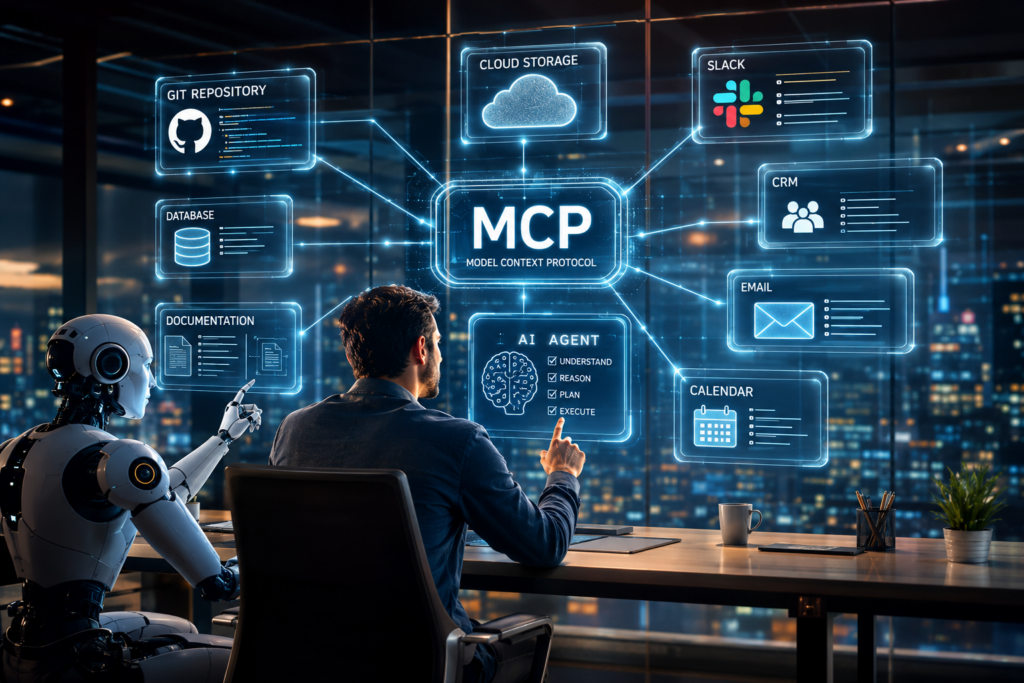
Often described as the “USB-C for AI,” Model Context Protocol is rapidly becoming the universal language that allows AI models to communicate with tools, databases, APIs, applications, and enterprise software through one standardized protocol. Instead of developers writing dozens of unique integrations, MCP enables a single standard that works across countless services.
In 2026, the protocol is no longer viewed as an experimental technology. Major AI ecosystems—including support in Anthropic products and integrations within OpenAI’s Agents SDK—are embracing MCP as a practical way to connect language models with external tools and enterprise systems.
For businesses, this means:
- Smarter enterprise automation
- Faster AI deployment
- Lower development costs
- Better interoperability
- More reliable AI agents
- Future-proof software architecture
For developers, it means building once and connecting AI almost everywhere.
Whether you’re an AI engineer, automation specialist, entrepreneur, software developer, or simply curious about where artificial intelligence is heading, understanding Model Context Protocol may be one of the most valuable skills you can learn in 2026.
In this comprehensive guide, you’ll discover:
- What Model Context Protocol actually is
- Why MCP AI has become the industry’s fastest-growing standard
- How Model Context Protocol works with AI agents
- Why enterprises are adopting MCP
- The biggest advantages over traditional API integrations
- How beginners can understand MCP without advanced programming knowledge
- Why experts believe MCP will shape the future of enterprise AI through 2027 and beyond
Let’s begin with the fundamentals.

What Is Model Context Protocol?
At its core, Model Context Protocol (MCP) is an open standard that enables artificial intelligence models to communicate with external tools, applications, databases, and services through a common interface.
Think about your smartphone.
Years ago, every manufacturer used different charging cables.
Then USB-C arrived.
Today, one cable works across numerous devices because manufacturers agreed on a common standard.
Model Context Protocol does the same thing—but for AI.
Instead of creating a unique integration for every AI application, developers build an MCP server once, and any compatible AI client can use it. This dramatically reduces integration complexity and makes AI systems easier to scale.
Instead of building connections like:
- AI → Google Drive
- AI → Slack
- AI → GitHub
- AI → Salesforce
- AI → PostgreSQL
- AI → Notion
developers expose these tools through MCP so compatible AI applications can discover and use them through a consistent protocol.
Model Context Protocol Explained for Beginners
If you’re new to AI development, the phrase “protocol” might sound intimidating.
It isn’t.
A protocol is simply a set of agreed rules for communication.
For example:
- HTTP tells browsers how to communicate with websites.
- SMTP defines how email servers exchange messages.
- Bluetooth specifies how nearby devices connect wirelessly.
Likewise, Model Context Protocol defines how AI applications discover tools, access data, and perform actions in a standardized way
Imagine asking an AI assistant:
“Summarize yesterday’s sales report, compare it with last month, then send the findings to my manager on Slack.”
Without MCP, developers would have to build separate integrations for spreadsheets, analytics tools, messaging platforms, and authentication.
With MCP, the AI can use compatible tools through one standardized interface, reducing engineering effort while improving consistency.
Why This Matters
Businesses increasingly want AI that doesn’t just answer questions but also performs meaningful work.
Examples include:
- Searching company documents
- Querying databases
- Creating reports
- Updating CRM records
- Scheduling meetings
- Managing cloud resources
- Writing software
- Automating repetitive business processes
Model Context Protocol helps make these scenarios more practical by giving AI a standardized way to interact with external systems.
Why MCP AI Is Becoming the Universal Standard in 2026
The excitement around MCP AI is driven by a broader shift toward “agentic AI”—systems that don’t just generate text but actively use tools and complete tasks.
Several factors explain the momentum:
1. AI Agents Need Reliable Tool Access
Modern AI agents are expected to:
- Read files
- Query databases
- Search the web
- Execute workflows
- Trigger APIs
- Collaborate with other software
MCP provides a common language for these interactions, reducing the need for custom integrations.
2. Enterprises Want Interoperability
Large organizations often rely on hundreds of software systems.
Without standardization, connecting AI to each application can become costly and difficult to maintain.
MCP offers a more unified integration approach that can simplify enterprise AI deployments. (Claude)
3. Developers Save Significant Time
Instead of maintaining dozens of bespoke connectors, developers can build or integrate with MCP-compatible servers, reducing duplication and accelerating AI projects. (Model Context Protocol)
4. Broad Industry Adoption
Support for MCP has expanded across multiple AI ecosystems, with documentation and tooling available from Anthropic and integration support within OpenAI’s Agents SDK, helping establish MCP as an emerging cross-platform standard. (OpenAI GitHub Pages)
How Model Context Protocol Works with AI Agents
Artificial intelligence has evolved from answering questions to completing real-world tasks. Modern AI Agents are expected to retrieve documents, search databases, analyze reports, schedule meetings, send emails, update customer records, and even collaborate with other software systems.
This shift from “conversation” to “action” is precisely why Model Context Protocol (MCP) has become one of the most important developments in AI infrastructure.
To understand why, let’s first examine how AI worked before MCP.
How AI Agents Worked Before Model Context Protocol
Before the emergence of Model Context Protocol, developers had to create separate integrations for every application an AI needed to access.
Imagine you wanted to build an AI assistant capable of:
- Reading emails from Gmail
- Retrieving files from Google Drive
- Updating Salesforce
- Creating tasks in Jira
- Posting messages to Slack
- Accessing a PostgreSQL database
- Searching company documentation in Notion
Each service required:
- A different API
- A different authentication method
- Separate SDKs
- Custom error handling
- Individual documentation
- Continuous maintenance as APIs evolved
As organizations added more software, the complexity increased rapidly.
For example:
- 10 applications might require 10 custom integrations.
- 50 applications could mean maintaining 50 separate connectors.
- Hundreds of enterprise systems could create thousands of hours of engineering work.
This approach was expensive, time-consuming, and difficult to scale.
More importantly, AI agents could only interact with systems that developers had explicitly integrated.
How Model Context Protocol Works with AI Agents
Model Context Protocol changes this by introducing a standardized communication layer between AI models and external tools.
Instead of building a unique integration for every service, developers expose capabilities through an MCP server. Any compatible AI client can then discover and use those capabilities through the same protocol. This reduces duplication and makes AI systems easier to extend as new tools are added.
At a high level, the process looks like this:
- The user gives the AI agent a task.
- The AI understands the intent.
- The AI discovers available MCP tools.
- The AI selects the appropriate tool.
- The MCP server communicates with the external application.
- The application returns data.
- The AI processes the results and responds to the user.
From the user’s perspective, the experience feels seamless.
Instead of asking:
“Can you tell me today’s sales?”
You can ask:
“Compare this month’s revenue with last month, identify the top-performing region, generate a summary, and send it to the executive team.”
An MCP-enabled AI agent can coordinate multiple tools to complete that workflow.
Understanding the Three Core Components of Model Context Protocol
One of the reasons Model Context Protocol explained for beginners is becoming such a popular search topic is that its architecture is surprisingly straightforward.
The protocol revolves around three primary components.
1. MCP Host (The AI Application)
The host is the AI-powered application the user interacts with.
Examples include:
- AI coding assistants
- Enterprise chatbots
- Customer support assistants
- Internal company AI copilots
- Workflow automation platforms
The host receives user requests and decides when external tools are needed.
Think of it as the “brain” coordinating the overall task.
2. MCP Client
The MCP client is responsible for communication.
It:
- Connects to MCP servers
- Discovers available tools
- Sends requests
- Receives responses
- Passes results back to the AI model
Because every MCP server follows the same protocol, the client doesn’t need custom logic for each individual service.
3. MCP Server
The MCP server is where the real work happens.
Each server exposes one or more tools or data sources to AI models in a standardized way.
Examples include servers that provide access to:
- Cloud storage
- Databases
- Project management software
- Source code repositories
- CRM platforms
- Email systems
- Calendar applications
- Knowledge bases
Rather than forcing the AI to understand every external API, the MCP server handles those details.
A Simple Example of How Model Context Protocol Works with AI Agents
Imagine you’re a sales manager.
You ask your AI assistant:
“Create a report of this week’s highest-value customers and email it to the finance department.”
Without MCP, the AI would need separate custom integrations for:
- The CRM
- The analytics database
- Email services
With MCP:
- The AI discovers the available tools.
- It retrieves customer data.
- It generates the report.
- It uses the email tool to send the report.
- It confirms completion.
The user experiences a single, natural conversation while the AI coordinates multiple systems behind the scenes.
Traditional APIs vs. Model Context Protocol
The differences become clearer when viewed side by side.
| Feature | Traditional API Integrations | Model Context Protocol (MCP) |
|---|---|---|
| Integration method | Separate custom connector for every service | One standardized protocol for many services |
| Development effort | High | Lower |
| Maintenance | Multiple integrations to maintain | Centralized protocol reduces duplication |
| Scalability | Becomes more complex as tools increase | Designed to scale as new tools are added |
| Tool discovery | Often hard-coded | Dynamic discovery of available tools |
| AI interoperability | Limited by custom implementations | Improved interoperability across compatible systems |
| Enterprise readiness | Depends on each integration | Designed with enterprise integration in mind |
| Future expansion | Slower | Easier to extend with new MCP-compatible servers |
The key idea isn’t that APIs disappear—MCP typically sits above them, providing a consistent interface that AI systems can use while the server handles the underlying API interactions.
Why Model Context Protocol Is a Game Changer for Enterprise AI Automation
Every large organization faces a common challenge.
Different departments rely on different software:
- Marketing uses analytics platforms.
- Finance uses ERP systems.
- Human Resources manages HR software.
- Sales depends on CRM tools.
- Engineering works with Git repositories and issue trackers.
- Customer support relies on ticketing systems.
Each application stores valuable information.
The challenge is enabling AI to work across all of them efficiently.
Enterprise AI Automation increasingly depends on standardized access to these systems rather than building one-off integrations for every new AI project.
With MCP, organizations can:
- Connect AI to existing business systems more consistently.
- Reuse integrations across multiple AI applications.
- Reduce repetitive engineering work.
- Speed up deployment of internal AI assistants.
- Simplify long-term maintenance.
This doesn’t eliminate all integration work, but it creates a common framework that many organizations can build upon.
Key Benefits of Model Context Protocol for Developers
Developers are among the biggest beneficiaries of MCP adoption because it addresses many long-standing integration challenges.
Some of the most significant advantages include:
Faster Development
Teams can spend less time writing repetitive connector code and more time building valuable AI experiences.
Improved Scalability
As organizations adopt additional software, new capabilities can often be exposed through additional MCP servers without redesigning the entire AI system.
Easier Maintenance
A standardized interface means fewer custom integration points to update when systems evolve.
Better Reusability
An MCP-compatible server can potentially be used by multiple AI applications instead of being tied to a single project.
Greater Flexibility
Organizations can adapt more easily as AI platforms, models, and business needs change.
Common Enterprise Use Cases for MCP AI
The flexibility of MCP AI opens the door to a wide range of practical business applications.
Some of the most promising include:
- Customer support automation: AI agents retrieve customer history, create tickets, and draft responses.
- Software development: AI assistants access repositories, documentation, and issue trackers to help developers code more efficiently.
- Business intelligence: AI combines information from databases, dashboards, and spreadsheets to generate executive reports.
- Human resources: AI assists with onboarding, answers policy questions, and retrieves employee documents.
- Finance: AI automates invoice processing, reconciles records, and prepares financial summaries.
- Knowledge management: AI searches internal documentation, wikis, and knowledge bases to answer employee questions.
- Project management: AI creates tasks, updates project boards, summarizes meetings, and tracks deadlines across collaboration platforms.
These examples illustrate why MCP is attracting attention across industries: it provides a consistent way for AI to interact with the diverse software ecosystems that modern businesses depend on.

The 9 Powerful Breakthroughs Driving Successful AI Agents, Enterprise Automation & Workflows in 2026
The excitement surrounding Model Context Protocol (MCP) isn’t driven by hype alone. It stems from practical improvements in how AI systems connect to data, tools, and enterprise software. As organizations move from experimenting with AI to deploying production-ready AI agents, MCP is helping address many of the integration challenges that previously slowed adoption.
Below are nine of the most important breakthroughs that are making Model Context Protocol one of the defining AI standards of 2026.
1. Model Context Protocol Enables Truly Action-Oriented AI Agents
For years, AI assistants excelled at generating text but often struggled to perform meaningful actions without extensive custom engineering.
Today’s AI Agents are expected to:
- Retrieve information from internal databases
- Update CRM records
- Search documentation
- Schedule meetings
- Trigger workflow automations
- Analyze spreadsheets
- Execute multi-step business processes
Model Context Protocol helps make these capabilities more practical by giving AI systems a standardized way to discover and interact with compatible tools.
Why This Breakthrough Matters
Organizations increasingly want AI that doesn’t simply answer questions—they want AI that can help complete work.
Consider a sales manager who asks:
“Identify our top five customers by revenue this quarter, summarize their recent activity, and draft personalized follow-up emails.”
An MCP-enabled AI agent can coordinate multiple tools to complete that workflow, reducing manual effort while keeping the interaction conversational.
Business Benefits
- Less repetitive manual work
- Faster decision-making
- Higher employee productivity
- Better customer experiences
- More efficient knowledge retrieval
This shift from “AI that knows” to “AI that does” is one of the biggest reasons MCP is attracting enterprise attention.
2. MCP AI Simplifies Enterprise AI Automation at Scale
One of the biggest barriers to enterprise AI has always been integration complexity.
Large organizations often use dozens—or even hundreds—of software platforms:
- Microsoft 365
- Google Workspace
- Salesforce
- SAP
- ServiceNow
- Jira
- Slack
- GitHub
- Internal databases
Historically, each new AI project required separate integration work.
With MCP AI, organizations can expose capabilities through standardized servers, making those integrations easier to reuse across multiple AI applications.
Why Enterprises Care
Instead of rebuilding similar integrations for every chatbot, assistant, or automation project, teams can leverage a more consistent integration approach.
Potential benefits include:
- Faster deployment of AI solutions
- Reduced engineering overhead
- Easier maintenance
- Better consistency across projects
- Improved long-term scalability
For CIOs and IT leaders, this can translate into lower operational complexity and a clearer path toward enterprise-wide AI adoption.
3. Model Context Protocol Makes AI Tool Discovery Smarter
One of the standout features of MCP is dynamic tool discovery.
Traditional AI integrations often relied on hard-coded knowledge of available tools.
With MCP, compatible AI applications can discover what tools are available from an MCP server and understand how to use them through standardized metadata. This makes systems more flexible as new capabilities are added.
Why This Is Powerful
Imagine an organization adds a new document repository.
Instead of rewriting significant portions of the AI application, administrators can expose the repository through an MCP server, allowing compatible AI clients to discover and use it.
This flexibility is especially valuable in fast-changing enterprise environments.
4. How Model Context Protocol Works with AI Agents Improves Multi-Step Workflows
Businesses rarely need AI for isolated tasks.
Instead, they want AI to complete end-to-end workflows.
For example:
“Review today’s customer support tickets, identify high-priority issues, prepare a summary, and notify the operations manager.”
Completing that request may involve:
- Reading support tickets
- Prioritizing issues
- Summarizing findings
- Accessing contact information
- Sending a notification
MCP provides a common framework for coordinating these interactions across different systems.
Why Workflow Automation Is Changing
Organizations increasingly measure AI success not by how well it chats, but by how effectively it helps complete real work.
That shift is driving strong interest in enterprise AI automation built on interoperable standards like MCP.
5. Model Context Protocol Improves Developer Productivity
Developers have traditionally spent significant time building and maintaining custom integrations.
Every service introduced:
- Authentication requirements
- API documentation
- SDK updates
- Rate limits
- Error handling
- Version compatibility
These tasks often consumed more time than developing the AI experience itself.
With MCP, many of these integration patterns become more standardized.
Productivity Gains
Development teams can focus more on:
- Designing intelligent AI behaviors
- Improving user experiences
- Optimizing prompts and reasoning
- Building business logic
- Testing workflows
- Enhancing security and governance
Instead of repeatedly solving similar integration problems.
6. Enterprise AI Automation Becomes More Flexible and Future-Ready
Technology evolves quickly.
Organizations regularly adopt:
- New collaboration tools
- New cloud platforms
- New databases
- New CRM systems
- New analytics software
A rigid integration strategy can make adapting to these changes expensive.
MCP’s standardized approach helps organizations introduce new compatible tools without redesigning every AI workflow from scratch.
Why Flexibility Matters
Future-ready AI systems should be able to grow alongside the business.
As companies expand globally, merge with other organizations, or adopt new software, AI infrastructure needs to adapt with minimal disruption.
MCP supports this long-term adaptability.
7. Model Context Protocol Strengthens Collaboration Between AI Systems
The future of AI is unlikely to revolve around a single model performing every task.
Instead, organizations are exploring ecosystems of specialized AI agents.
Examples include:
- A finance AI
- A marketing AI
- A customer support AI
- A software engineering AI
- A legal compliance AI
Each may access different tools and datasets.
Model Context Protocol provides a consistent way for these agents to interact with the resources they need, improving interoperability across AI-driven workflows.
Enterprise Impact
This can enable organizations to build modular AI ecosystems where specialized agents contribute to larger business processes.
8. Best MCP Servers for Enterprise AI Automation 2026 Are Expanding Rapidly
One reason MCP adoption is accelerating is the growing ecosystem of MCP-compatible servers.
These servers expose tools and data sources that AI agents can use.
Common categories include:
- Source code repositories
- Cloud storage
- Relational databases
- Documentation systems
- Project management platforms
- Communication tools
- Customer relationship management systems
- Internal knowledge bases
As the ecosystem expands, developers gain access to more reusable building blocks for AI applications.
Why This Matters
A richer ecosystem means organizations can integrate AI with more of their existing software stack while relying on a consistent protocol.
9. How to Build AI Agents Using Model Context Protocol Is Becoming Easier
Not long ago, building an enterprise AI assistant required expertise across numerous APIs and custom integrations.
Today, documentation, SDKs, and MCP-compatible tooling are making it easier for developers to get started.
A typical development process includes:
- Choosing an AI model.
- Identifying the business workflow.
- Connecting to relevant MCP servers.
- Implementing authentication and permissions.
- Testing tool interactions.
- Refining prompts and reasoning.
- Monitoring performance in production.
While building robust AI agents still requires thoughtful design, MCP reduces much of the repetitive integration work.
Summary Table: The 9 Powerful MCP Breakthroughs
| Breakthrough | Why It Matters | Business Impact |
|---|---|---|
| Action-oriented AI agents | Enables AI to interact with tools instead of only generating text | Increased productivity |
| Enterprise AI automation | Standardized integrations across business systems | Lower engineering effort |
| Dynamic tool discovery | AI can discover compatible tools more easily | Greater flexibility |
| Multi-step workflow support | Coordinates tasks across multiple systems | End-to-end automation |
| Developer productivity | Reduces repetitive integration work | Faster AI development |
| Future-ready architecture | Easier adaptation to new software and services | Long-term scalability |
| AI ecosystem collaboration | Supports specialized AI agents using shared standards | Better interoperability |
| Expanding MCP server ecosystem | More reusable integrations available | Faster enterprise adoption |
| Simplified AI agent development | Standardized tooling and workflows | Quicker time to deployment |
Why These Breakthroughs Matter Beyond 2026
The significance of Model Context Protocol extends beyond current AI trends.
As businesses continue investing in intelligent automation, they need infrastructure that is:
- Scalable
- Secure
- Interoperable
- Easy to maintain
- Compatible with evolving AI technologies
Rather than being just another developer specification, MCP is increasingly viewed as a foundational integration standard for the next generation of AI-powered enterprise applications.
By reducing fragmentation and encouraging reusable integrations, it helps organizations focus on delivering value instead of repeatedly solving the same connectivity problems.
Best MCP Servers for Enterprise AI Automation 2026
One of the biggest reasons behind the explosive growth of Model Context Protocol is its rapidly expanding ecosystem of MCP servers.
Think of an MCP server as a bridge that exposes a tool or data source in a standardized way so AI agents can discover and use it. Instead of writing separate integrations for every application, developers can connect AI to these servers through the MCP standard.
As more organizations adopt Enterprise AI Automation, the number of available MCP servers continues to grow, covering everything from cloud storage and code repositories to databases and collaboration platforms.
What Makes a Good MCP Server?
Before selecting an MCP server, organizations should evaluate several important factors:
- Security and authentication support
- Scalability
- Reliability
- Documentation quality
- Community support
- Enterprise compatibility
- Active maintenance
- Performance under heavy workloads
Choosing the right server isn’t just about features—it’s about ensuring that your AI agents can operate securely and reliably in production.
Popular Categories of MCP Servers
Rather than focusing on individual vendors, it’s more useful to think in terms of the capabilities your AI needs.
1. File System Servers
These allow AI agents to:
- Read documents
- Create files
- Organize folders
- Analyze PDFs
- Search project directories
Ideal for:
- Knowledge management
- Documentation assistants
- Legal firms
- Research organizations
2. Database MCP Servers
Database servers allow AI agents to interact with structured data.
Common capabilities include:
- SQL queries
- Report generation
- Business intelligence
- Analytics
- Customer insights
Popular database types include:
- PostgreSQL
- MySQL
- SQLite
- Microsoft SQL Server
3. Git Repository Servers
Software development teams increasingly use AI assistants.
Git-based MCP servers enable AI to:
- Review code
- Explain pull requests
- Search repositories
- Generate documentation
- Identify bugs
These are becoming indispensable in modern software engineering workflows.
4. Collaboration Platform Servers
AI agents can assist teams by connecting to collaboration tools.
Typical capabilities include:
- Reading conversations
- Posting updates
- Creating tasks
- Managing projects
- Scheduling reminders
This helps reduce repetitive administrative work.
5. Knowledge Base Servers
Enterprise knowledge often lives across multiple systems.
Knowledge-oriented MCP servers enable AI to:
- Search documentation
- Retrieve policies
- Answer employee questions
- Summarize manuals
- Connect organizational knowledge
These servers are particularly valuable for internal AI assistants.

Comparison Table: Best MCP Server Categories for Enterprise AI Automation 2026
| MCP Server Category | Primary Purpose | Best For |
|---|---|---|
| File System Servers | File access and document management | Research, legal, education |
| Database Servers | Structured data retrieval | Business intelligence, analytics |
| Git Repository Servers | Source code management | Software development |
| Collaboration Servers | Team communication | Project management |
| Knowledge Base Servers | Enterprise documentation | Internal AI assistants |
| CRM Integration Servers | Customer data access | Sales and customer support |
| Calendar & Productivity Servers | Scheduling and task management | Executive assistants |
| Cloud Storage Servers | Secure file storage | Enterprise collaboration |
How to Build AI Agents Using Model Context Protocol
One of the most exciting developments in 2026 is that building AI agents is becoming more accessible.
Thanks to Model Context Protocol, developers no longer need to reinvent integrations for every new project.
Instead, they can focus on designing intelligent workflows while relying on standardized connections to tools and data sources.
Below is a practical roadmap.
Step 1: Define the Agent’s Objective
Before writing any code, identify exactly what your AI agent should accomplish.
Examples include:
- Customer support
- Sales assistant
- HR assistant
- Financial analyst
- Coding assistant
- Healthcare documentation
- Internal knowledge assistant
A clearly defined purpose helps determine which MCP servers and tools are required.
Step 2: Select the Right AI Model
Choose a language model that aligns with your project’s needs.
Consider:
- Reasoning capability
- Cost
- Context window
- Speed
- Tool-use support
- Deployment options
Many modern AI platforms now provide tooling that works with MCP-compatible servers.
Step 3: Connect MCP Servers
This is where Model Context Protocol shines.
Instead of implementing separate APIs for every service, configure your AI agent to use the relevant MCP servers.
Examples include servers for:
- Databases
- Documentation
- Source code
- Calendars
- CRM systems
The AI can then discover and use the available tools exposed by those servers.
Step 4: Design Intelligent Workflows
The most effective AI agents do more than answer questions.
Think in terms of complete workflows.
For example:
Customer inquiry →
Retrieve customer profile →
Check previous orders →
Generate personalized response →
Create support ticket →
Notify account manager
This type of orchestration is where MCP-based architectures provide significant value.
Step 5: Test Every Tool
Before deployment:
- Verify permissions
- Test edge cases
- Confirm error handling
- Measure latency
- Validate responses
- Review logs
Comprehensive testing helps ensure AI agents behave predictably when interacting with external systems.
Step 6: Monitor and Improve
Enterprise AI systems should evolve over time.
Track:
- Response quality
- User satisfaction
- Tool usage
- Failure rates
- Workflow completion
- Cost efficiency
Continuous monitoring allows teams to refine prompts, permissions, and workflows as business needs change.
Common Mistakes to Avoid When Using Model Context Protocol
Although MCP AI simplifies integration, successful deployments still require thoughtful planning.
Avoid these common pitfalls:
Overloading the AI Agent
Giving an agent access to too many tools can reduce efficiency and make tool selection more difficult.
Instead:
- Expose only the tools required for the agent’s purpose.
- Group related capabilities logically.
- Keep tool descriptions clear and concise.
Ignoring Authentication and Permissions
AI should never have unrestricted access to sensitive business systems.
Implement:
- Role-based access control
- Least-privilege permissions
- Secure credential management
- Regular access reviews
Poor Workflow Design
AI should enhance existing business processes rather than introduce unnecessary complexity.
Map workflows carefully before implementing automation.
Lack of Documentation
As your MCP ecosystem grows, maintain clear documentation for:
- Available servers
- Tool descriptions
- Permissions
- Supported workflows
- Operational procedures
Good documentation makes systems easier to maintain and onboard new team members.
Security Best Practices for Enterprise AI Automation
Because MCP connects AI to real business systems, security is essential.
Recommended practices include:
- Encrypt data in transit and at rest.
- Authenticate every connection.
- Apply role-based authorization.
- Audit AI actions and tool usage.
- Monitor for anomalous behavior.
- Review third-party MCP servers before deployment.
- Keep servers and SDKs up to date.
Researchers have also highlighted emerging risks such as prompt injection, excessive tool permissions, and supply-chain vulnerabilities, underscoring the need for strong governance alongside protocol adoption.
The Future of Model Context Protocol Beyond 2026
Everything suggests that Model Context Protocol will remain a significant part of the AI ecosystem through 2027 and beyond.
Several trends support this outlook:
Wider Industry Adoption
Major AI platforms continue expanding support for MCP, helping establish it as a common integration standard across the industry.
Smarter AI Agents
Future AI systems will increasingly coordinate multiple tools and specialized agents to complete complex business workflows.
Growth of Enterprise Automation
Organizations are investing heavily in AI-driven automation to improve productivity and reduce repetitive work.
Larger MCP Ecosystems
The number of available servers, tools, and integrations is expected to continue growing, giving developers more reusable building blocks.
Frequently Asked Questions (FAQs)
What is Model Context Protocol (MCP)?
Model Context Protocol (MCP) is an open standard that enables AI applications to connect with external tools, data sources, and services through a standardized interface, making integrations more consistent and reusable.
Is MCP only for developers?
No.
While developers build MCP-enabled applications, business leaders, automation specialists, IT teams, and AI product managers also benefit by understanding how MCP can streamline enterprise AI initiatives.
Can beginners learn Model Context Protocol?
Yes.
A basic understanding of APIs and AI concepts is helpful, but many tutorials, SDKs, and examples make it increasingly approachable for newcomers.
Does MCP replace APIs?
No.
MCP complements existing APIs by providing a standardized way for AI applications to discover and use tools. The underlying services often still communicate through their native APIs.
Will Model Context Protocol remain relevant after 2026?
Based on current adoption trends, expanding tooling, and support from major AI platforms, MCP is well positioned to remain an important standard for AI integration and enterprise automation through 2027 and beyond.
Conclusion
Artificial intelligence is evolving rapidly, but one challenge has remained constant: connecting AI models to the tools, data, and applications that power real business work.
Model Context Protocol offers a compelling solution by introducing a common language for AI-to-tool communication. Instead of maintaining countless custom integrations, organizations can build more flexible, scalable, and maintainable AI systems using standardized MCP-compatible servers.
Whether you’re a developer creating intelligent assistants, an enterprise leader planning large-scale automation, or a technology enthusiast exploring the future of AI, understanding MCP is becoming an increasingly valuable skill.
As AI agents grow more capable and businesses continue embracing intelligent automation, the organizations that invest in interoperable, secure, and well-governed AI architectures will be best positioned to unlock the next wave of productivity and innovation.
- Official Model Context Protocol Documentation: https://modelcontextprotocol.io/docs/getting-started/intro (Model Context Protocol)
- OpenAI Agents SDK – Model Context Protocol Guide: https://openai.github.io/openai-agents-python/mcp/ (OpenAI GitHub Pages)