AI Agent Builder
For years, technology moved in a predictable direction. Every task required a separate app. One app for writing. Another for scheduling. Another for design. Another for customer service. Another for research. Businesses and individuals built entire digital ecosystems around downloading, organizing, and managing countless software tools.
But in 2026, something fundamentally changed.
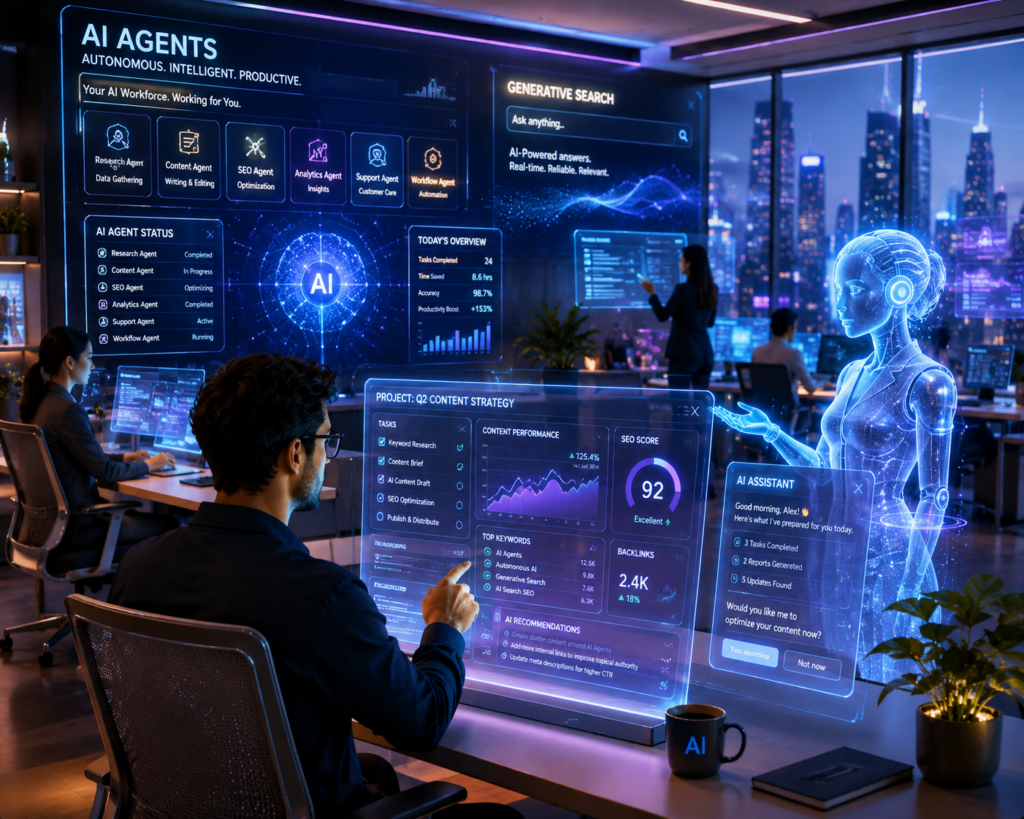
The rise of AI Agents and Autonomous AI is beginning to eliminate the need for many traditional applications altogether. Instead of opening multiple apps to complete different tasks, users can now rely on intelligent AI systems capable of performing entire workflows from start to finish.
At the same time, Generative Search Google AI Search Updates is transforming how people interact with search engines. Google’s AI-powered search experience is changing SEO forever, forcing marketers, bloggers, and businesses to rethink how online visibility works.
This is no longer just another tech trend.
It is the beginning of a complete shift in how software, productivity, search engines, and digital marketing operate.
In this guide, we’ll explore:
- How AI Agents are replacing apps
- Why Autonomous AI is becoming the future of workflow automation
- How Generative Search is disrupting traditional SEO
- The future of Google AI search rankings in 2027
- The biggest opportunities and risks businesses should prepare for now
What Are AI Agents and Why Are They Exploding in 2026?
AI Agents Are More Than Chatbots
One of the biggest misconceptions people still have is assuming AI Agents are simply advanced chatbots.
They are not.
Traditional chatbots respond to prompts. AI Agents perform tasks independently.
An AI Agent can:
- Research information
- Analyze data
- Create reports
- Send emails
- Schedule meetings
- Build presentations
- Automate workflows
- Interact with software tools
- Make decisions based on objectives
This is why the term Autonomous AI is becoming so important in 2026.
These systems are no longer waiting for constant human instructions. They are capable of operating with goals, memory, reasoning, and adaptive learning.
Instead of being passive assistants, they are becoming active digital workers.
How Autonomous AI Is Replacing Traditional Apps and Workflows
The Shift From “Using Apps” to “Managing Outcomes”
For decades, software companies competed by creating specialized applications.
Now AI Agents are changing the model entirely.
People increasingly care less about which app performs a task and more about whether the task gets completed automatically.
This is a massive psychological and technological shift.
Instead of:
- Opening Excel
- Copying data manually
- Creating charts
- Writing summaries
- Sending emails
An AI Agent can now handle the entire workflow autonomously.
That changes everything.
1. AI Agents Are Replacing Productivity Apps
AI Agents and Workflow Automation in 2026
Productivity apps once dominated workplaces.
Tools for:
- Note-taking
- Project management
- Calendar organization
- Task tracking
- Collaboration
But AI Agents are increasingly integrating all these functions into unified systems.
The best AI agents for workflow automation in 2026 can:
- Organize meetings automatically
- Summarize discussions
- Create action plans
- Assign tasks
- Monitor deadlines
- Follow up with teams
This removes friction from daily work.
Instead of constantly managing software, employees focus on strategic thinking while AI handles operational tasks.
Why This Matters
Businesses save:
- Time
- Labor costs
- Training expenses
- Software subscription costs
This is one reason investors are pouring billions into Autonomous AI startups.
2. Autonomous AI Tools Are Replacing Customer Service Platforms
Customer support is undergoing one of the fastest AI transformations.
Modern AI Agents can now:
- Understand customer intent
- Resolve complex inquiries
- Handle multilingual conversations
- Analyze customer emotions
- Generate personalized responses
Unlike traditional support bots, Autonomous AI systems continuously learn from interactions.
This means businesses no longer need massive support teams for many routine tasks.
Key Benefits
- Faster response times
- Lower operational costs
- 24/7 customer support
- Better scalability
- Improved personalization
In 2026, companies that fail to integrate AI-powered customer support risk falling behind competitors dramatically.
3. AI Agents Are Replacing Traditional Search Behavior
How Generative Search Is Changing User Experience
Search engines are evolving from “information retrieval tools” into “answer generation systems.”
Previously:
- Users searched keywords
- Opened multiple websites
- Compared information manually
Now Generative Search provides direct AI-generated answers instantly.
This dramatically reduces traditional website clicks.
And that is why AI Search SEO has become one of the most important digital marketing conversations in 2026.
How Generative Search Is Changing SEO in 2026
AI Search SEO Is No Longer Traditional SEO
For years, SEO focused on:
- Keywords
- Backlinks
- Meta tags
- Technical optimization
- Content length
These still matter.
But Generative Search changes how visibility works.
AI-powered search engines now prioritize:
- Context
- Authority
- Trustworthiness
- Original insights
- User intent satisfaction
- Conversational relevance
That means websites optimized only for keywords may lose rankings.
Traditional SEO vs AI Search SEO
| Traditional SEO | AI Search SEO |
|---|---|
| Keyword-heavy content | Context-rich content |
| Ranking pages | Generating trusted answers |
| Backlink-focused | Authority-focused |
| Search intent matching | Conversational intent understanding |
| Static optimization | Adaptive AI relevance |
| Click-driven traffic | AI Overview visibility |
4. AI Agents Are Becoming Personal Digital Employees
One of the most disruptive trends in 2026 is the rise of AI Agents acting like personal employees.
Imagine having an AI system that:
- Manages your calendar
- Researches competitors
- Handles outreach
- Creates reports
- Monitors analytics
- Optimizes campaigns
All without constant supervision.
This is becoming reality faster than many expected.
For entrepreneurs and creators, this creates enormous leverage.
A single person can now perform the work that once required an entire team.
5. Autonomous AI Is Disrupting Software-as-a-Service (SaaS)
Why AI Could Replace Traditional Software Apps
The SaaS industry is facing one of its biggest disruptions ever.
Instead of paying for:
- Separate writing tools
- Separate analytics platforms
- Separate CRM systems
- Separate automation software
Users increasingly prefer AI systems capable of doing everything inside one intelligent interface.
This is why many analysts believe Autonomous AI tools replacing traditional software apps will become one of the defining business shifts of the decade.
The New Software Model
The future may look like this:
Instead of:
“There’s an app for that.”
The new reality becomes:
“There’s an AI Agent for that.”
6. AI Agents Are Transforming Content Creation
Content marketing is evolving rapidly.
AI Agents can now:
- Research topics
- Analyze trends
- Generate outlines
- Write drafts
- Optimize SEO
- Repurpose content
- Schedule publishing
This dramatically accelerates content production.
However, there is a catch.
Because AI-generated content is everywhere, originality matters more than ever.
Google increasingly rewards:
- Unique perspectives
- Real expertise
- Authentic storytelling
- Human insight
- First-hand experience
This means creators who combine human creativity with AI efficiency will dominate.
7. Generative Search Is Reducing Organic Traffic
The Dark Side of AI Search SEO
Many publishers are already experiencing declining organic clicks due to AI-generated answers appearing directly in search results.
This creates a major challenge.
If users get answers instantly from AI summaries, fewer people visit websites.
This forces businesses to rethink:
- Monetization strategies
- Content formats
- Audience engagement
- Brand authority
What Will Still Work?
Websites that provide:
- Deep expertise
- Unique research
- Interactive experiences
- Strong communities
- Original opinions
will remain valuable.
Generic content will struggle.
8. AI Agents Are Creating Hyper-Personalized Experiences
AI Agents learn from:
- User behavior
- Preferences
- Habits
- Goals
- Work patterns
This allows them to deliver highly personalized recommendations and automation.
For example:
- AI shopping assistants
- AI financial planning agents
- AI education tutors
- AI health coaching systems
This level of personalization is something traditional apps often struggle to achieve.
9. The Future of Google AI Search and SEO Rankings in 2027
What Happens Next?
The future of Google AI search and SEO rankings in 2027 will likely become even more AI-driven.
Several trends are already emerging:
1. Search Will Become More Conversational
Users increasingly interact with search engines like assistants instead of keyword tools.
2. Authority Will Matter More Than Ever
Google will continue prioritizing trusted brands and credible creators.
3. AI Overviews Will Expand
AI-generated summaries will dominate more search categories.
4. Content Quality Will Become Critical
Thin, generic AI-written content will struggle to rank.
5. Human Creativity Will Become More Valuable
Ironically, the rise of AI increases demand for authentic human perspectives.
Best AI Agents for Workflow Automation in 2026
Here are some of the most talked-about AI workflow tools shaping the industry:
| AI Agent Type | Primary Function | Industry Impact |
|---|---|---|
| Research AI Agents | Data gathering and analysis | Faster decision-making |
| Customer Support Agents | Automated support systems | Reduced labor costs |
| Marketing AI Agents | Campaign optimization | Better targeting |
| Productivity AI Agents | Workflow management | Higher efficiency |
| Coding AI Agents | Software development assistance | Faster deployment |
How Businesses Should Prepare for the Autonomous AI Era
The companies winning in 2026 are not necessarily the largest.
They are the fastest adapters.
Key Strategies Businesses Should Focus On
Invest in AI Literacy
Teams must understand how AI systems work.
Combine Human Creativity With AI
AI should enhance human work, not completely replace it.
Focus on Brand Authority
Strong brands survive algorithm changes better.
Create Original Content
Unique insights outperform generic information.
Optimize for AI Search SEO
Content must answer questions naturally and conversationally.
The Biggest Risks of AI Agents and Autonomous AI
Despite the excitement, there are legitimate concerns.
Potential Challenges
Job Displacement
Some repetitive roles may disappear.
AI Hallucinations
AI can still generate inaccurate information.
Privacy Concerns
Autonomous systems require access to large amounts of data.
Overdependence on AI
Businesses risk losing human oversight.
Content Saturation
The internet may become flooded with low-quality AI content.
The future will likely belong to businesses that use AI responsibly rather than blindly.
Why Human Creativity Still Matters in the Age of AI
One surprising trend is emerging:
As AI-generated content increases, authentic human experiences become more valuable.
People still crave:
- Real stories
- Personal perspectives
- Emotional connection
- Trust
- Creativity
AI can automate workflows, but human originality remains difficult to replicate fully.
That may become one of the most valuable assets online by 2027.
All from one instruction.
Why Traditional Apps Are Becoming Obsolete in 2026
For years, digital life revolved around apps.
Need to write something? Open one platform.
Need to manage projects? Open another.
Need analytics, scheduling, customer support, or automation? More apps.
Over time, people became dependent on juggling dozens of software tools just to complete basic workflows. Businesses spent huge amounts of money subscribing to platforms, training employees, and connecting systems together.
But in 2026, that model is beginning to change rapidly.
A new generation of intelligent systems is transforming how people interact with technology. Instead of manually operating multiple applications, users can now rely on smart assistants capable of handling entire tasks from start to finish.
This shift is becoming one of the most disruptive technology movements of the decade.
From Passive Software to Intelligent Systems
Traditional software tools are reactive.
They wait for commands before doing anything. A spreadsheet won’t analyze data unless you ask it to. A calendar won’t organize priorities automatically. A project management tool still depends heavily on manual input.
Modern intelligent systems operate differently.
Rather than simply responding to instructions, they can:
- Understand goals
- Make decisions
- Automate repetitive actions
- Learn from user behavior
- Improve over time
This creates a much smoother experience for both individuals and businesses.
Instead of constantly managing software, users focus more on results while automation handles the background work.
The End of “App Switching”
One of the biggest frustrations in modern work culture is app overload.
Many professionals spend their day:
- Switching tabs
- Managing notifications
- Updating dashboards
- Copying information between tools
- Repeating small administrative tasks
This creates digital fatigue.
In 2026, people increasingly prefer systems that simplify work instead of adding more complexity.
Rather than opening five separate platforms to complete one project,OpenAI Research and AI Developments users now want a single assistant capable of managing the entire process conversationally.
That’s a major reason the software industry is evolving so quickly.
Productivity Is Being Redefined
For a long time, productivity meant learning how to use more tools efficiently.
Today, productivity is starting to mean something different:
achieving outcomes with less manual effort.
Modern automation systems can:
- Organize schedules
- Prioritize tasks
- Summarize meetings
- Generate reports
- Draft emails
- Coordinate workflows
This allows professionals to spend less time on repetitive digital tasks and more time on creative or strategic work.
The difference is significant.
Instead of becoming software operators, people are becoming decision-makers supported by intelligent automation.
Research and Information Gathering Are Faster Than Ever
Research used to require:
- Opening multiple browser tabs
- Reading long articles
- Comparing information manually
- Taking notes
- Organizing findings
Now, advanced assistants can handle much of this process automatically.
A single request can trigger:
- Topic research
- Data analysis
- Trend identification
- Summary generation
- Report creation
For businesses, this means faster insights and improved decision-making.
For individuals, it saves valuable time and mental energy.
Customer Service Is Changing Rapidly
Support systems are also evolving quickly.
Older chatbots often felt robotic and limited because they relied heavily on scripted responses. Today’s intelligent assistants are far more adaptive.
They can:
- Understand natural conversation
- Detect user intent
- Personalize responses
- Handle multilingual communication
- Learn from previous interactions
As a result, companies can provide faster and more scalable customer experiences without relying entirely on large support teams.
This is one reason many businesses are investing heavily in automation technologies.
Why Companies Are Moving Away From Traditional Software Models
Businesses are constantly looking for ways to:
- Reduce costs
- Improve efficiency
- Scale operations
- Save time
Smarter automation tools help achieve all four.
Instead of paying for multiple subscriptions and managing disconnected systems, companies increasingly prefer unified solutions capable of handling several workflows at once.
This reduces:
- Operational complexity
- Employee training needs
- Software management challenges
- Workflow inefficiencies
It also allows teams to move faster in highly competitive markets.
A More Personalized Digital Experience
Another major advantage of modern intelligent systems is personalization.
Unlike traditional applications, newer systems learn from:
- User habits
- Preferences
- Communication styles
- Daily routines
- Work patterns
This creates experiences that feel more adaptive and intuitive.
For example, a digital assistant might:
- Suggest priorities based on deadlines
- Recommend better scheduling times
- Automatically organize tasks
- Anticipate recurring needs
This level of personalization makes technology feel less mechanical and more helpful.
Industries Experiencing Major Transformation
The impact of automation is spreading across nearly every industry.
Marketing
Content planning, analytics, and campaign optimization are becoming more automated.
Healthcare
Digital systems assist with patient management, diagnostics, and medical research.
Finance
Automation improves fraud detection, reporting, and financial analysis.
Education
Personalized learning experiences are becoming more common.
Software Development
Coding assistants help developers write, debug, and optimize programs faster.
The pace of change is accelerating each year.
The Challenges Businesses Must Consider
Despite the benefits, this shift also raises important concerns.
Overdependence on Automation
Relying too heavily on intelligent systems can reduce human oversight.
Accuracy Issues
Automated systems can still generate incorrect information occasionally.
Privacy Concerns
Many tools require access to large amounts of user data.
Workforce Disruption
Some repetitive jobs may gradually disappear.
Security Risks
More advanced systems may also create new cybersecurity challenges.
Businesses that adopt these technologies responsibly will likely perform better long term.
Human Creativity Is Becoming More Valuable
One interesting effect of increased automation is that human originality is becoming more important.
As more content and workflows become automated, audiences increasingly value:
- Authentic stories
- Personal experiences
- Creativity
- Emotional connection
- Unique perspectives
Technology can improve efficiency, but human insight still drives innovation and trust.
The future will likely belong to people who know how to combine automation with creativity rather than depending entirely on machines.
Thoughts
The software industry is entering a completely new phase.
People are moving away from managing dozens of separate applications and toward systems capable of handling entire workflows intelligently.
This transformation is changing:
- Productivity
- Communication
- Research
- Customer service
- Business operations
And it’s happening much faster than many expected.
By 2027, manually switching between multiple apps for everyday tasks may feel outdated. The future of technology is becoming more streamlined, conversational, and outcome-focused — and that shift is only beginning.
Final Thoughts: AI Agents Are Reshaping the Digital World Faster Than Expected
The rise of AI Agents and Autonomous AI represents more than a technological upgrade.
It marks a complete transformation in:
- Software
- Productivity
- Search engines
- Digital marketing
- Online business
Traditional apps are slowly evolving into intelligent AI ecosystems capable of handling entire workflows independently.
At the same time, Generative Search is forcing businesses to rethink how visibility, traffic, and SEO work in an AI-first internet.
The biggest lesson from 2026 is clear:
The future does not belong to businesses that resist AI.
It belongs to those who learn how to combine AI efficiency with human creativity, strategy, and trust.
And this transformation is only just beginning.



Your point of view caught my eye and was very interesting. Thanks. I have a question for you. https://www.binance.info/register?ref=IHJUI7TF