AI cyber threats
Cybersecurity is no longer just a concern for giant corporations or government agencies. In 2026, online threats have evolved into something far more intelligent, automated, and dangerous. Artificial intelligence has transformed the digital world in incredible ways, but it has also empowered cybercriminals with tools that can launch attacks faster, smarter, and at a scale never seen before.
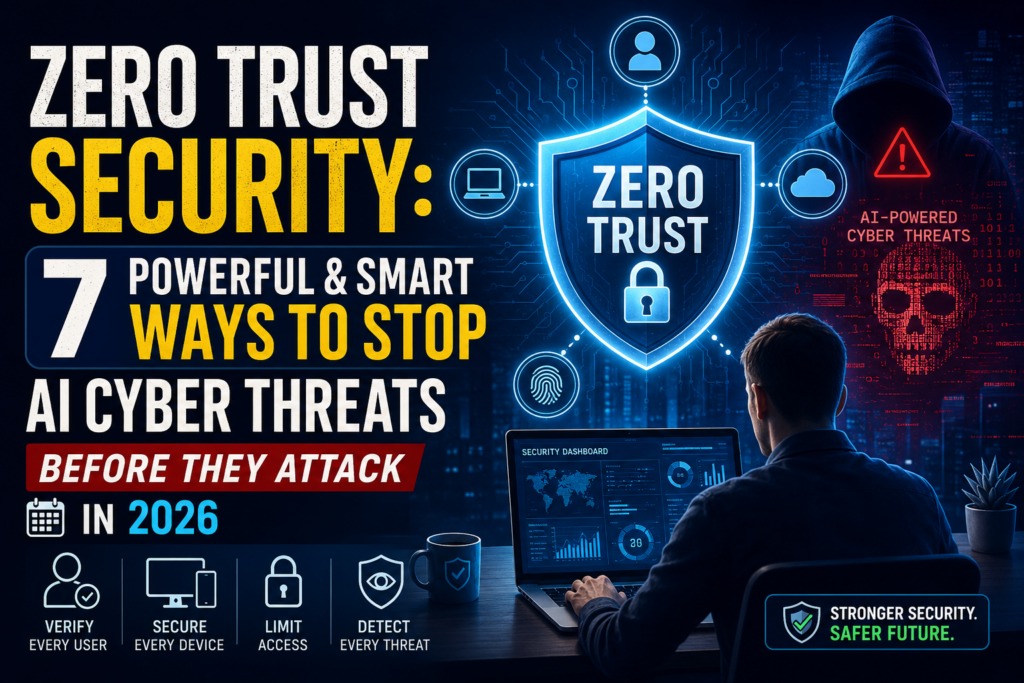
This is exactly why Zero Trust Security has become one of the most talked-about cybersecurity trends in 2026.
The traditional idea of cybersecurity was simple: once someone entered a network, they were trusted. Unfortunately, that outdated approach is failing in today’s digital environment. AI-powered cyber threats can bypass passwords, mimic human behavior, create realistic phishing scams, and even automate hacking attempts within seconds.
Now imagine a hacker gaining access to just one employee account inside a company. In older systems, that single access point could expose the entire network. That is the weakness Zero Trust Security is designed to eliminate.
The core principle behind Zero Trust is straightforward:
“Never trust, always verify.”
Every user, device, application, and network request must be verified continuously, regardless of whether it originates inside or outside the organization.
For beginners, this may sound technical, but the concept is actually practical and highly relevant to everyday internet use. Whether you own a small business, work remotely, use online banking, or simply browse social media, Zero Trust Security affects you directly.
In this guide, we will break down:
- How AI-powered cyber threats are changing cybersecurity
- Why traditional security systems are becoming obsolete
- The best Zero Trust security strategies for small businesses
- How to protect against AI-driven cyberattacks in 2026
- The seven smartest ways to stop attacks before they happen
By the end of this article, you will understand why Zero Trust Security is rapidly becoming the future of online security protection.

What Is Zero Trust Security for Beginners in 2026?
For many beginners, cybersecurity sounds complicated because of the technical language surrounding it. However, Zero Trust Security is easier to understand than most people think.
At its core, Zero Trust means that nobody gets automatic access.
Not employees.
Not devices.
Not applications.
Not even administrators.
Every access request must be verified continuously.
Think of it like airport security.
Even if you have a boarding pass, you still pass through identification checks, baggage scans, and security screening before entering restricted areas. Zero Trust applies this same logic to digital systems.
Instead of assuming users inside a network are safe, Zero Trust constantly asks questions like:
- Who is this person?
- What device are they using?
- Is the device secure?
- Is the login location suspicious?
- Is this behavior normal?
If something looks unusual, access can be denied instantly.
This modern approach became necessary because AI cyber threats are becoming more advanced every year.
How AI-Powered Cyber Threats Are Changing Cybersecurity
Artificial intelligence is transforming cybersecurity on both sides of the battle.
Security companies are using AI to detect threats faster.
Cybercriminals are using AI to launch smarter attacks.
That is what makes cybersecurity trends in 2026 both exciting and alarming.
The Rise of AI Cyber Threats
Hackers now use AI tools to:
- Create realistic phishing emails
- Generate fake voices and deepfakes
- Crack weak passwords rapidly
- Automate malware attacks
- Analyze security vulnerabilities
- Mimic legitimate user behavior
This creates a dangerous environment where traditional defenses struggle to keep up.
For example, phishing emails used to contain spelling mistakes and suspicious wording. Today, AI can generate perfectly written emails that appear completely authentic.
Some attacks even imitate the writing style of real executives or coworkers.
That means people are more likely to click malicious links or share sensitive information.
According to cybersecurity experts at IBM Security, AI-driven attacks are becoming increasingly sophisticated because automation allows cybercriminals to scale attacks globally with minimal effort.
Why Traditional Cybersecurity Is Failing in 2026
For years, cybersecurity focused heavily on perimeter protection.
The idea was simple:
- Keep hackers outside the network
- Protect the firewall
- Trust users inside the system
Unfortunately, modern cyber threats no longer operate that way.
Today’s attackers often gain access through:
- Stolen passwords
- Phishing emails
- Weak remote work security
- Compromised cloud accounts
- Third-party software vulnerabilities
Once inside, hackers can move freely across traditional networks.
This is where Zero Trust Security changes everything.
Instead of trusting users after login, Zero Trust continuously validates activity.
That means even if attackers steal credentials, their movement inside the network becomes extremely limited.
Cybersecurity Trends 2026: Why Zero Trust Security Is Exploding
Zero Trust Security has become one of the fastest-growing cybersecurity strategies globally.
Several major trends are fueling its rise.
1. Remote Work Expansion
Millions of employees now work remotely.
Traditional office-based security models no longer work effectively when users connect from homes, cafes, airports, and personal devices.
Zero Trust verifies every connection regardless of location.
2. Cloud Computing Growth
Businesses rely heavily on cloud platforms.
Sensitive data now exists across multiple applications and services rather than a single office server.
Zero Trust helps secure cloud environments more effectively.
3. AI Cyber Threats Are Evolving Rapidly
AI-generated attacks can adapt faster than traditional security tools.
Organizations need smarter defenses capable of real-time monitoring and automated verification.
4. Ransomware Attacks Are Increasing
Ransomware remains one of the biggest cybersecurity threats in 2026.
Zero Trust minimizes lateral movement, making it harder for ransomware to spread.
Table: Traditional Security vs Zero Trust Security in 2026
| Feature | Traditional Security | Zero Trust Security |
|---|---|---|
| Trust Model | Trust users inside network | Verify everyone continuously |
| Access Control | One-time login verification | Continuous authentication |
| Remote Work Security | Limited | Strong |
| AI Threat Resistance | Weak | Advanced |
| Cloud Protection | Partial | Comprehensive |
| Insider Threat Protection | Low | High |
| Real-Time Monitoring | Limited | Continuous |
| Data Segmentation | Minimal | Strong |
| Phishing Damage Control | Weak | Better containment |
| Ransomware Prevention | Reactive | Proactive |
1. Zero Trust Security Starts With Multi-Factor Authentication (MFA)
One of the simplest and most powerful ways to stop AI cyber threats is multi-factor authentication.
Passwords alone are no longer enough.
Hackers use AI tools to crack weak passwords quickly or steal credentials through phishing attacks.
MFA adds another verification layer such as:
- SMS verification codes
- Authentication apps
- Fingerprint scans
- Face recognition
- Hardware security keys
Even if hackers steal your password, they still need additional verification.
This dramatically reduces unauthorized access.
Why MFA Matters in 2026
AI-powered phishing scams are becoming highly convincing.
Hackers can now imitate company emails, login pages, and even executive voices.
MFA acts as a second security checkpoint that prevents many attacks from succeeding.
2. Best Zero Trust Security Strategies for Small Businesses Include Device Verification
Many small businesses assume hackers only target large corporations.
That is a dangerous misconception.
Cybercriminals increasingly target small businesses because their security systems are often weaker.
One infected device can expose an entire company network.
Zero Trust requires all devices to be verified before gaining access.
This includes:
- Smartphones
- Laptops
- Tablets
- Remote desktops
- IoT devices
What Device Verification Checks
A Zero Trust system may verify:
- Operating system updates
- Antivirus status
- Device location
- Suspicious behavior
- Device ownership
If a device appears compromised, access can be restricted immediately.
This proactive approach helps stop attacks before damage occurs.
3. Online Security Protection Requires Least Privilege Access
One major weakness in traditional systems is excessive access permissions.
Employees often gain access to files and systems they do not actually need.
This creates unnecessary risk.
Zero Trust follows the principle of least privilege.
That means users only access the specific resources required for their role.
Why This Matters
If attackers compromise one account, their access remains extremely limited.
Instead of reaching the entire network, they encounter multiple barriers.
This containment strategy significantly reduces damage from breaches.
4. How to Protect Against AI-Driven Cyberattacks in 2026 With Continuous Monitoring
AI-powered threats operate continuously.
Your security must do the same.
Zero Trust systems monitor activity in real time.
This includes:
- Login attempts
- File access
- Device changes
- Data transfers
- Unusual behavior patterns
AI security systems can detect suspicious behavior faster than humans.
For example:
- A login from another country
- Access requests at unusual hours
- Massive file downloads
- Repeated failed login attempts
These signs may trigger automatic security responses instantly.
5. Zero Trust Security Depends on Network Segmentation
One of the smartest cybersecurity trends in 2026 is network segmentation.
Instead of one giant network, Zero Trust divides systems into smaller protected zones.
This limits attacker movement.
Imagine a ship with multiple compartments.
If one section floods, the entire ship does not sink.
Network segmentation works similarly.
Even if hackers access one area, they cannot move freely across the entire infrastructure.
Benefits of Segmentation
- Reduces ransomware spread
- Protects sensitive data
- Limits insider threats
- Improves breach containment
- Enhances monitoring
This strategy is especially important for healthcare, finance, and e-commerce businesses.
6. AI Cyber Threats Make Employee Training More Important Than Ever
Technology alone cannot stop every cyberattack.
Human error remains one of the biggest cybersecurity risks globally.
Employees often fall victim to:
- Phishing scams
- Fake login pages
- Social engineering attacks
- Malicious attachments
AI-generated scams now appear incredibly realistic.
That means cybersecurity awareness training is essential.
Important Training Areas
Employees should learn how to:
- Identify phishing emails
- Use strong passwords
- Avoid suspicious downloads
- Secure remote devices
- Report unusual activity quickly
According to security guidance from CISA (Cybersecurity & Infrastructure Security Agency), human awareness remains a critical layer of modern cybersecurity defense.
7. Zero Trust Security Requires Strong Data Encryption
Data encryption protects information even if attackers manage to intercept it.
Encryption converts data into unreadable code unless users possess the correct decryption key.
This protects:
- Customer information
- Financial records
- Emails
- Passwords
- Cloud storage
In 2026, encryption is no longer optional.
It is essential.
AI-powered cyber threats can steal enormous amounts of information rapidly. Encryption ensures stolen data remains useless to attackers.
The Biggest AI Cyber Threats Businesses Face in 2026
Understanding the current threat landscape helps explain why Zero Trust Security matters so much.
AI-Powered Phishing
Hackers use AI to create realistic messages personalized for specific targets.
These attacks are highly convincing.
Deepfake Scams
Cybercriminals can generate fake voices or videos impersonating executives.
This can trick employees into transferring money or revealing sensitive information.
Intelligent Malware
AI-powered malware adapts dynamically to avoid detection.
Traditional antivirus software may struggle against these evolving threats.
Automated Credential Attacks
AI systems rapidly test stolen usernames and passwords across multiple platforms.
Weak password reuse becomes extremely dangerous.
Best Zero Trust Security Strategies for Small Businesses
Small businesses often assume advanced cybersecurity is too expensive.
That is no longer true.
Many affordable Zero Trust tools exist today.
Recommended Strategies
Use Cloud-Based Security Platforms
Cloud security providers offer scalable protection for smaller organizations.
Implement MFA Everywhere
Every account should require additional verification.
Secure Remote Work
Use secure VPN alternatives and identity verification systems.
Monitor Employee Activity Carefully
Continuous monitoring helps detect unusual behavior quickly.
Limit Access Permissions
Employees should only access necessary systems.
Update Software Regularly
Outdated software remains one of the biggest security weaknesses.
How Zero Trust Security Improves Online Security Protection for Everyday Users
Zero Trust is not just for corporations.
Ordinary internet users also benefit from these principles.
Everyday Applications Include
- Banking apps
- Social media accounts
- Cloud storage
- Email platforms
- Streaming services
Modern platforms increasingly use Zero Trust principles behind the scenes.
For example:
- Device verification
- Login alerts
- Biometric authentication
- Suspicious activity monitoring
These measures help protect users from account takeovers and identity theft.
The Future of Zero Trust Security Beyond 2026
Cybersecurity will continue evolving rapidly.
Several trends are expected to shape the future.
AI vs AI Cybersecurity
Security systems will increasingly use AI to fight AI-powered threats.
This creates a continuous digital arms race.
Passwordless Authentication
Passwords may gradually disappear in favor of biometrics and security keys.
Behavioral Verification
Future systems may analyze typing patterns, mouse movement, and user behavior continuously.
Stronger Global Regulations
Governments worldwide are introducing stricter cybersecurity requirements.
Organizations failing to adopt modern security standards may face severe penalties.
Common Mistakes Beginners Make With Zero Trust Security
Many organizations misunderstand Zero Trust implementation.
Mistake 1: Thinking Zero Trust Is a Single Product
Zero Trust is a strategy, not one software tool.
Mistake 2: Ignoring Employee Training
Technology alone cannot stop phishing attacks.
Mistake 3: Trusting Internal Users Automatically
Insider threats remain dangerous.
Mistake 4: Weak Password Policies
Strong authentication remains essential.
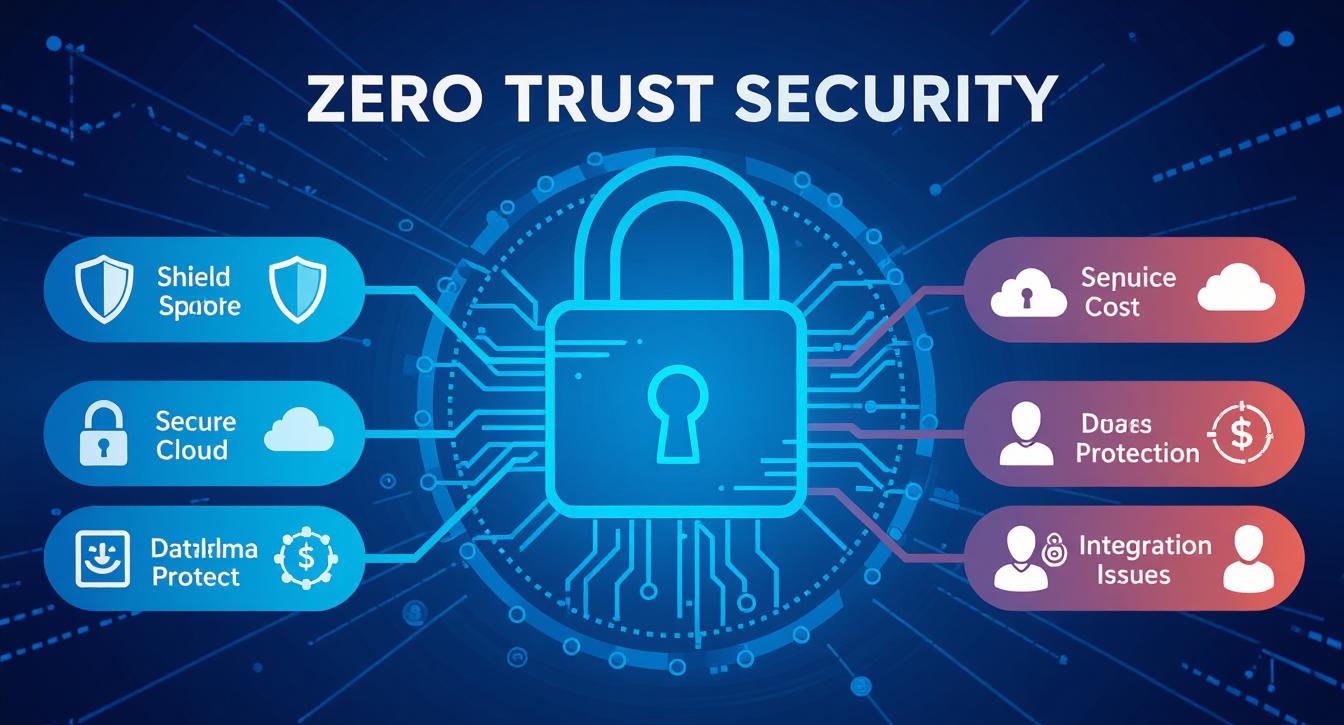
Zero Trust Security vs Traditional Cybersecurity: Which One Protects Better Against AI Cyber Threats in 2026?
Cybersecurity is changing faster than most people expected. Just a few years ago, businesses mainly worried about viruses, weak passwords, and suspicious emails. Today, the rise of AI Cyber Threats has completely transformed the digital security landscape. Attackers are now using artificial intelligence to automate hacking attempts, create convincing phishing scams, and bypass traditional defenses in ways that were almost impossible before.
This rapid evolution is forcing companies, governments, and even ordinary internet users to rethink how they approach Online Security Protection. One of the biggest debates in modern cybersecurity is whether traditional security systems are still enough or if organizations must fully adopt Zero Trust Security to survive the future of cyberattacks.
For beginners trying to understand Cybersecurity Trends 2026, the difference between these two security models can feel confusing at first. However, once you break them down, the contrast becomes very clear.
Traditional cybersecurity works like a castle protected by walls. Once someone enters the gate, they are trusted. Zero Trust Security takes a completely different approach. It assumes no user or device should ever be trusted automatically, even if they are already inside the network.
That single difference is changing the future of cybersecurity.
What Is Traditional Cybersecurity?
Traditional cybersecurity focuses heavily on perimeter defense. In simple terms, businesses create a secure boundary around their network using tools like:
- Firewalls
- Antivirus software
- Password protection
- Intrusion detection systems
- VPNs
The idea behind this model is straightforward:
Keep attackers outside the network and trust users once they are inside.
For many years, this system worked reasonably well because employees mainly worked from office locations using company-owned devices. Data stayed inside local servers, and internet threats were less advanced than they are today.
But technology evolved.
Now businesses rely on:
- Remote work environments
- Cloud storage
- Mobile devices
- Third-party applications
- AI-powered systems
As organizations became more connected, the old security perimeter started disappearing.
Unfortunately, many traditional security systems never evolved fast enough to keep up.
Why Traditional Cybersecurity Is Struggling Against AI Cyber Threats
The biggest weakness of traditional cybersecurity is trust.
Once attackers bypass the outer defense, they often gain broad access to internal systems. AI-powered hackers are exploiting this weakness aggressively in 2026.
Modern cybercriminals now use artificial intelligence to:
- Analyze vulnerabilities faster
- Automate phishing campaigns
- Mimic human communication
- Crack passwords rapidly
- Generate malware that adapts in real time
This is why How AI-powered cyber threats are changing cybersecurity has become one of the most important conversations in the tech industry.
For example, AI-generated phishing emails now look almost identical to legitimate messages. They use proper grammar, personalized details, and even realistic company branding. Employees who previously spotted suspicious emails easily are now falling victim to sophisticated AI scams.
Traditional antivirus software also struggles because modern malware can change its behavior dynamically to avoid detection.
In many cases, organizations do not realize they have been breached until weeks or even months later.
That delay can be devastating.
What Is Zero Trust Security?
Zero Trust Security was created to solve the trust problem.
Instead of automatically trusting users after login, Zero Trust continuously verifies every request, device, and activity.
The core principle is simple:
Never trust. Always verify.
This means every user must prove they are authorized every time they attempt to access systems or data.
Even employees inside the company network are treated as potential risks until verified.
For beginners, this may sound extreme at first, but it makes perfect sense in today’s threat landscape.
If AI-powered attackers can steal passwords or compromise devices, then relying on a one-time login is no longer enough.
How Zero Trust Security Works in 2026
Modern Zero Trust systems use multiple layers of verification to protect networks from evolving threats.
These layers include:
Identity Verification
Users must confirm their identity using multiple authentication methods.
Examples include:
- Passwords
- Authentication apps
- Fingerprints
- Face recognition
- Security keys
This dramatically reduces unauthorized access.
Device Verification
Zero Trust systems check whether a device is secure before granting access.
The system may analyze:
- Software updates
- Antivirus status
- Device location
- Suspicious behavior
- Operating system security
If something appears risky, access can be blocked immediately.
Least Privilege Access
Users only gain access to the specific information they need.
This limits the damage attackers can cause if an account becomes compromised.
Continuous Monitoring
Unlike traditional systems, Zero Trust continuously watches user activity in real time.
Unusual behavior can trigger alerts instantly.
For example:
- Logging in from another country
- Accessing unusual files
- Downloading excessive data
- Using unknown devices
This proactive monitoring helps stop attacks before they spread.
Zero Trust Security vs Traditional Cybersecurity: Key Differences
The differences between these two security models become even clearer when compared directly.
| Feature | Traditional Cybersecurity | Zero Trust Security |
|---|---|---|
| Trust Model | Trust users inside network | Verify everyone continuously |
| Authentication | One-time login | Continuous verification |
| Remote Work Security | Limited | Strong |
| AI Threat Protection | Reactive | Proactive |
| Insider Threat Defense | Weak | Strong |
| Cloud Security | Partial protection | Built for cloud environments |
| Data Access | Broad permissions | Least privilege access |
| Breach Containment | Difficult | Easier through segmentation |
| Monitoring | Periodic | Continuous real-time monitoring |
| Adaptability Against AI Cyber Threats | Limited | Advanced |
This comparison explains why Zero Trust Security for beginners in 2026 is becoming such an important topic.
Businesses are realizing that older security models simply cannot handle modern cyber threats effectively anymore.
Why Zero Trust Security Protects Better Against AI Cyber Threats
The reason Zero Trust performs better is because it assumes attackers may already be inside the network.
That mindset changes everything.
Traditional cybersecurity focuses mainly on prevention. Zero Trust focuses on both prevention and containment.
Even if attackers gain access:
- Their movement is restricted
- Sensitive systems remain segmented
- Suspicious behavior gets detected faster
- Permissions stay limited
This dramatically reduces the impact of breaches.
AI-powered cyberattacks thrive in environments where users and systems are trusted too easily. Zero Trust removes that automatic trust completely.
That is why many cybersecurity experts now consider Zero Trust one of the most effective defenses against next-generation attacks.
Cybersecurity Trends 2026 Are Accelerating Zero Trust Adoption
Several major trends are pushing businesses toward Zero Trust Security faster than ever before.
Remote Work Expansion
Employees now work from homes, airports, hotels, and cafes worldwide.
Traditional office-based security models no longer work effectively.
Zero Trust secures users regardless of location.
Cloud Computing Growth
Businesses increasingly rely on cloud services instead of local servers.
Zero Trust is designed specifically for modern cloud environments.
AI-Powered Cyberattacks
Attackers using artificial intelligence can launch faster and more convincing attacks.
Organizations need smarter, adaptive security systems to respond effectively.
Ransomware Growth
Ransomware attacks continue increasing globally.
Zero Trust limits lateral movement, making ransomware spread much harder.
Best Zero Trust Security Strategies for Small Businesses
Small businesses are now major targets for cybercriminals because attackers assume their defenses are weaker.
Fortunately, Zero Trust strategies are becoming more accessible and affordable.
Here are some of the best approaches for small businesses:
Enable Multi-Factor Authentication Everywhere
Passwords alone are no longer safe.
MFA provides additional protection against stolen credentials.
Restrict Employee Access
Only give employees access to the systems they truly need.
Monitor Devices Continuously
Ensure all devices meet security standards before connecting.
Use Strong Cloud Security Tools
Modern cloud security platforms often include Zero Trust features.
Train Employees Regularly
Human error remains one of the biggest cybersecurity risks.
Employees should learn how to recognize phishing attacks and suspicious activity.
How to Protect Against AI-Driven Cyberattacks in 2026
As AI threats become more intelligent, cybersecurity must become more proactive.
Here are some practical ways individuals and businesses can improve protection:
- Use password managers
- Enable multi-factor authentication
- Update software regularly
- Avoid suspicious email links
- Monitor login activity
- Use encrypted communication tools
- Segment sensitive systems
- Implement Zero Trust verification policies
These steps significantly improve overall Online Security Protection against evolving threats.
The Future Belongs to Zero Trust Security
The cybersecurity world is entering a completely new era.
AI is making cyberattacks smarter, faster, and more scalable than ever before. Traditional cybersecurity models were never designed for this level of sophistication.
That is why Zero Trust Security is rapidly becoming the future standard.
Instead of assuming users are safe after login, Zero Trust continuously validates identity, behavior, devices, and access requests in real time.
This modern approach offers stronger protection against:
- AI-generated phishing
- Credential theft
- Ransomware attacks
- Insider threats
- Cloud vulnerabilities
- Remote work security risks
For beginners trying to understand the future of cybersecurity, one reality is becoming impossible to ignore:
Traditional security is no longer enough on its own.
In 2026 and beyond, organizations that fail to adopt Zero Trust principles may struggle to defend themselves against increasingly intelligent AI cyber threats.

How AI-Powered Cyber Threats Are Targeting Remote Workers and Small Businesses in 2026
The way people work has changed dramatically over the last few years. Millions of employees now work remotely, businesses rely heavily on cloud platforms, and digital communication has become the backbone of modern operations. While this shift has created flexibility and convenience, it has also opened the door to a new generation of cybercrime powered by artificial intelligence.
In 2026, AI Cyber Threats are no longer futuristic predictions. They are happening right now, and remote workers alongside small businesses have become some of the biggest targets.
Cybercriminals understand a simple reality:
Smaller businesses and remote employees often have weaker cybersecurity defenses than large corporations.
That makes them attractive targets.
Unfortunately, the rise of artificial intelligence has made cyberattacks faster, cheaper, and far more convincing. Hackers no longer need advanced technical skills to launch sophisticated attacks. AI tools can now automate phishing campaigns, imitate human conversations, generate malicious code, and identify vulnerabilities within seconds.
This is one of the biggest reasons why Zero Trust Security has become a major focus in Cybersecurity Trends 2026.
For beginners trying to understand how AI-powered cyber threats are changing cybersecurity, it is important to recognize that the modern cyber battlefield is no longer only about hackers manually attacking systems. AI now acts like a digital weapon capable of scaling attacks globally at unprecedented speed.
And the consequences can be devastating.
Why Remote Workers Are Prime Targets for AI Cyber Threats
Remote work has permanently transformed the modern workplace.
Employees now connect from:
- Home Wi-Fi networks
- Coffee shops
- Airports
- Shared coworking spaces
- Personal mobile devices
While convenient, these environments are often far less secure than traditional office networks.
Hackers know this.
AI-driven cybercriminals actively scan for weak remote connections, vulnerable devices, and employees who may not recognize sophisticated phishing scams.
The Remote Work Security Problem
Traditional cybersecurity systems were originally designed for office-based work environments where devices and users operated within controlled networks.
Remote work changed everything.
Today:
- Employees use personal devices for work
- Sensitive data moves across cloud applications
- Public internet connections are common
- Login credentials are shared across platforms
- Security monitoring becomes harder
This creates multiple entry points for attackers.
Without proper Online Security Protection, one compromised remote worker account can expose an entire company.
How AI-Powered Cyber Threats Are Changing Cybersecurity
Artificial intelligence has fundamentally altered how cyberattacks operate.
In the past, cybercriminals often relied on manual processes that required time, effort, and technical expertise.
Now AI automates many of these tasks instantly.
This is exactly why experts say How AI-powered cyber threats are changing cybersecurity is one of the defining security conversations of this decade.
AI-Powered Phishing Attacks Are More Dangerous Than Ever
Phishing remains one of the most successful forms of cybercrime.
But in 2026, phishing has become significantly more advanced because of AI.
Older phishing emails were easier to identify because they often contained:
- Poor grammar
- Suspicious formatting
- Strange email addresses
- Obvious spelling mistakes
AI has changed that completely.
Modern AI tools can now create highly personalized phishing messages that appear authentic.
Hackers can generate emails that:
- Match company branding
- Mimic executive writing styles
- Reference real projects
- Use correct grammar
- Include personalized employee details
Some AI systems can even analyze social media profiles and public information to craft highly believable scams.
For remote workers constantly communicating online, these attacks can be extremely convincing.
Deepfake Technology Is Creating New Cybersecurity Risks
One of the most alarming cybersecurity trends in 2026 is the rise of deepfake attacks.
Deepfakes use artificial intelligence to create fake:
- Voices
- Videos
- Images
- Live conversations
Cybercriminals now use deepfake technology to impersonate company executives or managers.
Imagine receiving a video call that appears to come directly from your boss asking you to transfer money urgently or share confidential login information.
The voice sounds real.
The face looks real.
The behavior feels authentic.
But the entire interaction is fake.
This is becoming a serious problem for businesses worldwide.
Remote work environments make deepfake scams even more effective because employees communicate digitally far more often than face-to-face.
Small Businesses Are Becoming Easy Targets
Many small business owners assume hackers only target major corporations.
That assumption is dangerous.
In reality, small businesses are increasingly attractive targets because cybercriminals believe their security systems are weaker.
Small businesses often lack:
- Dedicated cybersecurity teams
- Advanced security software
- Employee training programs
- Regular security monitoring
- Strong authentication systems
Hackers understand this and actively exploit these weaknesses.
AI allows attackers to automate massive campaigns targeting thousands of businesses simultaneously.
Even a small success rate can generate enormous profits for cybercriminals.
Common AI Cyber Threats Facing Small Businesses in 2026
AI-Generated Phishing Emails
Employees receive convincing fake emails designed to steal passwords or install malware.
Automated Password Attacks
AI systems rapidly test stolen credentials across multiple platforms.
Weak password reuse becomes extremely dangerous.
Intelligent Malware
Modern malware can adapt its behavior dynamically to avoid detection.
Traditional antivirus tools may struggle to stop these threats.
Ransomware Attacks
Hackers encrypt company data and demand payment for its release.
AI helps attackers identify valuable targets faster.
Business Email Compromise (BEC)
Cybercriminals impersonate executives or vendors to trick employees into transferring money.
Why Traditional Security Is Failing Against AI Cyber Threats
Traditional cybersecurity relies heavily on perimeter protection.
The idea is simple:
Protect the outer network boundary and trust users inside.
Unfortunately, this approach struggles in modern digital environments.
Remote workers connect from multiple locations using various devices and cloud applications. The old security perimeter no longer exists in the same way.
Once attackers gain access through stolen credentials or phishing scams, traditional systems may trust them automatically.
That creates massive risks.
This is one reason why Zero Trust Security for beginners in 2026 is becoming such an important topic.
How Zero Trust Security Protects Remote Workers
Zero Trust Security assumes no user or device should ever be trusted automatically.
Instead, every access request is continuously verified.
This dramatically improves security for remote work environments.
Key Zero Trust Features That Protect Remote Workers
Multi-Factor Authentication (MFA)
Users must provide multiple forms of verification before accessing systems.
Even if passwords are stolen, attackers still face additional barriers.
Device Verification
The system checks whether devices meet security standards before granting access.
Compromised or outdated devices can be blocked instantly.
Continuous Monitoring
Zero Trust systems monitor behavior in real time.
Suspicious activity triggers immediate alerts.
Least Privilege Access
Employees only access the specific resources needed for their jobs.
This limits damage if accounts become compromised.
Network Segmentation
Sensitive systems are separated into protected zones.
Hackers cannot move freely across the entire network.
Best Zero Trust Security Strategies for Small Businesses
Small businesses do not need enormous budgets to improve cybersecurity significantly.
Many Zero Trust strategies are affordable and highly effective.
1. Enable Multi-Factor Authentication Everywhere
MFA is one of the most important defenses against AI-powered attacks.
Every critical account should require additional verification.
2. Train Employees to Recognize AI Scams
Employees should understand how modern phishing and deepfake attacks work.
Awareness reduces human error significantly.
3. Limit User Permissions
Not every employee needs access to all company systems.
Restricting access minimizes risk exposure.
4. Secure Remote Devices
Require security updates, antivirus software, and device verification before allowing access.
5. Monitor User Activity Continuously
Real-time monitoring helps detect suspicious behavior before attacks spread.
6. Back Up Data Regularly
Frequent backups reduce the impact of ransomware attacks.
Table: AI Cyber Threats vs Zero Trust Security Protection
| AI Cyber Threat | Traditional Security Weakness | Zero Trust Security Advantage |
|---|---|---|
| AI Phishing Attacks | Relies heavily on passwords | MFA reduces stolen credential risks |
| Deepfake Scams | Minimal identity verification | Continuous verification improves protection |
| Ransomware | Easy network movement | Segmentation limits spread |
| Credential Theft | Broad user access | Least privilege access reduces damage |
| Remote Device Compromise | Weak device monitoring | Device verification blocks unsafe access |
| Cloud Account Breaches | Limited cloud visibility | Continuous monitoring improves detection |
How to Protect Against AI-Driven Cyberattacks in 2026
Whether you are a business owner or remote worker, cybersecurity can no longer be treated as optional.
The threat landscape is evolving too quickly.
Here are some essential protection strategies:
Use Strong Password Managers
Password managers generate and store complex passwords securely.
Avoid Password Reuse
Using the same password across platforms increases risk dramatically.
Verify Requests Carefully
Always confirm financial requests or sensitive instructions through multiple channels.
Update Software Regularly
Security updates patch vulnerabilities before attackers exploit them.
Use Encrypted Communication Tools
Encryption helps protect sensitive information from interception.
Watch for Suspicious Behavior
Unexpected login alerts or unusual account activity should never be ignored
Cybersecurity Trends 2026 Show AI Attacks Will Continue Growing
Experts predict AI-powered cybercrime will continue expanding rapidly over the next several years.
Several factors are driving this growth:
- Increased AI accessibility
- More remote work environments
- Greater cloud dependency
- Expanding digital payment systems
- Growing amounts of online personal data
Unfortunately, attackers are innovating just as quickly as security companies.
This creates an ongoing cybersecurity arms race.
Organizations that fail to modernize their defenses may struggle to survive future threats.
The Future of Online Security Protection Belongs to Zero Trust
The cybersecurity world is moving toward a future where continuous verification becomes the standard.
Trust alone is no longer safe.
Remote work, cloud computing, and AI-powered attacks have permanently changed how organizations must think about security.
This is why Zero Trust Security is rapidly becoming the foundation of modern cybersecurity strategies.
For beginners, the most important lesson is simple:
Cybersecurity in 2026 is no longer about building bigger walls.
It is about verifying every user, every device, and every action continuously.
As AI cyber threats become smarter and more automated, businesses and remote workers that embrace Zero Trust principles will be far better prepared to defend themselves in the years ahead.
Conclusion: Why AI Cyber Threats Make Zero Trust Security Essential in 2026 and Beyond
The rise of AI Cyber Threats is completely transforming the future of digital security. In 2026, cybercriminals are no longer relying only on traditional hacking methods. They are now using artificial intelligence to automate phishing scams, launch intelligent ransomware attacks, steal credentials faster, and bypass outdated security systems with alarming speed. This is exactly why Cybersecurity Trends 2026 are heavily focused on smarter and more proactive defense strategies.
For businesses, remote workers, and everyday internet users, the message is becoming impossible to ignore: traditional cybersecurity alone is no longer enough to stop modern AI Cyber Threats.
This is where Zero Trust Security becomes critical.
Unlike older security models that automatically trust users inside a network, Zero Trust Security continuously verifies every user, every device, and every access request. That “never trust, always verify” approach is one of the strongest ways to improve Online Security Protection against modern AI-driven cyberattacks.
As more organizations adopt cloud computing, remote work systems, and AI-powered technologies, the need for Zero Trust Security for beginners in 2026 will continue growing rapidly. Businesses that fail to modernize their security strategies may struggle against increasingly advanced AI Cyber Threats that evolve faster every year.
The good news is that organizations do not need massive budgets to improve protection. Simple but powerful strategies such as:
- Multi-factor authentication
- Continuous monitoring
- Device verification
- Least privilege access
- Employee cybersecurity awareness
- Network segmentation
can dramatically reduce the risk of AI-powered attacks.
Understanding How AI-powered cyber threats are changing cybersecurity is now essential for anyone using the internet. Whether you run a small business, work remotely, manage customer data, or simply browse online daily, modern cyber risks affect everyone.
The future of Online Security Protection belongs to organizations and individuals who embrace smarter cybersecurity strategies early. That is why the Best Zero Trust security strategies for small businesses are becoming one of the most important investments for long-term digital safety.
Ultimately, learning How to protect against AI-driven cyberattacks in 2026 is no longer optional. It is becoming a survival skill in the digital age.
As AI Cyber Threats continue evolving beyond 2026, one thing is becoming very clear:
The future of cybersecurity will not be built on trust alone. It will be built on continuous verification, intelligent monitoring, and strong Zero Trust Security systems designed to stop threats before they attack.