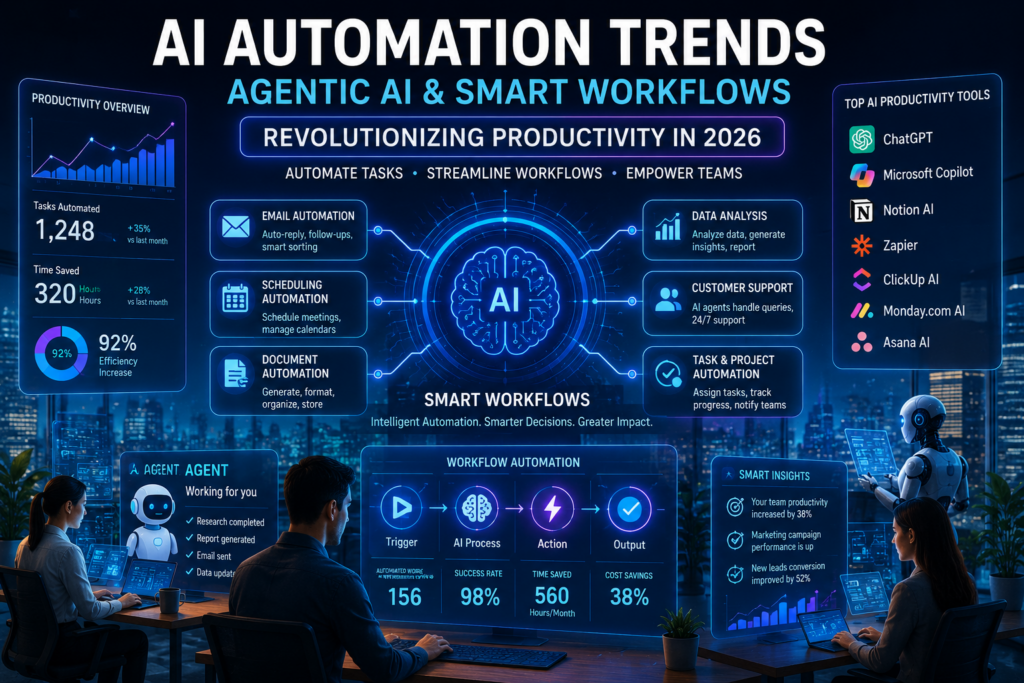
AI automation trends
For years, automation was mostly associated with repetitive factory tasks, robotic assembly lines, and software scripts that handled simple digital processes. But in 2026, the conversation has changed dramatically. We are now entering the era of Agentic AI, where intelligent systems do more than automate tasks — they make decisions, manage workflows, adapt to changing environments, and collaborate with humans almost like digital coworkers.
This shift is one of the biggest AI Automation Trends businesses have seen in decades.
Today’s AI systems can:
- Write emails
- Schedule meetings
- Analyze data
- Generate reports
- Manage customer interactions
- Build marketing campaigns
- Automate coding tasks
- Coordinate entire workflows
And the most surprising part? Many of these tasks once required entire teams.
Businesses of all sizes are now embracing Workflow Automation and AI Productivity Tools to reduce costs, improve speed, and stay competitive in an increasingly digital economy. Remote workers, startups, agencies, and enterprise companies are all benefiting from this new wave of intelligent automation.
The rise of smart workflows is not simply a temporary trend. It represents a fundamental transformation in how modern work gets done.
In this guide, we will explore the 11 most powerful AI automation trends in 2026, explain how agentic AI is replacing manual tasks, examine the top AI workflow automation tools for remote work and productivity, and look ahead to the future of AI automation and smart workflows through 2027.

What Is Agentic AI and Why Is It Becoming So Important?
Before diving into the trends, it’s important to understand what makes Agentic AI different from traditional automation.
Traditional automation follows rigid instructions.
For example:
- “If a customer submits a form, send an email.”
- “If payment is received, generate an invoice.”
Agentic AI goes much further.
It can:
- Understand context
- Make decisions
- Learn from outcomes
- Coordinate multiple tools
- Complete multi-step objectives independently
Think of it as the difference between a calculator and a virtual employee.
According to insights from IBM’s explanation of Agentic AI, these systems are designed to act autonomously toward goals instead of simply responding to commands.
This is why businesses are rapidly investing in intelligent workflow systems.
Why AI Automation Trends Matter More in 2026 Than Ever Before
Several major factors are accelerating AI adoption:
Rising Operational Costs
Businesses want to reduce expenses without sacrificing efficiency.
Remote and Hybrid Work
Distributed teams require better automation and coordination tools.
Demand for Faster Productivity
Companies now compete in real-time digital environments where speed matters.
Employee Burnout
Workers are overwhelmed with repetitive administrative tasks.
Rapid AI Advancements
Modern AI tools are becoming more affordable, accessible, and powerful.
These factors combined have created the perfect environment for AI-powered smart workflows to thrive.
Table: The Biggest AI Automation Trends in 2026
| AI Automation Trend | Main Benefit | Industries Most Affected |
|---|---|---|
| Agentic AI Assistants | Autonomous task management | Marketing, SaaS, HR |
| AI Workflow Automation | Faster operations | Finance, Logistics |
| AI Productivity Tools | Increased efficiency | Remote Work, Startups |
| Hyperautomation | End-to-end process automation | Enterprise Businesses |
| AI Customer Support Agents | 24/7 support | E-commerce, Banking |
| AI Content Automation | Faster content creation | Media, Marketing |
| AI Decision Intelligence | Better forecasting | Healthcare, Finance |
| AI Coding Assistants | Faster software development | Tech Industry |
| Predictive Automation | Reduced downtime | Manufacturing |
| AI Meeting Assistants | Smarter collaboration | Remote Teams |
| Multi-Agent AI Systems | Coordinated AI operations | Large Enterprises |
1. Agentic AI Is Becoming the New Digital Workforce
One of the biggest AI Automation Trends in 2026 is the rise of autonomous AI agents.
Unlike chatbots from previous years, modern AI agents can independently perform tasks across multiple platforms.
For example, an AI agent can:
- Read incoming emails
- Analyze customer requests
- Update CRM records
- Generate reports
- Schedule follow-ups
- Notify team members
All without human involvement.
This is dramatically changing workplace productivity.
Businesses are realizing that repetitive knowledge work can now be delegated to AI systems.
Why This Trend Is Growing Fast
Businesses Want Scalability
Hiring large teams is expensive. AI agents allow companies to scale operations without dramatically increasing payroll costs.
AI Models Are More Capable
Modern large language models now understand context far better than earlier systems.
Integration Ecosystems Are Expanding
AI systems can now connect with:
- Slack
- Notion
- Google Workspace
- Microsoft 365
- CRM software
- Project management tools
This interoperability makes AI workflows extremely powerful.
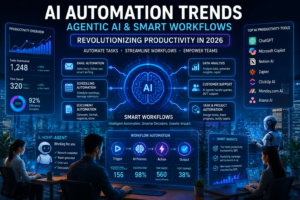
2. AI Workflow Automation Is Replacing Repetitive Manual Tasks
One of the clearest examples of how agentic AI is replacing manual tasks in 2026 is workflow automation.
Businesses are increasingly automating:
- Invoice processing
- Customer onboarding
- Data entry
- Content approvals
- Employee scheduling
- Social media publishing
- Email marketing
Instead of employees spending hours handling repetitive actions, AI systems now manage entire processes automatically.
Real-World Example
A marketing agency can now automate:
- Content planning
- SEO optimization
- Social media scheduling
- Email outreach
- Performance reporting
With minimal human intervention.
This allows teams to focus on strategy and creativity instead of administrative work.
3. AI Productivity Tools Are Transforming Remote Work
Remote work has permanently changed how organizations operate.
As a result, AI Productivity Tools have become essential for modern teams.
Today’s AI tools help remote workers:
- Summarize meetings
- Organize schedules
- Generate documents
- Manage projects
- Prioritize tasks
- Improve communication
This trend continues to grow because remote workers need digital support systems to stay efficient.
Top AI Workflow Automation Tools for Remote Work and Productivity
Some of the most popular tools in 2026 include:
- ChatGPT
- Notion AI
- Zapier AI
- ClickUp AI
- Microsoft Copilot
- Google Gemini
- Asana AI
- Monday.com AI
According to Zapier’s AI automation insights, businesses using workflow automation save countless hours every month by reducing repetitive work.
4. Hyperautomation Is Becoming a Major Business Strategy
Hyperautomation is the idea of automating everything that can reasonably be automated.
This includes:
- AI
- Machine learning
- robotic process automation
- analytics
- workflow orchestration
Large enterprises are heavily investing in hyperautomation because it improves:
- Efficiency
- Accuracy
- Customer experience
- Scalability
Why Hyperautomation Matters
Businesses no longer want isolated automation systems.
They want interconnected workflows where AI coordinates entire operations seamlessly.
This trend is expected to accelerate significantly through 2027.
5. AI Customer Service Agents Are Replacing Traditional Support Systems
Customer service is being transformed rapidly by AI.
Modern AI agents can now:
- Handle customer complaints
- Process refunds
- Recommend products
- Troubleshoot issues
- Detect customer sentiment
- Escalate complex cases
Unlike older chatbots, these systems understand natural language much better.
Benefits for Businesses
Reduced Costs
AI agents reduce the need for large support teams.
Faster Response Times
Customers receive instant assistance.
24/7 Availability
AI never sleeps.
Better Customer Experience
Modern AI systems provide more personalized support.
6. AI Content Automation Is Reshaping Digital Marketing
Content marketing has become heavily influenced by AI automation.
Businesses now use AI for:
- Blog writing
- Video scripts
- Email marketing
- Product descriptions
- SEO optimization
- Social media captions
This has dramatically increased content production speed.
However, businesses still need human oversight to maintain originality, quality, and emotional connection.
The New Human-AI Collaboration Model
The future is not humans versus AI.
It is humans working alongside AI.
Successful businesses now combine:
- Human creativity
- AI speed
- Strategic oversight
- Automated workflows
This hybrid model is proving extremely effective.
7. AI Decision Intelligence Is Helping Businesses Make Smarter Choices
Another major AI Automation Trend is decision intelligence.
AI systems now analyze enormous amounts of data and provide predictive recommendations.
For example, AI can help businesses:
- Forecast sales
- Predict customer behavior
- Identify market trends
- Optimize pricing
- Detect fraud
- Improve inventory management
This allows companies to make faster and more accurate decisions.
8. AI Coding Assistants Are Accelerating Software Development
Developers are now using AI coding assistants daily.
These tools help with:
- Code generation
- Bug fixing
- Documentation
- Testing
- Optimization
This trend is increasing developer productivity significantly.
Instead of replacing programmers, AI is allowing developers to focus on higher-level problem-solving.
Why This Matters
Software development cycles are becoming shorter.
Businesses can now:
- Launch products faster
- Reduce engineering bottlenecks
- Improve software quality
This creates a major competitive advantage.
9. Predictive Automation Is Reducing Operational Risks
Predictive automation combines AI forecasting with workflow automation.
This allows businesses to predict problems before they occur.
Examples include:
- Predicting machine failures
- Detecting cybersecurity threats
- Forecasting inventory shortages
- Identifying customer churn
This proactive approach helps companies reduce downtime and improve efficiency.
10. AI Meeting Assistants Are Revolutionizing Collaboration
Meetings are becoming smarter thanks to AI.
Modern AI meeting tools can:
- Record discussions
- Generate summaries
- Extract action items
- Schedule follow-ups
- Translate conversations
- Create searchable transcripts
Remote teams especially benefit from these features.
Employees no longer need to spend hours reviewing meeting notes.
11. Multi-Agent AI Systems Are the Future of Smart Workflows Through 2027
Perhaps the most exciting development is the rise of multi-agent AI systems.
Instead of one AI handling tasks independently, multiple AI agents collaborate together.
For example:
- One AI researches data
- Another writes reports
- Another analyzes performance
- Another coordinates communication
This creates highly sophisticated automated ecosystems.
The Future of AI Automation and Smart Workflows Through 2027
Experts predict that by 2027:
- AI agents will manage entire departments
- Businesses will rely heavily on autonomous workflows
- Human workers will focus more on creativity and leadership
- AI collaboration systems will become standard in most industries
This evolution could redefine workplace productivity entirely.
The Benefits of AI Automation Trends for Businesses
Businesses adopting AI automation are already seeing major advantages.
Increased Productivity
AI handles repetitive tasks faster than humans.
Lower Costs
Automation reduces operational expenses.
Better Accuracy
AI minimizes human error.
Faster Decision-Making
AI analyzes data instantly.
Improved Employee Satisfaction
Workers spend less time on boring administrative tasks.
Challenges Businesses Must Consider
Despite the excitement around AI, businesses must also prepare for challenges.
Data Privacy Concerns
AI systems require access to sensitive data.
Workforce Adaptation
Employees need training to work alongside AI.
Ethical Concerns
Businesses must use AI responsibly.
Overdependence on Automation
Human oversight remains important.
The companies that balance automation with human judgment will likely achieve the best results.

How Small Businesses Can Benefit From AI Automation Trends
AI is no longer limited to large corporations.
Small businesses can now access affordable AI tools that improve operations significantly.
https://www.microsoft.com/en-us/microsoft-copilot
Practical Examples
E-commerce Stores
- AI customer support
- Automated inventory updates
- AI product recommendations
Freelancers
- AI writing assistants
- Automated scheduling
- Proposal generation
Agencies
- Automated marketing workflows
- AI reporting dashboards
- Content generation
The accessibility of AI tools is one reason adoption continues growing rapidly.
How to Prepare for the Future of AI Automation
Businesses should not wait too long before exploring AI automation.
Start Small
Begin with simple workflow automation.
Identify Repetitive Tasks
Look for time-consuming manual processes.
Train Employees
Help teams understand AI tools.
Focus on Human-AI Collaboration
Use AI to support employees, not replace all human involvement.
Continuously Adapt
AI technology evolves rapidly.
Companies that remain flexible will benefit most.
AI Automation Trends Are Transforming Modern Workplaces in 2026
The modern workplace in 2026 looks very different from what many people imagined just a few years ago. Businesses are no longer relying solely on traditional software systems or manual operations to stay productive. Instead, companies across different industries are embracing intelligent automation technologies that simplify daily operations, improve efficiency, and help teams focus on more meaningful work.
What makes this shift so significant is that automation is no longer limited to repetitive factory tasks or basic digital processes. Today’s systems are capable of handling communication, organizing workflows, analyzing information, and even assisting with decision-making. This evolution is reshaping how employees work, how businesses grow, and how customers experience services.
For many organizations, the goal is no longer simply “working harder.” The focus has shifted toward building smarter systems that save time, reduce unnecessary stress, and allow people to concentrate on creativity, strategy, and innovation.
Businesses Are Moving Away From Repetitive Manual Operations
One of the biggest workplace changes happening right now is the reduction of repetitive administrative work. Employees used to spend large portions of their day handling tasks such as:
- Sorting emails
- Updating spreadsheets
- Scheduling meetings
- Processing invoices
- Managing customer inquiries
- Preparing reports
- Organizing project updates
While these activities are necessary, they can consume valuable time and energy. Modern automation tools are helping businesses reduce this burden by handling many of these responsibilities automatically.
For example, a company can now use intelligent workflow systems to:
- Route customer requests to the right department
- Generate performance reports instantly
- Send automated follow-up emails
- Organize project deadlines
- Manage employee onboarding processes
This allows workers to dedicate more attention to problem-solving, communication, and strategic planning rather than repetitive operational duties.
Workplace Productivity Is Becoming More Efficient
Efficiency has become one of the most important priorities for modern businesses. Companies want faster results without overwhelming employees or increasing operational complexity.
Automation technologies are helping organizations achieve this balance in several ways:
Faster Task Completion
Processes that previously took hours can now be completed in minutes. Data entry, content scheduling, and document management are becoming far more streamlined.
Improved Accuracy
Human error is common when employees repeat the same tasks continuously. Automated systems help reduce mistakes, especially in areas like financial processing, inventory management, and reporting.
Better Time Management
Teams can organize workloads more effectively because many systems now prioritize tasks automatically and provide real-time workflow updates.
Stronger Collaboration
Remote and hybrid teams benefit from tools that centralize communication, task tracking, and file sharing in one place.
As businesses continue adapting to digital work environments, efficiency is becoming less about working longer hours and more about using smarter systems that improve overall performance.https://aws.amazon.com/ai/
Small Businesses Are Benefiting Alongside Large Companies
A few years ago, advanced automation systems were mostly available to large enterprises with massive budgets. That is no longer the case.
In 2026, smaller businesses and startups have access to affordable tools that help them compete more effectively. Many cloud-based platforms now offer automation features that are simple to use and require little technical expertise.
Small business owners are using these tools to:
- Automate appointment scheduling
- Manage customer relationships
- Track inventory
- Handle marketing campaigns
- Organize accounting processes
- Improve customer support response times
This accessibility is creating new opportunities for entrepreneurs who want to grow without hiring large operational teams.
For startups especially, automation has become a major advantage because it allows lean teams to operate with greater speed and flexibility.
Remote Work Has Accelerated Digital Transformation
The growth of remote and hybrid work environments has also contributed to the rapid adoption of intelligent workplace systems.
Managing distributed teams can be difficult when communication, scheduling, and collaboration happen across different locations and time zones. Businesses now rely heavily on digital platforms that automate coordination and simplify team management.
Modern workplace systems can now:
- Summarize meetings automatically
- Track project progress in real time
- Generate reminders for deadlines
- Organize team communication channels
- Assist with workflow approvals
This reduces confusion and helps remote teams remain productive even when employees are working from different parts of the world.
More importantly, these systems help reduce burnout by eliminating some of the repetitive administrative work that often slows down remote collaboration.
Employees Are Shifting Toward Higher-Value Work
One concern people often have about automation is whether technology will completely replace human workers. In reality, many businesses are discovering that automation works best when it supports employees rather than replacing them entirely.
As repetitive work becomes automated, employees are spending more time on areas where human skills remain essential, including:
- Creative thinking
- Leadership
- Emotional intelligence
- Relationship building
- Strategic planning
- Innovation
This shift is creating a new workplace model where humans and intelligent systems work together instead of competing against each other.
In many industries, automation is helping employees become more productive and less overwhelmed rather than eliminating jobs altogether.
Industries Experiencing the Biggest Workplace Changes
Almost every industry is experiencing some level of transformation, but certain sectors are moving particularly quickly.
Marketing and Media
Teams use automation tools for content planning, campaign management, and audience analysis.
Healthcare
Hospitals and clinics use intelligent systems for appointment scheduling, patient record management, and administrative support.
Finance
Banks and financial institutions automate fraud detection, reporting, and transaction monitoring.
E-Commerce
Online stores rely on automation for customer support, inventory updates, and personalized recommendations.
Human Resources
HR departments use smart systems to streamline hiring, onboarding, and employee communication.
The widespread adoption of these technologies shows that automation is no longer a niche business strategy. It is becoming part of everyday operations across multiple industries.
The Workplace of the Future Is Being Built Right Now
What makes 2026 especially important is that businesses are no longer experimenting cautiously with automation. Many organizations are now integrating these systems directly into their core operations.
Companies that adapt quickly are gaining important advantages such as:
- Faster growth
- Lower operational costs
- Improved customer experiences
- Better team productivity
- Stronger scalability
At the same time, employees are learning how to collaborate more effectively with intelligent tools rather than viewing them as threats.
This transition represents one of the biggest workplace shifts of the digital era. The businesses that embrace these changes thoughtfully will likely be better prepared for the future of work as automation technologies continue evolving through 2027 and beyond.
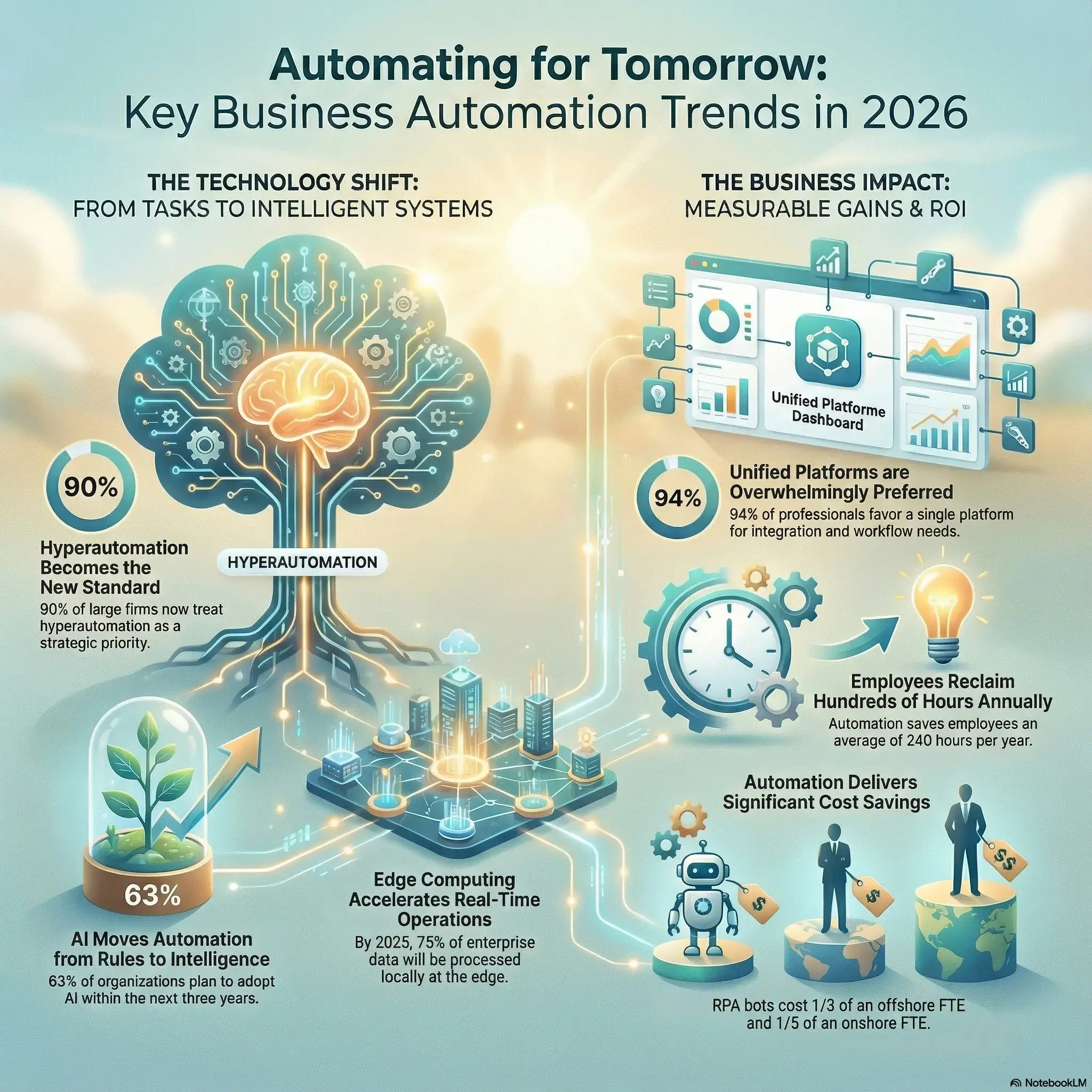
Final Thoughts: AI Automation Trends Are Defining the Future of Work
The workplace is changing faster than many people expected.
What once seemed futuristic is now becoming everyday reality.
From Agentic AI to intelligent workflow systems, businesses are discovering new ways to improve productivity, reduce manual labor, and scale operations efficiently.
The biggest takeaway is this:
AI is no longer just a tool. It is becoming an active participant in how work gets done.
The organizations that embrace these changes early will likely gain major advantages in productivity, innovation, and competitiveness.
As we move deeper into 2026 and toward 2027, one thing is becoming increasingly clear:
Smart workflows and AI automation are not temporary trends — they are the future foundation of modern business operations.