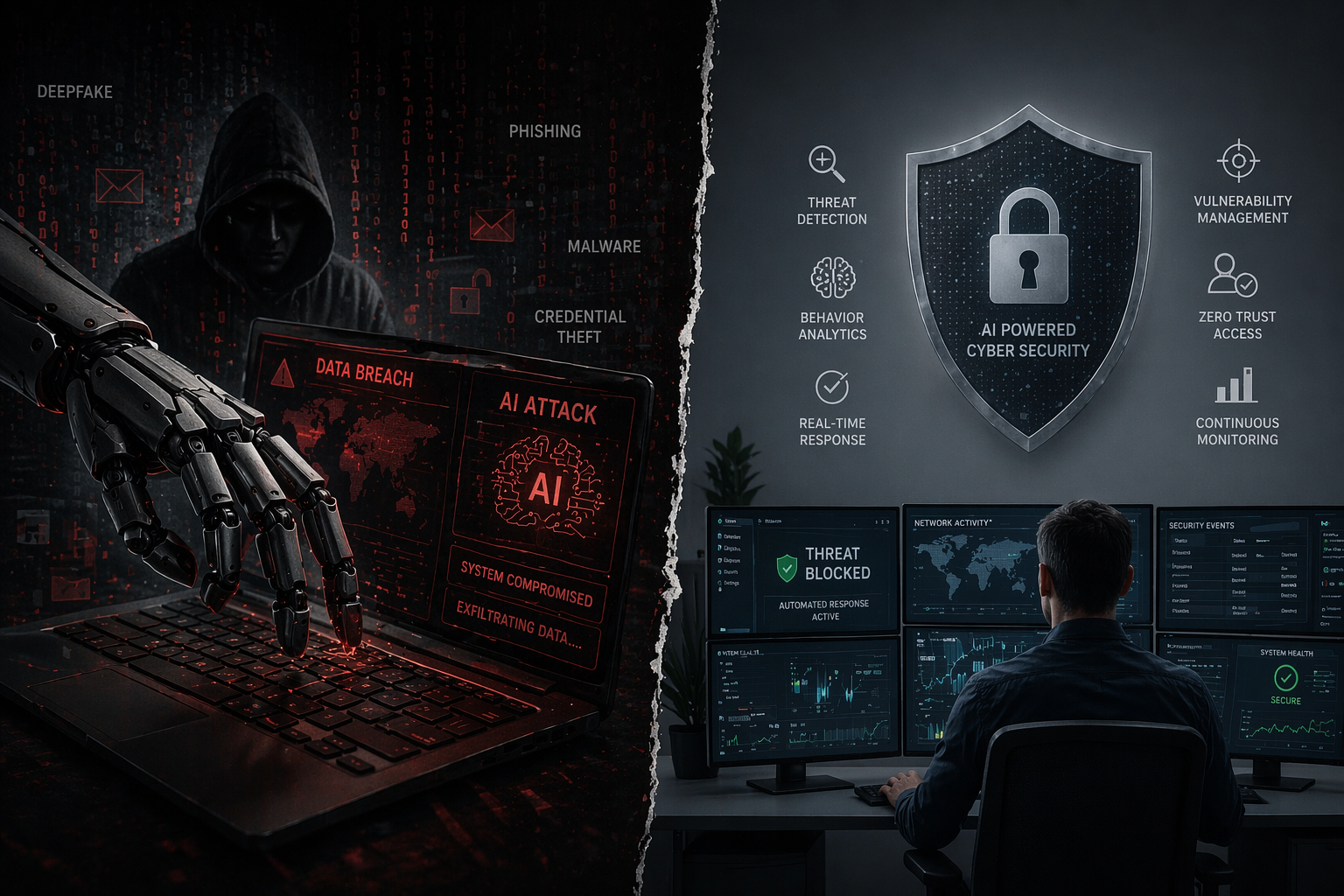
AI Cyber Attacks Are Changing the Game
There’s no denying it—AI cyber attacks are no longer a futuristic concept. They are happening right now, and they’re evolving faster than most people can keep up with. In 2026, hackers are no longer just skilled individuals typing away in dark rooms. They are leveraging powerful AI hacking tools to automate attacks, analyze vulnerabilities, and exploit systems at a scale we’ve never seen before.
What makes this shift particularly alarming is how accessible these tools have become. Tasks that once required deep technical expertise can now be executed with minimal effort, thanks to artificial intelligence. From phishing emails that sound eerily human to malware that adapts in real time, the landscape of cybersecurity threats 2026 is more complex than ever.
But here’s the good news: understanding how these attacks work gives you the upper hand. This guide will walk you through 10 shocking secrets behind modern AI-driven cybercrime and, more importantly, how you can stay safe.

Understanding AI Cyber Attacks in 2026
What Are AI Cyber Attacks?
At their core, AI cyber attacks are malicious activities powered or enhanced by artificial intelligence. These attacks use machine learning algorithms to:
- Analyze massive datasets quickly
- Identify system vulnerabilities
- Automate attack execution
- Adapt strategies in real time
Unlike traditional attacks, AI-driven threats are smarter, faster, and more scalable.
How Hackers Use AI to Steal Data in 2026
Understanding how hackers use AI to steal data in 2026 is crucial for effective data breach prevention. Here are some of the most common tactics:
- AI-generated phishing emails that mimic real communication styles
- Deepfake technology to impersonate executives or trusted contacts
- Automated vulnerability scanning tools
- AI-powered password cracking systems
- Behavioral analysis to bypass security systems
A helpful breakdown of modern cybersecurity risks can be found at
https://www.ibm.com/topics/cybersecurity
Table: Traditional vs AI-Powered Cyber Attacks
| Feature | Traditional Cyber Attacks | AI Cyber Attacks |
|---|---|---|
| Speed | Slow, manual execution | Extremely fast and automated |
| Accuracy | Limited targeting | Highly precise targeting |
| Adaptability | Static methods | Self-learning and adaptive |
| Scale | Limited reach | Massive, global scale |
| Detection | Easier to detect | Harder due to sophistication |
AI Cyber Attacks: 10 Shocking Secrets You Must Know
1. AI Cyber Attacks Can Learn From Your Behavior
Modern AI systems analyze user behavior patterns such as login times, typing speed, and browsing habits. Hackers use this data to mimic legitimate users.
Prevention Tips
- Use multi-factor authentication (MFA)
- Monitor unusual login behavior
- Avoid predictable routines online
2. AI Hacking Tools Make Attacks Fully Automated
One of the biggest cybersecurity threats 2026 is automation. Hackers can launch thousands of attacks simultaneously using AI.
Prevention Tips
- Invest in AI-based security tools
- Regularly update systems
- Conduct automated security scans
3. AI-Powered Phishing Is Almost Impossible to Detect
Gone are the days of poorly written scam emails. AI now generates perfectly crafted messages tailored to individuals.
Prevention Tips
- Double-check email sources
- Avoid clicking unknown links
- Use advanced spam filters
4. Deepfake Technology Is Fueling Data Breaches
Hackers use AI-generated voices and videos to trick employees into revealing sensitive data.
Prevention Tips
- Verify requests through multiple channels
- Train employees on deepfake risks
- Implement strict verification protocols
5. AI Can Crack Passwords Faster Than Ever
AI-powered systems can test billions of password combinations in seconds.
Prevention Tips
- Use strong, unique passwords
- Enable password managers
- Implement biometric authentication
6. AI Malware Evolves in Real Time
Unlike traditional malware, AI-driven malware adapts to security measures.
Prevention Tips
- Use real-time threat detection tools
- Keep antivirus updated
- Monitor system anomalies
7. AI Exploits Human Psychology
AI doesn’t just target systems—it targets people. It analyzes emotional triggers to craft convincing scams.
Prevention Tips
- Stay skeptical of urgent requests
- Avoid emotional decision-making online
- Educate teams on social engineering
8. Businesses Are Prime Targets in 2026
The latest AI cybersecurity threats businesses must prepare for in 2026 include targeted attacks on corporate systems.
Prevention Tips
- Implement zero-trust security models
- Conduct regular audits
- Train employees continuously
For deeper insights into enterprise-level protection strategies:
https://www.cisa.gov/cybersecurity
9. AI Cyber Attacks Are Harder to Detect
AI can disguise attacks to look like normal activity, making detection extremely difficult.
Prevention Tips
- Use AI-driven threat detection
- Monitor network traffic closely
- Analyze behavioral patterns
10. Prevention Requires AI Too
The only way to fight AI is with AI. Modern security systems use machine learning to detect and stop threats.
How to Protect Against Automated Data Breaches Using AI Security Tools
- Deploy AI-based intrusion detection systems
- Use predictive analytics
- Automate response strategies
AI-Powered Cyber Attacks Examples and Prevention Tips
Here are real-world-style scenarios:
Example 1: AI Phishing Attack
A fake email from your “bank” asks you to verify your account.
Solution: Always verify through official channels.
Example 2: Deepfake CEO Fraud
An employee receives a video call from a “CEO” requesting urgent payment.
Solution: Confirm requests via internal communication systems.
Example 3: Automated Data Breach
AI scans a company’s system and finds weak endpoints.
Solution: Conduct regular penetration testing.
How to Protect Against AI Cyber Attacks in 2026 and Beyond
Essential Strategies for Data Breach Prevention
- Adopt Zero Trust Architecture
- Use AI-powered cybersecurity tools
- Train employees regularly
- Encrypt sensitive data
- Monitor systems 24/7
Key Tools to Consider
- AI threat detection software
- Endpoint security platforms
- Cloud security solutions
- Identity and access management systems
How Hackers Use AI to Steal Data in 2026
If you think cybercrime is still about lone hackers manually breaking into systems, 2026 tells a very different story. Today’s AI cyber attacks are powered by intelligent systems that can think, learn, and adapt—often faster than the defenses designed to stop them. Understanding how hackers use AI to steal data in 2026 is no longer optional; it’s the foundation of effective data breach prevention.
Let’s walk through what’s really happening behind the scenes—and why it matters to you.
The Shift From Manual Hacking to Intelligent Automation
In the past, launching a cyberattack required time, skill, and persistence. Hackers had to manually scan systems, write code, and test vulnerabilities. Now, AI hacking tools have changed everything.
With AI, attackers can:
- Scan thousands of systems in minutes
- Identify weak points automatically
- Launch attacks without human intervention
- Continuously improve their methods based on success rates
This shift means attacks are not just faster—they’re smarter and more precise.
How AI Identifies and Exploits Vulnerabilities
One of the most dangerous aspects of AI cyber attacks is how efficiently AI can discover vulnerabilities.
Instead of guessing, AI systems:
- Analyze massive datasets of previous breaches
- Learn common patterns in weak security systems
- Predict where new vulnerabilities are likely to exist
For example, an AI system can scan a company’s network and instantly detect:
- Outdated software
- Weak authentication protocols
- Misconfigured cloud settings
Once a vulnerability is found, the AI doesn’t wait—it exploits it immediately. This is why cybersecurity threats 2026 are so difficult to manage.
AI-Powered Phishing: Smarter, More Personal Attacks
Phishing has evolved dramatically. In 2026, it’s no longer about generic “You’ve won a prize” emails.
AI now enables:
- Personalized messages based on social media data
- Perfect grammar and natural tone
- Context-aware conversations that feel real
Imagine receiving an email that references your recent online activity or even mimics your boss’s writing style. That’s the reality of AI-powered cyber attacks examples and prevention tips in action.
These attacks are effective because they:
- Build trust quickly
- Avoid suspicion
- Trigger emotional responses
And once a victim clicks a link or shares credentials, the data breach begins.
Deepfake Technology: When Seeing Is No Longer Believing
Another alarming way hackers use AI is through deepfake technology. This goes beyond text—AI can now replicate voices and faces with shocking accuracy.
Hackers use deepfakes to:
- Impersonate executives during video calls
- Send fake voice messages requesting sensitive data
- Trick employees into approving transactions
This tactic is especially dangerous for businesses, making it one of the latest AI cybersecurity threats businesses must prepare for in 2026.
AI in Password Cracking and Credential Theft
Passwords are still a primary line of defense—but AI is making them easier to break.
Modern AI hacking tools can:
- Analyze leaked password databases
- Predict password patterns
- Test millions (or billions) of combinations instantly
This means weak or reused passwords are almost guaranteed to be compromised.
Even more concerning, AI can:
- Monitor login behavior
- Mimic user patterns
- Bypass detection systems
This is why traditional password security alone is no longer enough for data breach prevention.
Automated Malware That Learns and Adapts
Malware has also evolved. In 2026, it’s no longer static—it’s intelligent.
AI-driven malware can:
- Change its code to avoid detection
- Learn from failed attacks
- Adjust strategies in real time
For example:
- If antivirus software blocks one method, the malware tries another
- If a system detects unusual behavior, the malware slows down to remain hidden
This adaptability makes AI cyber attacks incredibly difficult to stop once they begin.Social Engineering Meets Artificial Intelligence
One of the most underestimated threats is how AI enhances social engineering.
Hackers now use AI to:
- Analyze personality traits from online activity
- Identify emotional triggers
- Craft messages that manipulate behavior
For instance:
- Urgent messages that create panic
- Friendly tones that build trust
- Authority-based requests that demand compliance
These tactics exploit human psychology, making them highly effective and a key part of how hackers use AI to steal data in 2026.
The Role of Data in Fueling AI Attacks
AI thrives on data—and ironically, the more data available online, the more powerful these attacks become.
Hackers collect data from:
- Social media profiles
- Public databases
- Previous data breaches
This information helps AI systems:
- Build detailed profiles of targets
- Customize attacks
- Increase success rates dramatically
In essence, your digital footprint becomes a roadmap for attackers.
Why AI Cyber Attacks Are So Hard to Detect
Traditional security systems rely on recognizing known threats. But AI changes the rules.
AI attacks:
- Don’t follow predictable patterns
- Continuously evolve
- Blend in with normal activity
This makes them:
- Harder to identify
- Faster to execute
- More damaging overall
It’s a major reason why cybersecurity threats 2026 are considered more dangerous than ever before.
Key Takeaways: Staying One Step Ahead
Understanding how hackers use AI to steal data in 2026 gives you a powerful advantage. While the technology behind these attacks is complex, the core idea is simple: automation + intelligence = scale and precision.
To protect yourself, remember:
- AI-driven attacks are fast—so your response must be faster
- Human error is still the biggest vulnerability
- Proactive security is far more effective than reactive fixes
The rise of AI cyber attacks marks a turning point in cybersecurity. Hackers are no longer just exploiting systems—they’re leveraging intelligence to outsmart them.
But awareness changes everything.
By understanding these tactics, you’re not just another target—you’re someone who sees the threat coming and knows how to respond. And in a world driven by AI, that awareness is your strongest defense.
AI Cyber Attacks and the Latest Cybersecurity Threats 2026 You Must Know
If subtopic one revealed how attacks happen, this section focuses on what’s coming next. The reality is simple: AI cyber attacks are evolving so quickly that what worked last year may already be outdated today. The cybersecurity threats 2026 landscape is defined by speed, automation, and a level of sophistication that often blurs the line between human and machine behavior.
To stay protected, you need a clear understanding of the latest AI cybersecurity threats businesses must prepare for in 2026—not just in theory, but in real-world application.
Why Cybersecurity Threats in 2026 Are Different
Traditional cyber threats were reactive. Hackers would try something, wait for results, then adjust. In 2026, AI has flipped that model entirely.
Today’s threats are:
- Predictive – AI anticipates vulnerabilities before they are exploited
- Adaptive – Attacks evolve mid-execution
- Scalable – One system can target thousands of victims simultaneously
- Personalized – Each attack is tailored to its target
This transformation is largely driven by the widespread availability of AI hacking tools, which allow even low-skilled attackers to execute highly advanced operations.
1. AI-Driven Phishing Campaigns Are More Convincing Than Ever
Phishing remains one of the most effective attack methods—but AI has made it significantly more dangerous.
Instead of generic emails, attackers now use AI to:
- Study your communication patterns
- Mimic writing styles of trusted contacts
- Reference real events from your digital life
These messages feel authentic because they are built from real data. This makes them a major contributor to data breach prevention challenges.
What makes this threat unique in 2026:
- Near-perfect language and tone
- Real-time conversation capabilities (chat-based phishing)
- Multi-channel attacks (email, SMS, social media)
2. Deepfake Identity Attacks Are Becoming Mainstream
One of the most alarming cybersecurity threats 2026 is the rise of deepfake-based fraud.
AI can now generate:
- Realistic voice clones
- Video impersonations
- Synthetic identities
Imagine receiving a voice note from your CEO asking for urgent access to sensitive data—it sounds exactly like them. This is no longer hypothetical.
For businesses, this represents one of the latest AI cybersecurity threats businesses must prepare for in 2026, especially in finance, HR, and executive communications.
3. AI-Powered Malware That Thinks for Itself
Malware used to be static—once detected, it could be removed. Not anymore.
AI-driven malware now:
- Learns from failed attempts
- Changes its code to avoid detection
- Adjusts behavior based on the environment
This creates a moving target for cybersecurity systems, making AI cyber attacks far more persistent and damaging.
4. Automated Vulnerability Exploitation at Scale
One of the biggest shifts in 2026 is how quickly vulnerabilities are exploited.
Using AI hacking tools, attackers can:
- Scan millions of systems globally
- Identify weaknesses instantly
- Launch coordinated attacks within minutes
This reduces the window for response, making data breach prevention more urgent than ever.
5. AI-Enhanced Social Engineering Attacks
Social engineering has always relied on human psychology—but AI has refined it into a science.
Attackers now use AI to:
- Analyze personality traits
- Identify emotional triggers
- Craft highly persuasive messages
For example:
- Urgent financial requests during stressful times
- Friendly messages that build trust over time
- Authority-based instructions that feel legitimate
These tactics are subtle, effective, and increasingly common in AI cyber attacks.
6. Cloud Security Exploits Are Rising Rapidly
As more businesses move to the cloud, attackers are following closely behind.
AI systems can:
- Detect misconfigured cloud settings
- Identify weak access controls
- Exploit vulnerabilities across multiple platforms
This makes cloud environments a key focus in the latest AI cybersecurity threats businesses must prepare for in 2026.
7. AI-Powered Credential Stuffing and Account Takeovers
Credential theft is still one of the easiest ways into a system—but AI has made it faster and more efficient.
Attackers use AI to:
- Analyze leaked credentials
- Predict password variations
- Automate login attempts across platforms
This results in:
- Higher success rates
- Faster account takeovers
- Increased financial and data loss
8. Data Poisoning Attacks on AI Systems
Here’s a lesser-known but critical threat: attackers are now targeting AI itself.
Data poisoning involves:
- Feeding incorrect data into AI systems
- Manipulating outcomes
- Causing systems to make flawed decisions
For businesses relying on AI, this can lead to:
- Incorrect analytics
- Security blind spots
- Compromised decision-making
9. AI-Driven Ransomware Evolution
Ransomware is not new—but AI has made it smarter.
Modern ransomware can:
- Identify the most valuable data to encrypt
- Adjust ransom demands based on the victim
- Avoid detection until maximum damage is done
This makes it one of the most financially damaging cybersecurity threats 2026.
10. The Rise of Autonomous Cyber Attacks
Perhaps the most concerning trend is the emergence of fully autonomous attacks.
These systems can:
- Plan attacks
- Execute them
- Adjust strategies without human input
This level of independence represents a new era of AI cyber attacks, where threats operate continuously and intelligently.
Why Businesses Must Pay Attention Now
The latest AI cybersecurity threats businesses must prepare for in 2026 are not just technical challenges—they are strategic risks.
A single breach can lead to:
- Financial loss
- Reputation damage
- Legal consequences
- Loss of customer trust
And because AI attacks scale so easily, even small businesses are now prime targets.
Key Takeaways: Navigating Cybersecurity Threats 2026
To stay ahead of these evolving threats:
- Adopt AI-powered security solutions to match the sophistication of attackers
- Train employees regularly to recognize modern attack patterns
- Implement strong access controls across all systems
- Continuously monitor and update security protocols
The landscape of AI cyber attacks in 2026 is both complex and rapidly evolving. What makes these threats particularly dangerous is not just their technical capability, but their ability to blend seamlessly into everyday digital interactions.
But there’s a silver lining—awareness is a powerful defense.
By understanding the cybersecurity threats 2026 brings, you’re not just reacting to risks—you’re preparing for them. And in a world where AI is shaping both attacks and defenses, that preparation makes all the difference.

AI Cyber Attacks: AI-Powered Cyber Attacks Examples and Prevention Tips
Understanding theory is helpful—but seeing how AI cyber attacks play out in real-world situations is what truly sharpens your awareness. In 2026, these attacks are no longer abstract concepts; they are happening daily, affecting individuals, startups, and global enterprises alike.
In this section, we’ll walk through AI-powered cyber attacks examples and prevention tips, breaking each scenario down in a way that feels relatable and practical. The goal is simple: help you recognize these threats early and respond effectively.
Example 1: AI-Generated Phishing That Feels Personal
What Happens
You receive an email that appears to be from your bank. It addresses you by name, references a recent transaction, and asks you to confirm your account details. Everything looks legitimate—logo, tone, even the timing.
Behind the scenes, AI has:
- Scraped your data from previous leaks or social platforms
- Analyzed your transaction habits
- Crafted a message tailored specifically to you
This is one of the most common ways how hackers use AI to steal data in 2026.
Why It Works
- The message feels familiar and urgent
- It uses accurate personal details
- It mimics trusted communication patterns
Prevention Tips
- Never click links directly from emails—visit official websites instead
- Enable multi-factor authentication (MFA)
- Use spam filters powered by AI for better data breach prevention
Example 2: Deepfake Voice Scam Targeting Employees
What Happens
An employee receives a voice message from what sounds like their CEO requesting urgent access to confidential data or approval for a payment.
The voice is convincing because AI has:
- Cloned speech patterns from public recordings
- Recreated tone, pitch, and emotion
This is quickly becoming one of the latest AI cybersecurity threats businesses must prepare for in 2026.
Why It Works
- It exploits authority and urgency
- The voice sounds authentic
- Employees may hesitate to question leadership
Prevention Tips
- Always verify sensitive requests through a second channel
- Establish strict internal approval processes
- Train staff to recognize deepfake risks
Example 3: AI-Powered Password Cracking
What Happens
Hackers use advanced AI hacking tools to analyze millions of leaked passwords and predict patterns. If you reuse passwords or rely on simple combinations, your account becomes an easy target.
AI systems can:
- Learn common password structures
- Predict variations of your existing passwords
- Test combinations at lightning speed
Why It Works
- Many users reuse passwords
- Weak passwords are still common
- Traditional defenses can’t keep up with AI speed
Prevention Tips
- Use strong, unique passwords for every account
- Adopt a password manager
- Enable biometric or multi-factor authentication
Example 4: Automated Data Breach Through Vulnerability Scanning
What Happens
A company’s system has a minor security flaw—something that might go unnoticed for weeks. An AI system scans the network, identifies the vulnerability, and exploits it within minutes.
This is a classic example of AI cyber attacks operating at scale.
Why It Works
- AI detects vulnerabilities faster than humans
- Exploitation happens instantly
- Businesses often delay updates or patches
Prevention Tips
- Run regular automated security scans
- Keep all software updated
- Use AI-driven monitoring tools for continuous protection
Example 5: AI Malware That Adapts to Security Systems
What Happens
Malware enters a system and begins to operate quietly. When detected, it changes its behavior to avoid removal.
This type of attack represents the evolving nature of cybersecurity threats 2026.
Why It Works
- The malware learns from detection attempts
- It modifies its code in real time
- Traditional antivirus tools struggle to keep up
Prevention Tips
- Use advanced endpoint protection systems
- Monitor unusual system behavior
- Implement real-time threat detection
Example 6: AI Social Engineering Through Chatbots
What Happens
You engage with what seems like a customer support chatbot. Over time, it asks for sensitive information under the guise of “verification.”
In reality, it’s an AI system designed to extract data gradually.
Why It Works
- Conversations feel natural and ongoing
- Trust builds over time
- Requests seem harmless at first
Prevention Tips
- Avoid sharing sensitive data via chat
- Verify platforms before interacting
- Be cautious of repeated or unusual requests
Example 7: AI-Driven Ransomware Attack
What Happens
A company’s data is encrypted, and a ransom is demanded. The AI system behind the attack has already identified the most valuable files and set a ransom based on the company’s ability to pay.
Why It Works
- Targets high-value data first
- Adjusts demands strategically
- Delays detection until maximum impact
Prevention Tips
- Maintain regular backups
- Segment networks to limit damage
- Use AI tools to detect unusual file activity
Example 8: Data Harvesting From Social Media
What Happens
Hackers use AI to collect publicly available information from your social media profiles. This data is then used to craft personalized attacks.
This method plays a major role in how hackers use AI to steal data in 2026.
Why It Works
- People overshare personal information
- Data is easily accessible
- Attacks feel highly personalized
Prevention Tips
- Limit what you share online
- Adjust privacy settings
- Regularly review your digital footprint
Example 9: AI-Based Credential Stuffing
What Happens
Hackers take stolen usernames and passwords and use AI to test them across multiple platforms automatically.
Why It Works
- Many users reuse login details
- AI increases speed and efficiency
- Attacks happen silently in the background
Prevention Tips
- Avoid password reuse
- Enable login alerts
- Use identity protection services
Example 10: AI Manipulating Business Data Systems
What Happens
Attackers inject false data into a company’s AI systems, causing incorrect decisions or security failures.
This is an emerging risk among the latest AI cybersecurity threats businesses must prepare for in 2026.
Why It Works
- AI systems rely heavily on data accuracy
- Manipulated data leads to flawed outcomes
- Detection is difficult
Prevention Tips
- Validate data sources
- Monitor AI system outputs
- Implement strict data governance policies
Key Lessons From These AI-Powered Cyber Attacks Examples
Across all these scenarios, a few patterns stand out:
- Automation is the backbone of modern attacks
- Personalization increases success rates
- Human error remains a major vulnerability
These insights are critical for improving data breach prevention strategies.
Practical Prevention Checklist
To stay protected from AI cyber attacks, make these habits part of your routine:
- Use strong authentication methods
- Stay updated on cybersecurity threats 2026
- Be cautious with emails and messages
- Regularly update software and systems
- Invest in AI-based security tools
Seeing these AI-powered cyber attacks examples and prevention tips in action makes one thing clear: the threat is not just technological—it’s deeply human.
Hackers are no longer just breaking systems; they’re understanding people, predicting behavior, and exploiting trust. But with awareness and the right precautions, you can turn that knowledge into a powerful defense.
In the end, staying safe in 2026 isn’t about fear—it’s about being informed, prepared, and just a little more cautious than the average user.
How to Protect Against Automated Data Breaches Using AI Security Tools
By now, one thing should be clear: AI cyber attacks are not slowing down—they’re accelerating. The same intelligence that powers innovation is also fueling increasingly sophisticated threats. So the real question is no longer if attacks will happen, but how prepared you are when they do.
The encouraging part? You’re not defenseless. In fact, the most effective way to counter these threats is by using the very technology behind them. This is where understanding how to protect against automated data breaches using AI security tools becomes essential for modern data breach prevention.
Let’s explore how you can stay ahead in a world defined by cybersecurity threats 2026.
Why Traditional Security Is No Longer Enough
Before diving into solutions, it’s important to understand why older security approaches fall short.
Traditional cybersecurity systems:
- React after an attack has already started
- Depend heavily on known threat signatures
- Struggle to keep up with rapid attack evolution
Meanwhile, AI hacking tools operate:
- In real time
- At massive scale
- With the ability to learn and adapt
This mismatch is exactly why many organizations are turning to AI-driven defense systems.
What Are AI Security Tools and How Do They Work?
AI security tools use machine learning and data analysis to detect, prevent, and respond to threats automatically.
They can:
- Monitor network activity continuously
- Identify unusual behavior patterns
- Predict potential vulnerabilities
- Respond instantly to suspicious actions
In essence, they shift cybersecurity from reactive to proactive—an essential step in combating AI cyber attacks.
Core AI Security Tools for Data Breach Prevention
To effectively handle how to protect against automated data breaches using AI security tools, you need a layered approach. Here are the most important categories:
1. AI-Powered Threat Detection Systems
These tools analyze network traffic and user behavior to detect anomalies.
Key Benefits:
- Early detection of suspicious activity
- Reduced false positives
- Continuous learning from new threats
They are particularly effective against evolving cybersecurity threats 2026.
2. Automated Incident Response Platforms
Once a threat is detected, speed matters. AI-driven response tools act instantly.
What they do:
- Isolate compromised systems
- Block malicious traffic
- Alert security teams in real time
This reduces damage and improves overall data breach prevention.
3. Behavioral Analytics Tools
These tools focus on how users interact with systems.
They can:
- Detect unusual login times or locations
- Identify abnormal data access patterns
- Flag insider threats
Since many AI cyber attacks mimic legitimate behavior, this layer is critical.
4. AI-Based Endpoint Protection
Endpoints (laptops, phones, servers) are common entry points for attackers.
AI-powered endpoint tools:
- Detect malware before it executes
- Monitor device activity
- Block suspicious processes automatically
5. Predictive Vulnerability Management Tools
Instead of waiting for weaknesses to be exploited, these tools predict them.
They:
- Scan systems continuously
- Prioritize high-risk vulnerabilities
- Recommend fixes before attackers strike
This proactive approach is key to handling latest AI cybersecurity threats businesses must prepare for in 2026.
How to Build an AI-Driven Cybersecurity Strategy
Using tools alone isn’t enough—you need a strategy that ties everything together.
Here’s a practical roadmap:
Step 1: Adopt a Zero Trust Security Model
Zero Trust means no user or system is trusted by default.
Key principles:
- Verify every access request
- Limit permissions strictly
- Continuously monitor activity
This approach significantly reduces the risk of AI cyber attacks.
Step 2: Integrate AI Across All Security Layers
Don’t rely on a single solution.
Instead:
- Combine detection, response, and analytics tools
- Ensure systems communicate with each other
- Use centralized dashboards for visibility
Step 3: Train People Alongside Technology
Even the best AI tools can’t fix human error.
Focus on:
- Employee awareness programs
- Phishing simulation exercises
- Clear reporting procedures
Human vigilance remains a critical factor in data breach prevention.
Step 4: Automate Routine Security Tasks
AI excels at handling repetitive processes.
Automate:
- System monitoring
- Patch management
- Threat detection
This frees up human teams to focus on complex challenges.
Step 5: Continuously Update and Test Systems
Cybersecurity is not a one-time effort.
To stay ahead of cybersecurity threats 2026:
- Run regular penetration tests
- Update software frequently
- Review security policies
Common Mistakes to Avoid
Even with advanced tools, mistakes can create vulnerabilities.
Avoid these pitfalls:
- Relying solely on traditional security systems
- Ignoring software updates
- Overlooking employee training
- Using weak or reused passwords
- Failing to monitor systems continuously
Each of these can open the door to AI cyber attacks.
Balancing Automation With Human Oversight
While AI is powerful, it shouldn’t operate unchecked.
The best approach combines:
- AI speed and accuracy
- Human judgment and experience
Security teams should:
- Review AI-generated alerts
- Validate automated actions
- Continuously refine system settings
This balance ensures both efficiency and control.
Future Trends in AI Cybersecurity
Looking ahead, the fight between attackers and defenders will continue to evolve.
Expect to see:
- More advanced AI security tools
- Increased use of predictive analytics
- Greater integration of automation
- Rising demand for cybersecurity professionals
At the same time, AI hacking tools will also become more sophisticated, making continuous improvement essential.
Quick Action Checklist for Immediate Protection
If you want to act right now, start with these steps:
- Enable multi-factor authentication on all accounts
- Use AI-powered antivirus and security tools
- Regularly back up important data
- Monitor accounts for unusual activity
- Limit access to sensitive information
These simple actions can dramatically improve your resilience against AI cyber attacks.
Learning how to protect against automated data breaches using AI security tools is not just about technology—it’s about mindset. It’s about moving from reactive defense to proactive protection.
In a world where AI cyber attacks are becoming more intelligent and widespread, your best defense is to stay informed, stay prepared, and embrace the tools designed to keep you safe.
Because in 2026 and beyond, cybersecurity isn’t just an IT issue—it’s a fundamental part of living and working in a digital world.
Final Thoughts: Staying Ahead of AI Cyber Attacks
The rise of AI cyber attacks is both fascinating and frightening. As technology evolves, so do the tactics used by cybercriminals. But while the threats are real, so are the solutions.
The key takeaway? Awareness is your first line of defense. By understanding how these attacks work and implementing proactive strategies, you can significantly reduce your risk.
As we move deeper into 2026 and beyond, one thing is clear: cybersecurity is no longer optional—it’s essential.
Conclusion
AI is reshaping the digital world, and with it comes a new wave of cybersecurity threats 2026 that demand attention. From automated attacks to deepfake scams, the risks are growing—but so are the tools to fight them.
By applying the insights and strategies outlined in this guide, you’re not just reacting to threats—you’re staying ahead of them. Whether you’re an individual or a business, investing in data breach prevention today will save you from costly consequences tomorrow.
Stay informed. Stay protected. And most importantly, stay one step ahead of the hackers.